







Transatlantic rift widens; from economic spats to geopolitical crisis in Greenland
By Asgar Ghahremanpour
Editor-in-chief
The transatlantic alliance, once the cornerstone of the liberal international order, is undergoing its most profound transformation since the Cold War’s end. While united against Russian aggression, the United States and Europe are now entrenched in deep structural competition over trade, technology, and strategic influence. This analysis contends that the relationship is shifting from a “strategic partnership” toward a new paradigm of “cooperative competition.” A hypothetical 2026 crisis over Chinese investment in Greenland’s critical mineral reserves crystallizes this new reality. The incident exposes core fissures: America’s security-first approach demanding a veto versus Europe’s insistence on sovereignty and strategic autonomy, alongside a damaging transatlantic subsidy race. The article concludes that the alliance’s future hinges on managing this inherent tension, preserving unity against direct threats while establishing new frameworks to govern inevitable competition over the resources and technologies defining the future. Failure to adapt risks the alliance’s strategic atrophy.
For decades, the US-European relationship formed the bedrock of the international order. Today, that foundation is fracturing. The remarkable solidarity displayed following Russia’s 2022 invasion of Ukraine has, by 2026, given way to a more complex and contentious reality. Beneath the surface of ongoing military coordination, profound structural divides over economics, strategy, and global influence are boiling over, finding a flashpoint in an unexpected arena: Greenland. This is not a narrative of alliance collapse, but of its painful evolution. The transatlantic partnership is mutating from a hierarchical strategic alliance into an untested model of cooperative competition, where collaboration on existential threats coexists uneasily with fierce rivalry across economic and technological domains.
Part 1: Unhealed wounds (2024-2026)
These fissures did not emerge overnight. They result from years of diverging priorities now codified into concrete policy.
Subsidy war: The US Inflation Reduction Act (IRA) of 2022 was a seismic event. By 2026, it has triggered not merely complaints but a full-blown transatlantic subsidy race. The European Union, initially outraged by what it decried as «green protectionism,» has responded with its own massive industrial policy packages, most notably the Green Deal Industrial Plan. While both sides pursue the noble goal of accelerating the clean energy transition, the effect has been a costly fragmentation of supply chains and deep-seated resentment. Brussels perceives its industrial base as being undermined by its closest ally.
Strategic drift: Europe›s long-debated goal of «strategic autonomy» is gradually materializing. By 2026, concrete progress on EU defense initiatives, from the Eurodrone to a more integrated command structure, is evident. In Washington, this development is met with profound ambivalence. While the Pentagon welcomes a more capable partner, a faction within the US security apparatus worries about duplicated efforts and a Europe that might eventually chart an independent course, thereby complicating NATO cohesion. Simultaneously, America’s strategic gaze remains fixed on the Indo-Pacific, leading some European capitals to feel relegated to a secondary theater.
Populist reshaping: A new wave of populist parties, often skeptical of Russia yet pragmatically engaged with China, holds significant sway in several European capitals. Their ascent injects volatility into established foreign policy consensus. Concurrently, a new generation of leaders on both sides of the Atlantic, unburdened by Cold War nostalgia, approaches the alliance with a cooler calculus of immediate national interest.
Part 2: Case study: Greenland crisis of 2026
It is against this fraught backdrop that a hypothetical “Greenland Crisis” erupts in 2026, serving as a pressure cooker for these simmering divisions.
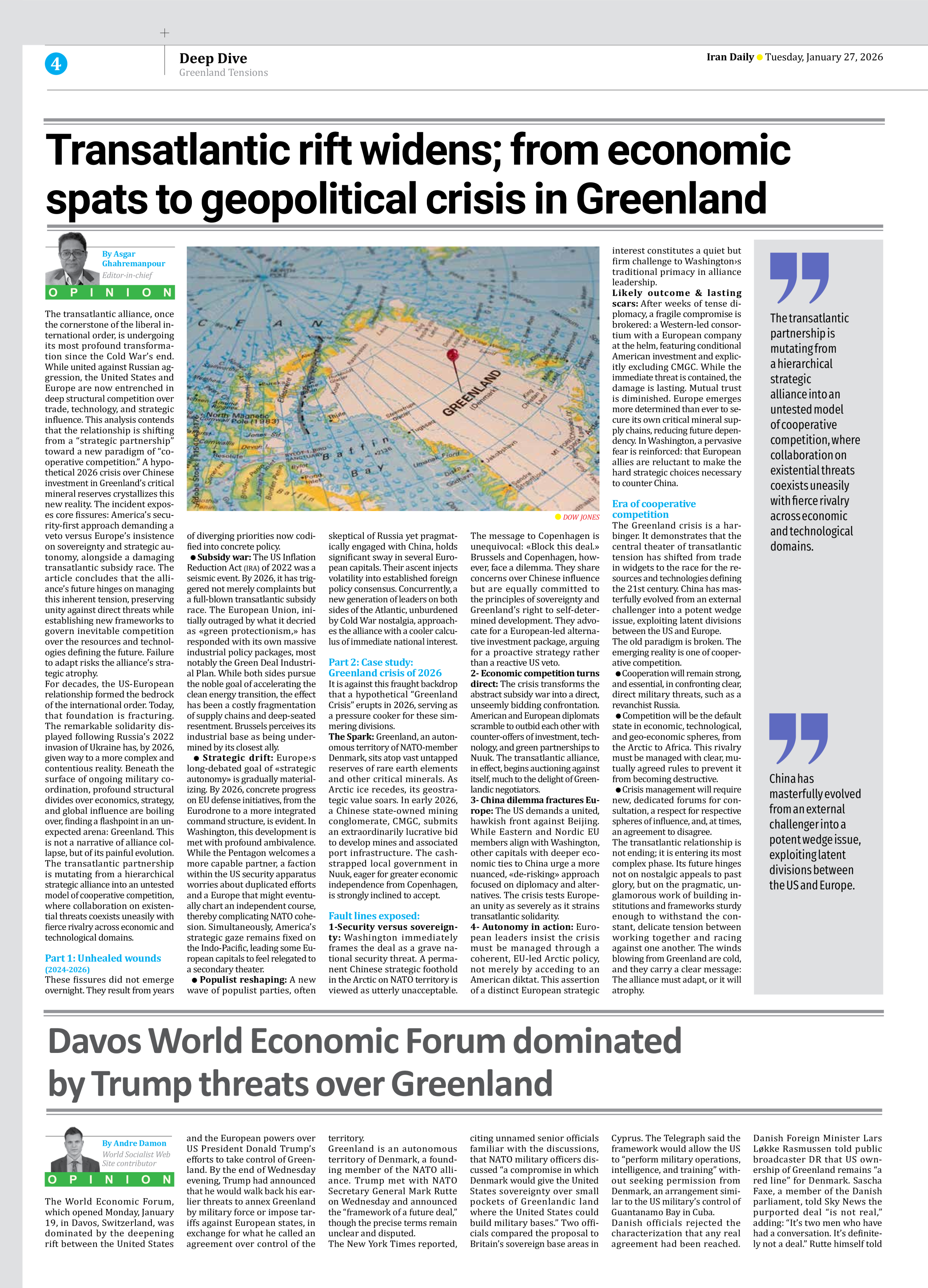
The Spark: Greenland, an autonomous territory of NATO-member Denmark, sits atop vast untapped reserves of rare earth elements and other critical minerals. As Arctic ice recedes, its geostrategic value soars. In early 2026, a Chinese state-owned mining conglomerate, CMGC, submits an extraordinarily lucrative bid to develop mines and associated port infrastructure. The cash-strapped local government in Nuuk, eager for greater economic independence from Copenhagen, is strongly inclined to accept.
Fault lines exposed:
1-Security versus sovereignty: Washington immediately frames the deal as a grave national security threat. A permanent Chinese strategic foothold in the Arctic on NATO territory is viewed as utterly unacceptable. The message to Copenhagen is unequivocal: «Block this deal.» Brussels and Copenhagen, however, face a dilemma. They share concerns over Chinese influence but are equally committed to the principles of sovereignty and Greenland’s right to self-determined development. They advocate for a European-led alternative investment package, arguing for a proactive strategy rather than a reactive US veto.
2- Economic competition turns direct: The crisis transforms the abstract subsidy war into a direct, unseemly bidding confrontation. American and European diplomats scramble to outbid each other with counter-offers of investment, technology, and green partnerships to Nuuk. The transatlantic alliance, in effect, begins auctioning against itself, much to the delight of Greenlandic negotiators.
3- China dilemma fractures Europe: The US demands a united, hawkish front against Beijing. While Eastern and Nordic EU members align with Washington, other capitals with deeper economic ties to China urge a more nuanced, «de-risking» approach focused on diplomacy and alternatives. The crisis tests European unity as severely as it strains transatlantic solidarity.
4- Autonomy in action: European leaders insist the crisis must be managed through a coherent, EU-led Arctic policy, not merely by acceding to an American diktat. This assertion of a distinct European strategic interest constitutes a quiet but firm challenge to Washington›s traditional primacy in alliance leadership.
Likely outcome & lasting scars: After weeks of tense diplomacy, a fragile compromise is brokered: a Western-led consortium with a European company at the helm, featuring conditional American investment and explicitly excluding CMGC. While the immediate threat is contained, the damage is lasting. Mutual trust is diminished. Europe emerges more determined than ever to secure its own critical mineral supply chains, reducing future dependency. In Washington, a pervasive fear is reinforced: that European allies are reluctant to make the hard strategic choices necessary to counter China.
Era of cooperative competition
The Greenland crisis is a harbinger. It demonstrates that the central theater of transatlantic tension has shifted from trade in widgets to the race for the resources and technologies defining the 21st century. China has masterfully evolved from an external challenger into a potent wedge issue, exploiting latent divisions between the US and Europe.
The old paradigm is broken. The emerging reality is one of cooperative competition.
Cooperation will remain strong, and essential, in confronting clear, direct military threats, such as a revanchist Russia.
Competition will be the default state in economic, technological, and geo-economic spheres, from the Arctic to Africa. This rivalry must be managed with clear, mutually agreed rules to prevent it from becoming destructive.
Crisis management will require new, dedicated forums for consultation, a respect for respective spheres of influence, and, at times, an agreement to disagree.
The transatlantic relationship is not ending; it is entering its most complex phase. Its future hinges not on nostalgic appeals to past glory, but on the pragmatic, unglamorous work of building institutions and frameworks sturdy enough to withstand the constant, delicate tension between working together and racing against one another. The winds blowing from Greenland are cold, and they carry a clear message: The alliance must adapt, or it will atrophy.