







Eyvanekey; historical gateway between ancient dynasties, modern Semnan
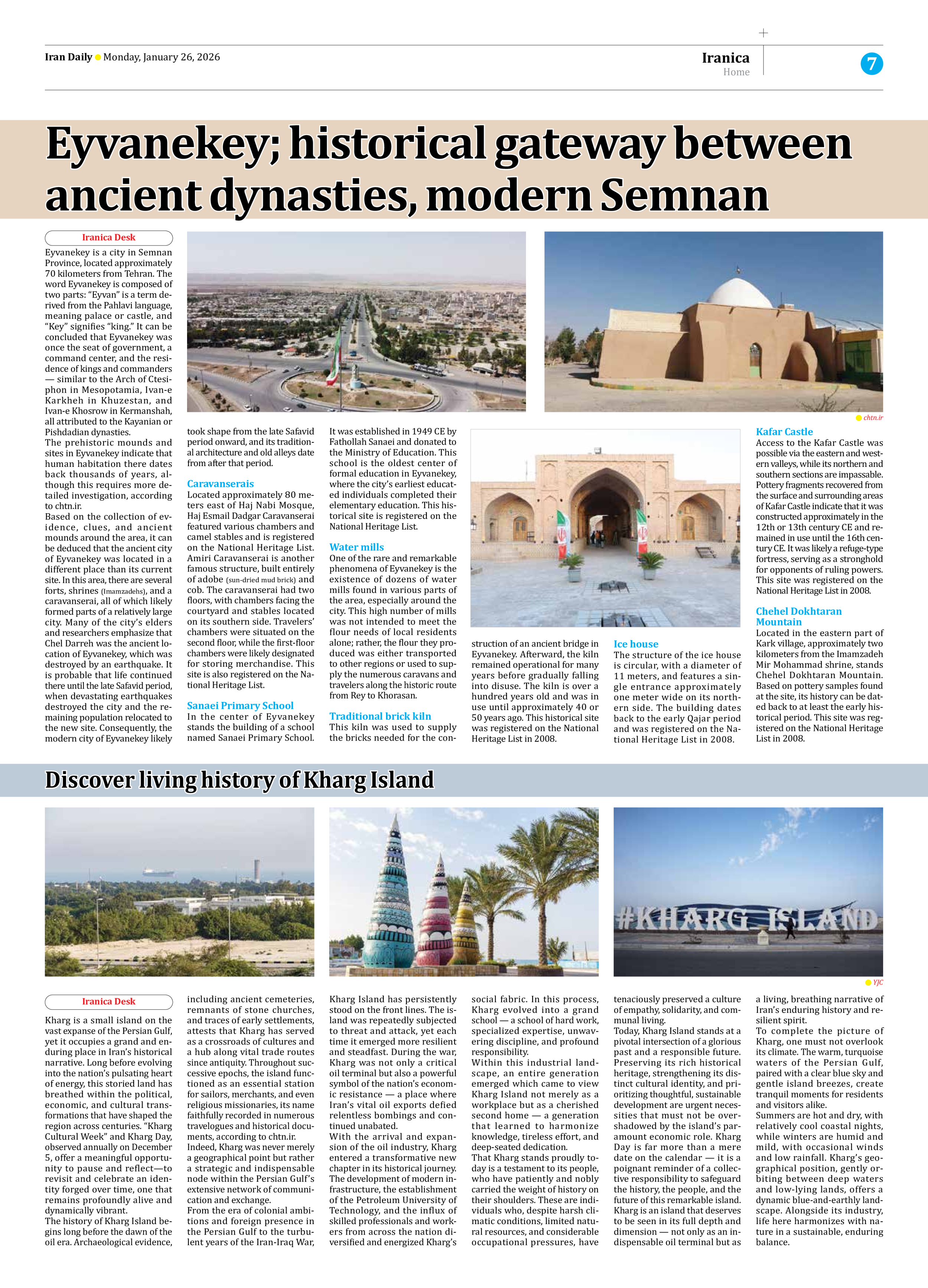
Eyvanekey is a city in Semnan Province, located approximately 70 kilometers from Tehran. The word Eyvanekey is composed of two parts: “Eyvan” is a term derived from the Pahlavi language, meaning palace or castle, and “Key” signifies “king.” It can be concluded that Eyvanekey was once the seat of government, a command center, and the residence of kings and commanders — similar to the Arch of Ctesiphon in Mesopotamia, Ivan-e Karkheh in Khuzestan, and Ivan-e Khosrow in Kermanshah, all attributed to the Kayanian or Pishdadian dynasties.
The prehistoric mounds and sites in Eyvanekey indicate that human habitation there dates back thousands of years, although this requires more detailed investigation, according to chtn.ir.
Based on the collection of evidence, clues, and ancient mounds around the area, it can be deduced that the ancient city of Eyvanekey was located in a different place than its current site. In this area, there are several forts, shrines (Imamzadehs), and a caravanserai, all of which likely formed parts of a relatively large city. Many of the city’s elders and researchers emphasize that Chel Darreh was the ancient location of Eyvanekey, which was destroyed by an earthquake. It is probable that life continued there until the late Safavid period, when devastating earthquakes destroyed the city and the remaining population relocated to the new site. Consequently, the modern city of Eyvanekey likely took shape from the late Safavid period onward, and its traditional architecture and old alleys date from after that period.
Caravanserais
Located approximately 80 meters east of Haj Nabi Mosque, Haj Esmail Dadgar Caravanserai featured various chambers and camel stables and is registered on the National Heritage List. Amiri Caravanserai is another famous structure, built entirely of adobe (sun-dried mud brick) and cob. The caravanserai had two floors, with chambers facing the courtyard and stables located on its southern side. Travelers’ chambers were situated on the second floor, while the first-floor chambers were likely designated for storing merchandise. This site is also registered on the National Heritage List.
Sanaei Primary School
In the center of Eyvanekey stands the building of a school named Sanaei Primary School. It was established in 1949 CE by Fathollah Sanaei and donated to the Ministry of Education. This school is the oldest center of formal education in Eyvanekey, where the city’s earliest educated individuals completed their elementary education. This historical site is registered on the National Heritage List.
Water mills
One of the rare and remarkable phenomena of Eyvanekey is the existence of dozens of water mills found in various parts of the area, especially around the city. This high number of mills was not intended to meet the flour needs of local residents alone; rather, the flour they produced was either transported to other regions or used to supply the numerous caravans and travelers along the historic route from Rey to Khorasan.
Traditional brick kiln
This kiln was used to supply the bricks needed for the construction of an ancient bridge in Eyvanekey. Afterward, the kiln remained operational for many years before gradually falling into disuse. The kiln is over a hundred years old and was in use until approximately 40 or 50 years ago. This historical site was registered on the National Heritage List in 2008.
Ice house
The structure of the ice house is circular, with a diameter of 11 meters, and features a single entrance approximately one meter wide on its northern side. The building dates back to the early Qajar period and was registered on the National Heritage List in 2008.
Kafar Castle
Access to the Kafar Castle was possible via the eastern and western valleys, while its northern and southern sections are impassable. Pottery fragments recovered from the surface and surrounding areas of Kafar Castle indicate that it was constructed approximately in the 12th or 13th century CE and remained in use until the 16th century CE. It was likely a refuge-type fortress, serving as a stronghold for opponents of ruling powers. This site was registered on the National Heritage List in 2008.
Chehel Dokhtaran Mountain
Located in the eastern part of Kark village, approximately two kilometers from the Imamzadeh Mir Mohammad shrine, stands Chehel Dokhtaran Mountain. Based on pottery samples found at the site, its history can be dated back to at least the early historical period. This site was registered on the National Heritage List in 2008.