







NATO’s shadow
Can Europe free itself from security dependence on United States?
By Parham Pourramezan
Political science researcher
For over seven decades, Europe’s security architecture has been shaped under the heavy and extensive shadow of the North Atlantic Treaty Organization (NATO) and the decisive power of the United States. From the Cold War era to the Balkan conflicts and post-9/11 missions, Washington has been not only the primary patron but often the field commander of the continent’s security. This dependency-based relationship brought unprecedented stability and protection to Western Europe, but it simultaneously severely restricted its strategic choice and room for independent action. Today, this longstanding dependence has become one of Europe’s greatest geopolitical questions: Can, or should, a continent with such civilizational heritage and economic capacity take full control of its own security destiny?
This fundamental question is no longer an academic debate but has been propelled into the realm of action under the pressure of a new and harsh reality. Russia’s invasion of Ukraine in 2022, while strengthening NATO solidarity, sounded a serious alarm for Europeans; a warning revealing how fragile their security is and how dependent it remains on the changing will and priorities of Washington. Fluctuations in US policy from Trump’s “America First” era to Biden’s increasing focus on competition with China, coupled with uncertainty about the continuity of American commitments in the future, have compelled Europe to consider “strategic autonomy” and strengthening NATO’s European pillar with unprecedented urgency. But does this ambition align with complex practical obstacles such as budgetary gaps, disparities in military capabilities, and the divergent inclinations of the EU’s 27 member states? This analysis argues that the answer to this question will shape not only the future of the continent’s security but also the global balance of power.
In the decades following World War II, Europe built its security pillar on NATO and US strategic support. This deep dependence guaranteed the continent’s security during the Cold War and continued as a stabilizing umbrella thereafter. However, recent geopolitical shifts, including the reorientation of US priorities towards competition with China, fluctuations in allied commitments under different Washington administrations, and the shock of Russia’s invasion of Ukraine, have raised serious questions about the sustainability of this security model. The question of whether Europe can achieve greater security autonomy is now at the heart of strategic debates.
On the path to security autonomy, Europe faces major obstacles. The first challenge is the deficit in critical military capabilities that have been carried by the US for decades; ranging from missile defense systems and strategic logistics to intelligence and nuclear capabilities. Second is the issue of coordination and consensus among the EU’s 27 members with sometimes conflicting interests, which can subject any joint initiative to delay and compromise. Third is the heavy financial burden of building independent security structures, while many European countries face budgetary constraints. Nevertheless, steps such as NATO’s “European pillar,” the “Strategic Transportation” plan for troop movement, or the “Strategic Compass” initiative indicate a will to enhance capacity.
Europe’s efforts to gain greater autonomy do not necessarily imply the dissolution of NATO or severing ties with the US, but rather find meaning within the framework of a “more logical burden-sharing” and “strategic self-reliance.” This concept means that Europe should be able to independently manage crises in its vicinity, while still relying on the transatlantic alliance for extra-regional threats or confronting global major rivals. This two-tiered approach addresses Europe’s immediate security needs while preserving America’s role as an ultimate guarantor. However, achieving this delicate balance requires sustained investment, unprecedented political convergence, and a clear definition of responsibilities on both sides of the Atlantic.
This analysis posits the following potential scenarios for this divergence:
Scenario 1: Gradual consolidation of strategic self-reliance
In this scenario, Europe steadily and continuously strengthens joint defense initiatives like the “Strategic Compass” and NATO’s “European pillar.” Military investments increase, defense industry coordination improves, and joint command structures are enhanced. However, this process does not signify replacing NATO; instead, Europe becomes a “more capable partner” within the transatlantic security umbrella. The US, while welcoming a reduced burden of responsibility in Eastern Europe, maintains its role as the ultimate guarantor of the continent’s security. This path represents the most balanced and least costly route for Europe but requires maintaining European solidarity and sustained US commitment despite changes in administration.
Scenario 2: Strategic divergence due to a US pivot
Under pressure from intensifying competition with China and domestic isolationist tendencies, the US gradually shifts its focus and resources from Europe to the Indo-Pacific region. This forced retreat delivers a major shock to Europe, compelling it to hastily and expensively pursue entirely independent defense structures. In this case, a core group of leading European countries (such as France and Germany) might form a “European Defense Union” parallel to NATO. This scenario is destabilizing, increases the risk of security vacuums and internal competition within Europe, and could lead to a return of balance-of-power politics among European powers.
Scenario 3: NATO collapse and return to national balance of power
In the most pessimistic scenario, a US withdrawal from NATO or a severe weakening of the Article 5 commitment leads to the alliance’s complete disintegration. In this situation, each European country would be forced to assume responsibility for its own security individually, rapidly pursuing military modernization and potentially nuclear armament. Europe becomes a continent of armed and potentially rival states where multilateral cooperation is minimized. This scenario evokes a return to pre-World War I and II nationalist rivalries, severely threatens global stability, and creates an ideal environment for exploitation by powers like Russia.
Scenario 4: NATO renaissance and the consolidation of dependence
A significantly more aggressive and extensive move by Russia (e.g., an attack on a NATO member country) or the emergence of another existential common crisis could lead to a revival and consolidation of NATO. In this case, a shared sense of urgency overshadows internal disagreements, and Europeans prefer once again to rally fully under US leadership and protection. European defense investments would focus more on the agenda set by NATO, and movements for security autonomy would be marginalized. This scenario reinforces the traditional dependency and postpones any significant effort towards European strategic autonomy for decades to come.
In conclusion, a complete break from security dependence on the United States appears unrealistic in the short and even medium term. However, moving towards “self-reliance within the alliance” is an inescapable necessity. Internal pressures in the US to reduce foreign commitments, the rise of China as a systemic rival capturing Washington’s attention, and the persistent threat from Russia compel Europe to assume a greater share of its own security. The likely outcome of this process will be a Europe that remains under NATO’s shadow but has thinned that shadow and made its own role more prominent. The future of the continent’s security will be determined not by a rupture from America, but by a redefined and more mature version of this historically asymmetric partnership.
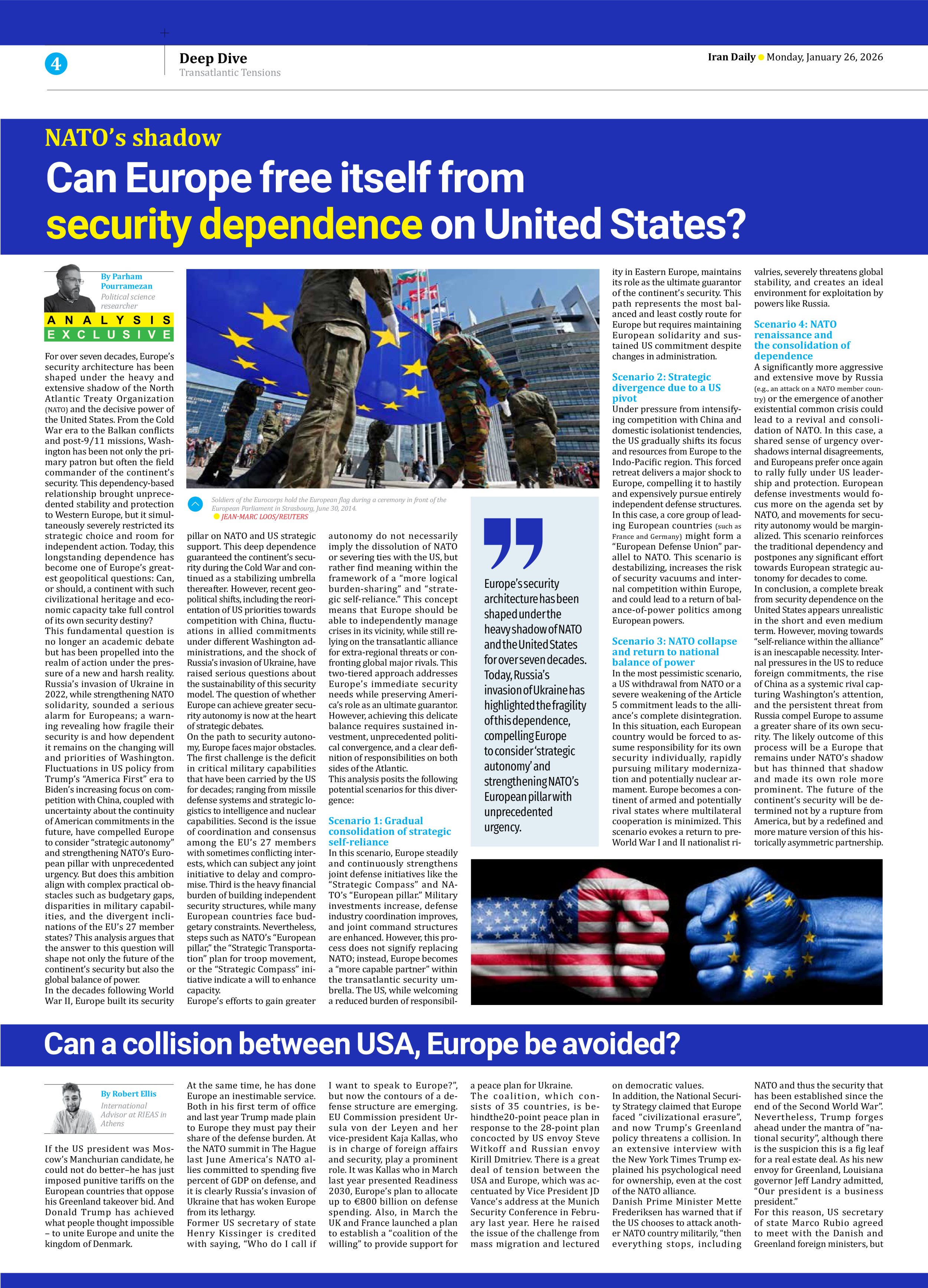
Can a collision between USA, Europe be avoided?
By Robert Ellis
International Advisor at RIEAS in Athens
If the US president was Moscow’s Manchurian candidate, he could not do better–he has just imposed punitive tariffs on the European countries that oppose his Greenland takeover bid. And Donald Trump has achieved what people thought impossible – to unite Europe and unite the kingdom of Denmark.
At the same time, he has done Europe an inestimable service. Both in his first term of office and last year Trump made plain to Europe they must pay their share of the defense burden. At the NATO summit in The Hague last June America’s NATO allies committed to spending five percent of GDP on defense, and it is clearly Russia’s invasion of Ukraine that has woken Europe from its lethargy.
Former US secretary of state Henry Kissinger is credited with saying, “Who do I call if I want to speak to Europe?”, but now the contours of a defense structure are emerging. EU Commission president Ursula von der Leyen and her vice-president Kaja Kallas, who is in charge of foreign affairs and security, play a prominent role. It was Kallas who in March last year presented Readiness 2030, Europe’s plan to allocate up to €800 billion on defense spending. Also, in March the UK and France launched a plan to establish a “coalition of the willing” to provide support for a peace plan for Ukraine.
The coalition, which consists of 35 countries, is behindthe20-point peace plan in response to the 28-point plan concocted by US envoy Steve Witkoff and Russian envoy Kirill Dmitriev. There is a great deal of tension between the USA and Europe, which was accentuated by Vice President JD Vance’s address at the Munich Security Conference in February last year. Here he raised the issue of the challenge from mass migration and lectured on democratic values.
In addition, the National Security Strategy claimed that Europe faced “civilizational erasure”, and now Trump’s Greenland policy threatens a collision. In an extensive interview with the New York Times Trump explained his psychological need for ownership, even at the cost of the NATO alliance.
Danish Prime Minister Mette Frederiksen has warned that if the US chooses to attack another NATO country militarily, “then everything stops, including NATO and thus the security that has been established since the end of the Second World War”. Nevertheless, Trump forges ahead under the mantra of “national security”, although there is the suspicion this is a fig leaf for a real estate deal. As his new envoy for Greenland, Louisiana governor Jeff Landry admitted, “Our president is a business president.”
For this reason, US secretary of state Marco Rubio agreed to meet with the Danish and Greenland foreign ministers, but at the last minute the venue was changed to the White House with JD Vance in charge.
There was no readout of the meeting or a joint press conference, so what we have learned is from the press conference with the Danish and Greenland ministers and an interview on Fox News with Danish foreign minister Lars Løkke Rasmussen.
At the press conference, Rasmussen stated the aim was to find a joint way forward to increase Arctic security. Also, that it was agreed to form a high-level working group with this aim. Both here and on Fox News Rasmussen emphasized that the territorial integrity of the kingdom of Denmark and the Greenlandic people’s right to self-determination must be respected.
Greenland’s prime minister Jens-Frederik Nielsen has also asserted that green land does not want to be owned or governed by the USA. If they have to choose here and now, they choose Denmark, NATO and the EU.
Therefore, it caused consternation when the White House’s press secretary Karoline Leavitt stated that the two sides agreed to establish a working group to continue to have technical talks on the acquisition of Greenland. Consequently, there have been mass protests in Nuuk, in Copenhagen and other Danish cities, making common cause against US demands.
Several European NATO countries have also dispatched token forces to Greenland in support. Trump’s angry response does not enjoy popular support in the USA, where You Govantes 86 percent are opposed to the use of military force to take control of Greenland. In Denmark there has been a call to cancel the annual celebration of US independence on July 4.
Anders Fogh Rasmussen, who earlier was Denmark’s prime minister and NATO’s secretary general, has told the Financial Times Trump uses Greenland as “a weapon of mass distraction” from the real threats such as Russia’s war in Ukraine. Instead, he suggests Denmark should present Trump with three concrete proposals: A revision of the 1951 defense agreement, an investment agreement, and a compact to prevent Russian and Chinese influence.
Danish Defense Minister Troels Lund Poulsen and Greenland’s foreign minister Vivian Motzfeldt have met with NATO secretary general Mark Rutte and proposed a NATO mission in Greenland and the Arctic, but whether this is acceptable to “Daddy” remains to be seen.
This article first appeared on the Research Institute for European and American Studies (RIEAS).
Trump, EU escalate tariff war
as US-European conflict mounts over Greenland
By Alex Lantier
Researcher
Major political crises inevitably produce turning points in which essential conflicts and issues, long hidden, emerge. The Trump administration’s conflict with the European imperialist powers over control of Greenland is reaching this point.
For over a decade, a period that included Trump’s first term in office and his launching of a global trade war in his second, European powers have reacted to criticism from Washington by boosting their military power. They slashed social spending by hundreds of billions of euros, impoverishing workers to pour funds into European armies and the Ukraine-Russia war. European officials called to improve relations with the United States by ensuring Europe did a fair share of spending on the NATO alliance.
Trump’s demands for a US takeover of Greenland from its status as an autonomous region of Denmark, after his illegal January 3 invasion of Venezuela to kidnap President Nicolas Maduro, and his threats to bomb Iran for regime change, are shattering this narrative. It is ever clearer that US-European relations are teetering on the brink of collapse, amid a deepening trade war that threatens potentially violent conflict between the NATO powers.
Last week, as Trump demanded US control over Greenland, supposedly to protect its strategic locations and minerals from Russia and China, seven European countries (Finland, France, Germany, Norway, the Netherlands, Sweden, the UK) sent a few dozen soldiers to the island. The operation posed no meaningful threat to the United States and was accompanied by pledges of loyalty to “Euro-Atlantic security” and NATO. However, the operation did not reassure, but rather enraged the US president, who is seeking not an alliance, but world hegemony.
On Saturday, Trump denounced the deployment on his Truth Social network, stating: “This is a very dangerous situation for the Safety, Security, and Survival of our Planet. These Countries, who are playing this very dangerous game, have put a level of risk in play that is not tenable or sustainable.”
Trump threatened to impose further tariffs on European countries opposing the sale of Greenland to Washington, which would rise from 10 to 25 percent if no deal was reached. Coming atop existing 10 percent tariffs on British and 15 percent tariffs on EU products, this could collapse trade between America and Europe, the world’s two largest trade blocs, with devastating implications for the global economy.
Trump’s threats provoked consternation and denunciations in European ruling circles. The seven governments who had participated in the deployment issued a joint statement with Denmark, defending their operation and threatening Trump with a collapse in US-European relations.
“As members of NATO, we are committed to strengthening Arctic security as a shared transatlantic interest. The pre-coordinated Danish exercise ‘Arctic Endurance’ conducted with Allies, responds to this necessity. It poses no threat to anyone,” it said, adding: “Tariff threats undermine transatlantic relations and risk a dangerous downward spiral. We will continue to stand united and coordinated in our response.”
Despite London’s “special relationship” with Washington and its non-EU status since Brexit, UK Prime Minister Keir Starmer issued his own statement criticizing Trump. “Applying tariffs on allies for pursuing the collective security of NATO allies is completely wrong,” he said. “Our position on Greenland is very clear: it is part of the Kingdom of Denmark and its future is a matter for the Greenlanders and the Danes.”
EU officials took several emergency decisions. The European Parliament suspended negotiations on a planned EU-US trade deal. A meeting of European ambassadors last night in Brussels imposed a pre-planned package of €93 billion in retaliatory tariffs on US products. European Council President Antonio Costa announced an emergency EU summit at the end of the week to discuss further measures.
“Trump will not get duty-free transit of his American products into the European market,” said Manfred Weber, the president of the right-wing European People’s Party coalition in the European Parliament. Boasting that he had put the US-EU trade deal “on ice,” Weber added: “Going forward, we are not powerless.”
Weber added that Berlin could support French President Emmanuel Macron’s call to invoke the EU’s Anti-Coercion Instrument (ACI) against the United States. “All options are on the table. That is a possibility we have,” he said. The ACI, or “trade bazooka,” lets the EU ban US firms from European government contracts (including defense), cut payments to US financial and tech firms for their services in Europe, and suspend intellectual property payments to US companies.
A mortal crisis of the global capitalist system is underway, as the traditions and institutions that previously determined economic and military relations between major capitalist powers for decades collapse. Workers internationally face the danger of trade and financial crises erupting from a renewed tariff war. Moreover, given Washington’s ever more aggressive foreign policy and Europe’s accelerating rearmament, this could escalate into military conflict between the major NATO powers.
Washington is far better armed than its European “allies” and can exploit the European powers’ economically suicidal foreign policy. They enthusiastically joined the Biden administration’s stoking of war with Russia in Ukraine in 2022. They thus cut off their access to Russian and Eurasian energy and raw materials and made themselves dependent on more expensive imports of US energy, even as Trump waged trade war against them.
However, the European imperialists are also well aware of key vulnerabilities of US imperialism: its industrial weakness; the indebtedness of the US government, which issues trillions of dollars in US Treasury debt; and its reliance on the US dollar’s global role to prop up its stock market.
Indeed, while Beijing has shifted out of the dollar and steadily cut its holdings of US Treasury debt, Europe kept adding to its Treasury holdings. Financial entities in Europe hold over $3 trillion in US Treasury debt, led by Britain ($865 billion), Belgium ($466 billion), Luxembourg ($421 billion), France ($376 billion) and Ireland ($340 billion). They thus are in the absurd situation of financing a government waging trade war against them and threatening to seize their territory.
Last year, however, key European banks like HSBC, Standard Chartered and BNP Paribas joined China’s Cross-Border Interbank Payment System (CIPS), which lets them finance international trade via currency swaps, thereby evading the SWIFT system and the US dollar. There were also growing rumors of European threats to retaliate against Trump by dumping the dollar so as to trigger a sovereign debt crisis and a financial crash in the United States.
In December, in an article titled, “Is Europe ready to pull the trigger?”, India’s Economic Times reported: “European leadership has begun weighing what some describe as a ‘nuclear option’: the mass liquidation of US Treasury securities held by European governments.” Britain’s Express daily explained this “nuclear option” as follows:
European leaders are considering adopting extreme countermeasures … designed to unleash economic chaos in the US. The alleged plan involves dumping trillions in US government debt owned by European states. A rapid sell off would likely cause a crash in the value of the US dollar, create a liquidity crisis across the banking system and cause a huge spike in borrowing costs. It would also lock the American financial sector into a paralysis more severe than the 2008 crisis.
Neither Trump’s plans for US global hegemony and conquest nor European imperialist plans for rearmament and global financial war offer anything to the working class, however. On both sides of the Atlantic, governments are pressing ahead with militarism, social austerity and repression in defiance of mass working class opposition. The decisive question is and remains unifying the working class in all the NATO countries and internationally in an international struggle against imperialist war and the capitalist system.
The article first published at the World Socialist Web Site.