







A stage that never closes
Street theater, 50-year legacy of 44th Fadjr Int’l Theater Festival
By Sadeq Dehqan
Staff writer
For nearly half a century, the Fadjr International Theater Festival has stood as a cornerstone of Iranian artistic life, now celebrating its 44th edition. More than a recurring event, it’s a deeply respected institution, a vibrant showcase for Iranian theater and the foremost platform for recognizing and celebrating the nation’s performing arts achievements. Revered as the country’s most significant theatrical event, the festival embodies the power of theater to transcend the confines of traditional venues and forge a direct connection with the community.
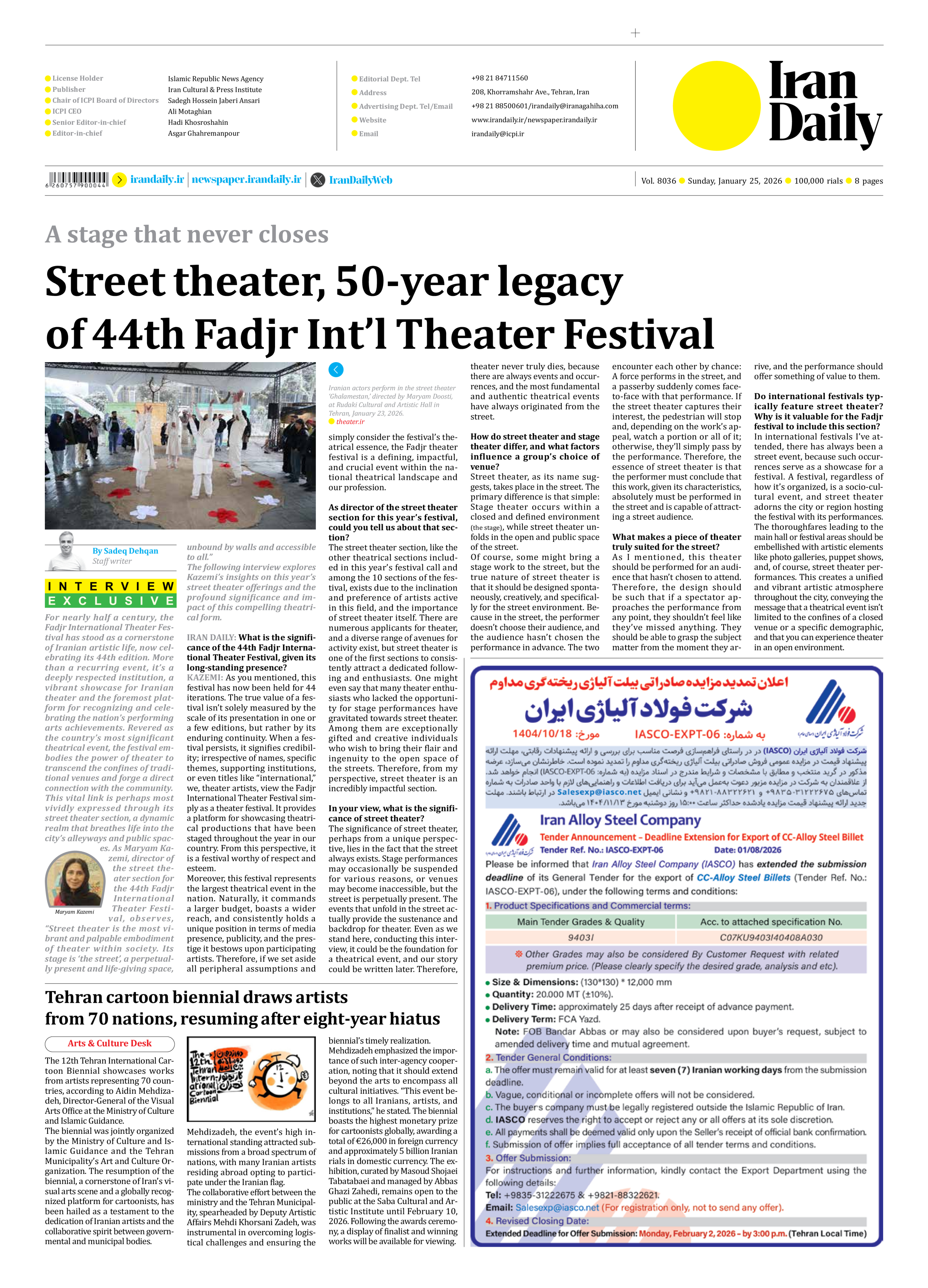
This vital link is perhaps most vividly expressed through its street theater section, a dynamic realm that breathes life into the city’s alleyways and public spaces. As Maryam Kazemi, director of the street theater section for the 44th Fadjr International Theater Festival, observes, “Street theater is the most vibrant and palpable embodiment of theater within society. Its stage is ‘the street’, a perpetually present and life-giving space, unbound by walls and accessible to all.”
The following interview explores Kazemi’s insights on this year’s street theater offerings and the profound significance and impact of this compelling theatrical form.
IRAN DAILY: What is the significance of the 44th Fadjr International Theater Festival, given its long-standing presence?
KAZEMI: As you mentioned, this festival has now been held for 44 iterations. The true value of a festival isn’t solely measured by the scale of its presentation in one or a few editions, but rather by its enduring continuity. When a festival persists, it signifies credibility; irrespective of names, specific themes, supporting institutions, or even titles like “international,” we, theater artists, view the Fadjr International Theater Festival simply as a theater festival. It provides a platform for showcasing theatrical productions that have been staged throughout the year in our country. From this perspective, it is a festival worthy of respect and esteem.
Moreover, this festival represents the largest theatrical event in the nation. Naturally, it commands a larger budget, boasts a wider reach, and consistently holds a unique position in terms of media presence, publicity, and the prestige it bestows upon participating artists. Therefore, if we set aside all peripheral assumptions and simply consider the festival’s theatrical essence, the Fadjr theater festival is a defining, impactful, and crucial event within the national theatrical landscape and our profession.
As director of the street theater section for this year’s festival, could you tell us about that section?
The street theater section, like the other theatrical sections included in this year’s festival call and among the 10 sections of the festival, exists due to the inclination and preference of artists active in this field, and the importance of street theater itself. There are numerous applicants for theater, and a diverse range of avenues for activity exist, but street theater is one of the first sections to consistently attract a dedicated following and enthusiasts. One might even say that many theater enthusiasts who lacked the opportunity for stage performances have gravitated towards street theater. Among them are exceptionally gifted and creative individuals who wish to bring their flair and ingenuity to the open space of the streets. Therefore, from my perspective, street theater is an incredibly impactful section.
In your view, what is the significance of street theater?
The significance of street theater, perhaps from a unique perspective, lies in the fact that the street always exists. Stage performances may occasionally be suspended for various reasons, or venues may become inaccessible, but the street is perpetually present. The events that unfold in the street actually provide the sustenance and backdrop for theater. Even as we stand here, conducting this interview, it could be the foundation for a theatrical event, and our story could be written later. Therefore, theater never truly dies, because there are always events and occurrences, and the most fundamental and authentic theatrical events have always originated from the street.
How do street theater and stage theater differ, and what factors influence a group’s choice of venue?
Street theater, as its name suggests, takes place in the street. The primary difference is that simple: Stage theater occurs within a closed and defined environment (the stage), while street theater unfolds in the open and public space of the street.
Of course, some might bring a stage work to the street, but the true nature of street theater is that it should be designed spontaneously, creatively, and specifically for the street environment. Because in the street, the performer doesn’t choose their audience, and the audience hasn’t chosen the performance in advance. The two encounter each other by chance: A force performs in the street, and a passerby suddenly comes face-to-face with that performance. If the street theater captures their interest, the pedestrian will stop and, depending on the work’s appeal, watch a portion or all of it; otherwise, they’ll simply pass by the performance. Therefore, the essence of street theater is that the performer must conclude that this work, given its characteristics, absolutely must be performed in the street and is capable of attracting a street audience.
What makes a piece of theater truly suited for the street?
As I mentioned, this theater should be performed for an audience that hasn’t chosen to attend. Therefore, the design should be such that if a spectator approaches the performance from any point, they shouldn’t feel like they’ve missed anything. They should be able to grasp the subject matter from the moment they arrive, and the performance should offer something of value to them.
Do international festivals typically feature street theater? Why is it valuable for the Fadjr festival to include this section?
In international festivals I’ve attended, there has always been a street event, because such occurrences serve as a showcase for a festival. A festival, regardless of how it’s organized, is a socio-cultural event, and street theater adorns the city or region hosting the festival with its performances. The thoroughfares leading to the main hall or festival areas should be embellished with artistic elements like photo galleries, puppet shows, and, of course, street theater performances. This creates a unified and vibrant artistic atmosphere throughout the city, conveying the message that a theatrical event isn’t limited to the confines of a closed venue or a specific demographic, and that you can experience theater in an open environment.