







Kalpurgan becomes global address for pottery art
In southeastern Iran, where soil and sun tell stories of history, the wheel of pottery still turns; but not on a wheel, but in the hands of women who have been guardians of the soil for thousands of years.
In Sistan and Baluchestan Province, pottery continues in a way that has traversed millennia, preserving its authenticity without relying on modern tools; an art that is not only a handicraft but a living narrative of Baluch culture and identity. Located 25 kilometers from Saravan, Kalpurgan village stands; a name that has transcended a mere point on a map to become a global address for pottery art. The 7,000-year-old Kalpurgan pottery, crafted by hand without the use of a wheel, has gained such fame that in November 2016, UNESCO experts traveled to this village to assess its potential for global registration; a journey that culminated in the global registration of this historic village and the presentation of a registration plaque to its people.
Kalpurgan is a tourist village where talented Baluch women, with humility and strength, create their art in front of visitors’ eyes. The name Kalpurgan is derived from a medicinal native plant of Baluchestan; just as the pottery of this village has its roots in the nature and traditional lifestyle of the region, according to chtn.ir.
Although agriculture and products like dates, citrus fruits, and vegetables are the main occupations of the locals, what sets Kalpurgan apart from other villages is its pottery art; an ancient art that dates back between 4,000 to 6,000 years and has remained untouched, counting as the only active pottery workshop in the world that still works in a primitive manner.
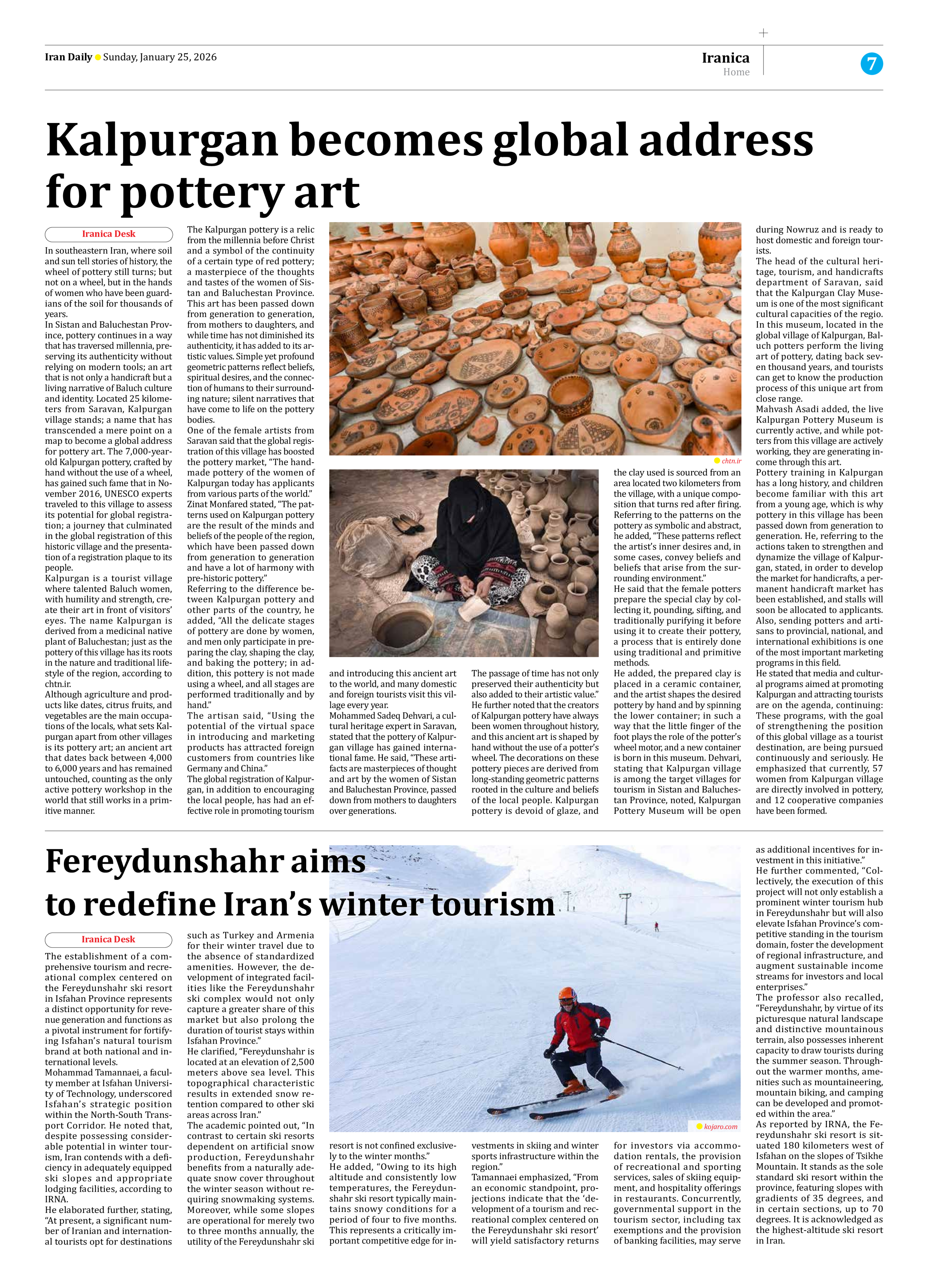
The Kalpurgan pottery is a relic from the millennia before Christ and a symbol of the continuity of a certain type of red pottery; a masterpiece of the thoughts and tastes of the women of Sistan and Baluchestan Province. This art has been passed down from generation to generation, from mothers to daughters, and while time has not diminished its authenticity, it has added to its artistic values. Simple yet profound geometric patterns reflect beliefs, spiritual desires, and the connection of humans to their surrounding nature; silent narratives that have come to life on the pottery bodies.
One of the female artists from Saravan said that the global registration of this village has boosted the pottery market, “The hand-made pottery of the women of Kalpurgan today has applicants from various parts of the world.”
Zinat Monfared stated, “The patterns used on Kalpurgan pottery are the result of the minds and beliefs of the people of the region, which have been passed down from generation to generation and have a lot of harmony with pre-historic pottery.”
Referring to the difference between Kalpurgan pottery and other parts of the country, he added, “All the delicate stages of pottery are done by women, and men only participate in preparing the clay, shaping the clay, and baking the pottery; in addition, this pottery is not made using a wheel, and all stages are performed traditionally and by hand.”
The artisan said, “Using the potential of the virtual space in introducing and marketing products has attracted foreign customers from countries like Germany and China.”
The global registration of Kalpurgan, in addition to encouraging the local people, has had an effective role in promoting tourism and introducing this ancient art to the world, and many domestic and foreign tourists visit this village every year.
Mohammed Sadeq Dehvari, a cultural heritage expert in Saravan, stated that the pottery of Kalpurgan village has gained international fame. He said, “These artifacts are masterpieces of thought and art by the women of Sistan and Baluchestan Province, passed down from mothers to daughters over generations.
The passage of time has not only preserved their authenticity but also added to their artistic value.”
He further noted that the creators of Kalpurgan pottery have always been women throughout history, and this ancient art is shaped by hand without the use of a potter’s wheel. The decorations on these pottery pieces are derived from long-standing geometric patterns rooted in the culture and beliefs of the local people. Kalpurgan pottery is devoid of glaze, and the clay used is sourced from an area located two kilometers from the village, with a unique composition that turns red after firing. Referring to the patterns on the pottery as symbolic and abstract, he added, “These patterns reflect the artist’s inner desires and, in some cases, convey beliefs and beliefs that arise from the surrounding environment.”
He said that the female potters prepare the special clay by collecting it, pounding, sifting, and traditionally purifying it before using it to create their pottery, a process that is entirely done using traditional and primitive methods.
He added, the prepared clay is placed in a ceramic container, and the artist shapes the desired pottery by hand and by spinning the lower container; in such a way that the little finger of the foot plays the role of the potter’s wheel motor, and a new container is born in this museum. Dehvari, stating that Kalpurgan village is among the target villages for tourism in Sistan and Baluchestan Province, noted, Kalpurgan Pottery Museum will be open during Nowruz and is ready to host domestic and foreign tourists.
The head of the cultural heritage, tourism, and handicrafts department of Saravan, said that the Kalpurgan Clay Museum is one of the most significant cultural capacities of the regio. In this museum, located in the global village of Kalpurgan, Baluch potters perform the living art of pottery, dating back seven thousand years, and tourists can get to know the production process of this unique art from close range.
Mahvash Asadi added, the live Kalpurgan Pottery Museum is currently active, and while potters from this village are actively working, they are generating income through this art.
Pottery training in Kalpurgan has a long history, and children become familiar with this art from a young age, which is why pottery in this village has been passed down from generation to generation. He, referring to the actions taken to strengthen and dynamize the village of Kalpurgan, stated, in order to develop the market for handicrafts, a permanent handicraft market has been established, and stalls will soon be allocated to applicants. Also, sending potters and artisans to provincial, national, and international exhibitions is one of the most important marketing programs in this field.
He stated that media and cultural programs aimed at promoting Kalpurgan and attracting tourists are on the agenda, continuing: These programs, with the goal of strengthening the position of this global village as a tourist destination, are being pursued continuously and seriously. He emphasized that currently, 57 women from Kalpurgan village are directly involved in pottery, and 12 cooperative companies have been formed.