





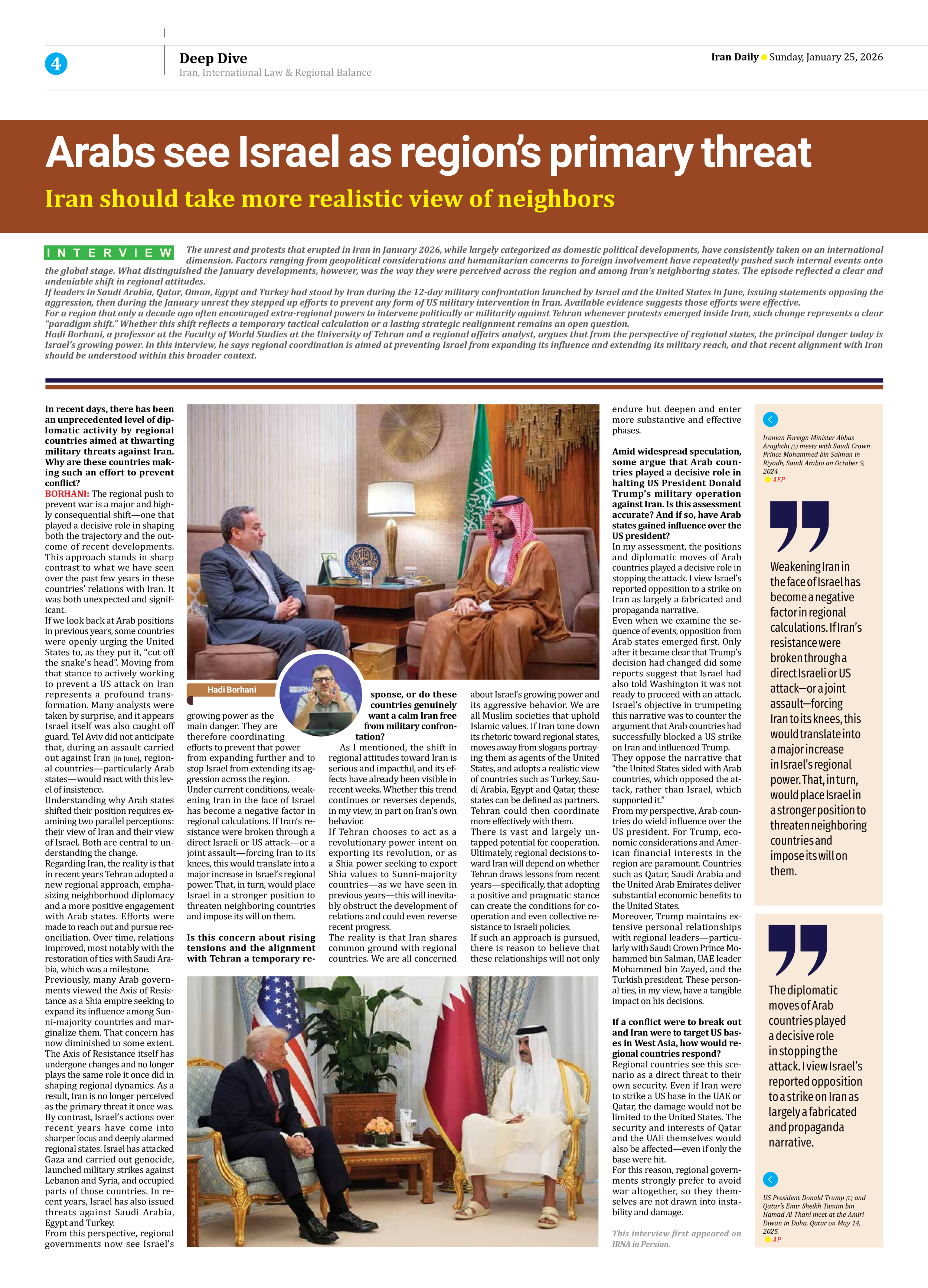


Arabs see Israel as region’s primary threat
Iran should take more realistic view of neighbors
The unrest and protests that erupted in Iran in January 2026, while largely categorized as domestic political developments, have consistently taken on an international dimension. Factors ranging from geopolitical considerations and humanitarian concerns to foreign involvement have repeatedly pushed such internal events onto the global stage. What distinguished the January developments, however, was the way they were perceived across the region and among Iran’s neighboring states. The episode reflected a clear and undeniable shift in regional attitudes. If leaders in Saudi Arabia, Qatar, Oman, Egypt and Turkey had stood by Iran during the 12-day military confrontation launched by Israel and the United States in June, issuing statements opposing the aggression, then during the January unrest they stepped up efforts to prevent any form of US military intervention in Iran. Available evidence suggests those efforts were effective. For a region that only a decade ago often encouraged extra-regional powers to intervene politically or militarily against Tehran whenever protests emerged inside Iran, such change represents a clear “paradigm shift.” Whether this shift reflects a temporary tactical calculation or a lasting strategic realignment remains an open question. Hadi Borhani, a professor at the Faculty of World Studies at the University of Tehran and a regional affairs analyst, argues that from the perspective of regional states, the principal danger today is Israel’s growing power. In this interview, he says regional coordination is aimed at preventing Israel from expanding its influence and extending its military reach, and that recent alignment with Iran should be understood within this broader context.
In recent days, there has been an unprecedented level of diplomatic activity by regional countries aimed at thwarting military threats against Iran. Why are these countries making such an effort to prevent conflict?
BORHANI: The regional push to prevent war is a major and highly consequential shift—one that played a decisive role in shaping both the trajectory and the outcome of recent developments. This approach stands in sharp contrast to what we have seen over the past few years in these countries’ relations with Iran. It was both unexpected and significant.
If we look back at Arab positions in previous years, some countries were openly urging the United States to, as they put it, “cut off the snake’s head”. Moving from that stance to actively working to prevent a US attack on Iran represents a profound transformation. Many analysts were taken by surprise, and it appears Israel itself was also caught off guard. Tel Aviv did not anticipate that, during an assault carried out against Iran [in June], regional countries—particularly Arab states—would react with this level of insistence.
Understanding why Arab states shifted their position requires examining two parallel perceptions: their view of Iran and their view of Israel. Both are central to understanding the change.
Regarding Iran, the reality is that in recent years Tehran adopted a new regional approach, emphasizing neighborhood diplomacy and a more positive engagement with Arab states. Efforts were made to reach out and pursue reconciliation. Over time, relations improved, most notably with the restoration of ties with Saudi Arabia, which was a milestone.
Previously, many Arab governments viewed the Axis of Resistance as a Shia empire seeking to expand its influence among Sunni-majority countries and marginalize them. That concern has now diminished to some extent. The Axis of Resistance itself has undergone changes and no longer plays the same role it once did in shaping regional dynamics. As a result, Iran is no longer perceived as the primary threat it once was.
By contrast, Israel’s actions over recent years have come into sharper focus and deeply alarmed regional states. Israel has attacked Gaza and carried out genocide, launched military strikes against Lebanon and Syria, and occupied parts of those countries. In recent years, Israel has also issued threats against Saudi Arabia, Egypt and Turkey.
From this perspective, regional governments now see Israel’s growing power as the main danger. They are therefore coordinating efforts to prevent that power from expanding further and to stop Israel from extending its aggression across the region.
Under current conditions, weakening Iran in the face of Israel has become a negative factor in regional calculations. If Iran’s resistance were broken through a direct Israeli or US attack—or a joint assault—forcing Iran to its knees, this would translate into a major increase in Israel’s regional power. That, in turn, would place Israel in a stronger position to threaten neighboring countries and impose its will on them.
Is this concern about rising tensions and the alignment with Tehran a temporary response, or do these countries genuinely want a calm Iran free from military confrontation?
As I mentioned, the shift in regional attitudes toward Iran is serious and impactful, and its effects have already been visible in recent weeks. Whether this trend continues or reverses depends, in my view, in part on Iran’s own behavior.
If Tehran chooses to act as a revolutionary power intent on exporting its revolution, or as a Shia power seeking to export Shia values to Sunni-majority countries—as we have seen in previous years—this will inevitably obstruct the development of relations and could even reverse recent progress.
The reality is that Iran shares common ground with regional countries. We are all concerned about Israel’s growing power and its aggressive behavior. We are all Muslim societies that uphold Islamic values. If Iran tone down its rhetoric toward regional states, moves away from slogans portraying them as agents of the United States, and adopts a realistic view of countries such as Turkey, Saudi Arabia, Egypt and Qatar, these states can be defined as partners. Tehran could then coordinate more effectively with them.
There is vast and largely untapped potential for cooperation. Ultimately, regional decisions toward Iran will depend on whether Tehran draws lessons from recent years—specifically, that adopting a positive and pragmatic stance can create the conditions for cooperation and even collective resistance to Israeli policies.
If such an approach is pursued, there is reason to believe that these relationships will not only endure but deepen and enter more substantive and effective phases.
Amid widespread speculation, some argue that Arab countries played a decisive role in halting US President Donald Trump’s military operation against Iran. Is this assessment accurate? And if so, have Arab states gained influence over the US president?
In my assessment, the positions and diplomatic moves of Arab countries played a decisive role in stopping the attack. I view Israel’s reported opposition to a strike on Iran as largely a fabricated and propaganda narrative.
Even when we examine the sequence of events, opposition from Arab states emerged first. Only after it became clear that Trump’s decision had changed did some reports suggest that Israel had also told Washington it was not ready to proceed with an attack. Israel’s objective in trumpeting this narrative was to counter the argument that Arab countries had successfully blocked a US strike on Iran and influenced Trump.
They oppose the narrative that “the United States sided with Arab countries, which opposed the attack, rather than Israel, which supported it.”
From my perspective, Arab countries do wield influence over the US president. For Trump, economic considerations and American financial interests in the region are paramount. Countries such as Qatar, Saudi Arabia and the United Arab Emirates deliver substantial economic benefits to the United States.
Moreover, Trump maintains extensive personal relationships with regional leaders—particularly with Saudi Crown Prince Mohammed bin Salman, UAE leader Mohammed bin Zayed, and the Turkish president. These personal ties, in my view, have a tangible impact on his decisions.
If a conflict were to break out and Iran were to target US bases in West Asia, how would regional countries respond?
Regional countries see this scenario as a direct threat to their own security. Even if Iran were to strike a US base in the UAE or Qatar, the damage would not be limited to the United States. The security and interests of Qatar and the UAE themselves would also be affected—even if only the base were hit.
For this reason, regional governments strongly prefer to avoid war altogether, so they themselves are not drawn into instability and damage.
This interview first appeared on IRNA in Persian.