







Fadjr Int’l Theater Festival, launchpad for new talent, legacy for Iranian dramatic arts
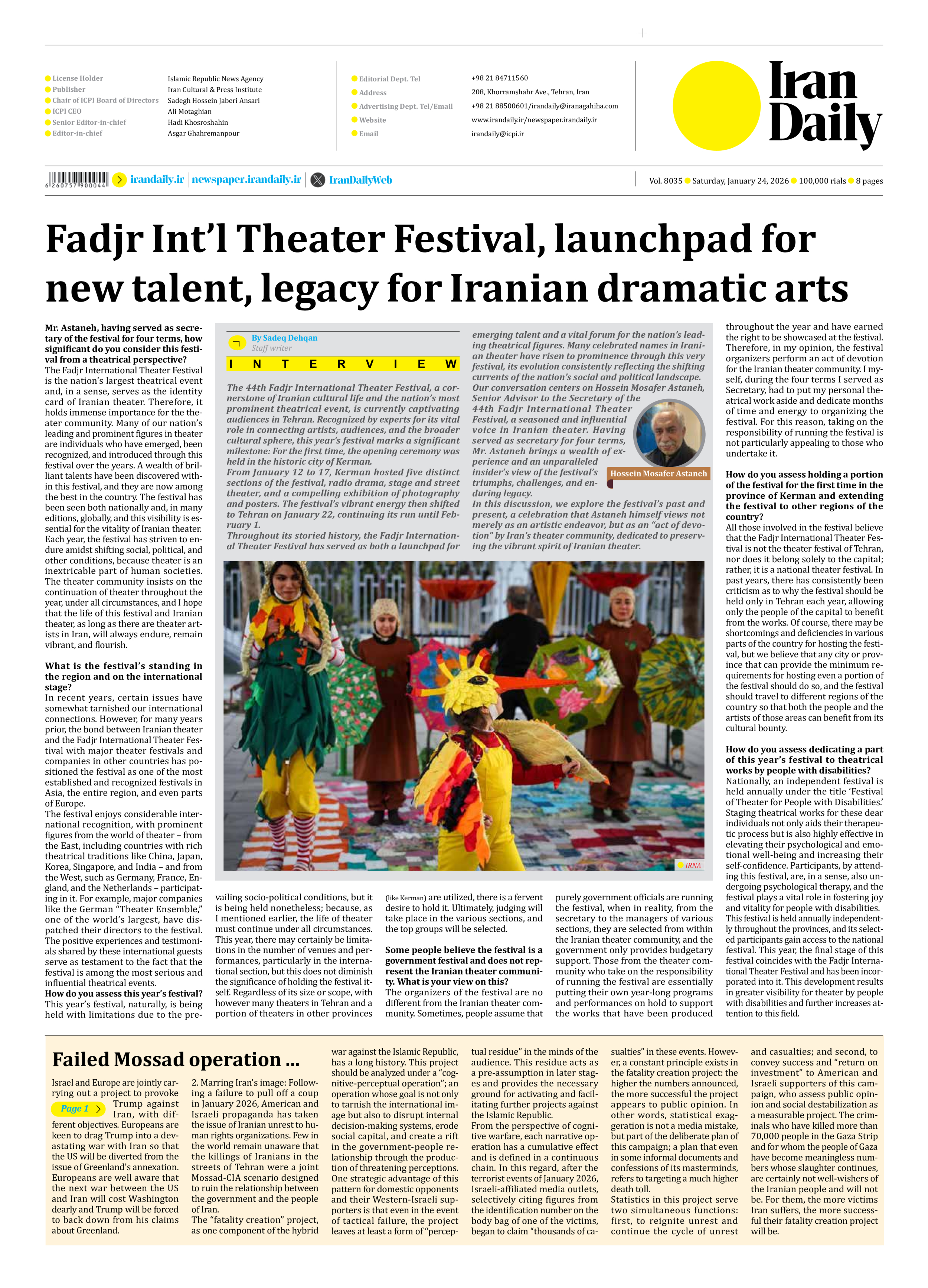
The 44th Fadjr International Theater Festival, a cornerstone of Iranian cultural life and the nation’s most prominent theatrical event, is currently captivating audiences in Tehran. Recognized by experts for its vital role in connecting artists, audiences, and the broader cultural sphere, this year’s festival marks a significant milestone: For the first time, the opening ceremony was held in the historic city of Kerman. From January 12 to 17, Kerman hosted five distinct sections of the festival, radio drama, stage and street theater, and a compelling exhibition of photography and posters. The festival’s vibrant energy then shifted to Tehran on January 22, continuing its run until February 1. Throughout its storied history, the Fadjr International Theater Festival has served as both a launchpad for emerging talent and a vital forum for the nation’s leading theatrical figures. Many celebrated names in Iranian theater have risen to prominence through this very festival, its evolution consistently reflecting the shifting currents of the nation’s social and political landscape. Our conversation centers on Hossein Mosafer Astaneh, Senior Advisor to the Secretary of the 44th Fadjr International Theater Festival, a seasoned and influential voice in Iranian theater. Having served as secretary for four terms, Mr. Astaneh brings a wealth of experience and an unparalleled insider’s view of the festival’s triumphs, challenges, and enduring legacy. In this discussion, we explore the festival’s past and present, a celebration that Astaneh himself views not merely as an artistic endeavor, but as an “act of devotion” by Iran’s theater community, dedicated to preserving the vibrant spirit of Iranian theater.
By Sadeq Dehqan
Staff writer
Mr. Astaneh, having served as secretary of the festival for four terms, how significant do you consider this festival from a theatrical perspective?
The Fadjr International Theater Festival is the nation’s largest theatrical event and, in a sense, serves as the identity card of Iranian theater. Therefore, it holds immense importance for the theater community. Many of our nation’s leading and prominent figures in theater are individuals who have emerged, been recognized, and introduced through this festival over the years. A wealth of brilliant talents have been discovered within this festival, and they are now among the best in the country. The festival has been seen both nationally and, in many editions, globally, and this visibility is essential for the vitality of Iranian theater.
Each year, the festival has striven to endure amidst shifting social, political, and other conditions, because theater is an inextricable part of human societies. The theater community insists on the continuation of theater throughout the year, under all circumstances, and I hope that the life of this festival and Iranian theater, as long as there are theater artists in Iran, will always endure, remain vibrant, and flourish.
What is the festival’s standing in the region and on the international stage?
In recent years, certain issues have somewhat tarnished our international connections. However, for many years prior, the bond between Iranian theater and the Fadjr International Theater Festival with major theater festivals and companies in other countries has positioned the festival as one of the most established and recognized festivals in Asia, the entire region, and even parts of Europe.
The festival enjoys considerable international recognition, with prominent figures from the world of theater – from the East, including countries with rich theatrical traditions like China, Japan, Korea, Singapore, and India – and from the West, such as Germany, France, England, and the Netherlands – participating in it. For example, major companies like the German “Theater Ensemble,” one of the world’s largest, have dispatched their directors to the festival. The positive experiences and testimonials shared by these international guests serve as testament to the fact that the festival is among the most serious and influential theatrical events.
How do you assess this year’s festival?
This year’s festival, naturally, is being held with limitations due to the prevailing socio-political conditions, but it is being held nonetheless; because, as I mentioned earlier, the life of theater must continue under all circumstances. This year, there may certainly be limitations in the number of venues and performances, particularly in the international section, but this does not diminish the significance of holding the festival itself. Regardless of its size or scope, with however many theaters in Tehran and a portion of theaters in other provinces (like Kerman) are utilized, there is a fervent desire to hold it. Ultimately, judging will take place in the various sections, and the top groups will be selected.
Some people believe the festival is a government festival and does not represent the Iranian theater community. What is your view on this?
The organizers of the festival are no different from the Iranian theater community. Sometimes, people assume that purely government officials are running the festival, when in reality, from the secretary to the managers of various sections, they are selected from within the Iranian theater community, and the government only provides budgetary support. Those from the theater community who take on the responsibility of running the festival are essentially putting their own year-long programs and performances on hold to support the works that have been produced throughout the year and have earned the right to be showcased at the festival. Therefore, in my opinion, the festival organizers perform an act of devotion for the Iranian theater community. I myself, during the four terms I served as Secretary, had to put my personal theatrical work aside and dedicate months of time and energy to organizing the festival. For this reason, taking on the responsibility of running the festival is not particularly appealing to those who undertake it.
How do you assess holding a portion of the festival for the first time in the province of Kerman and extending the festival to other regions of the country?
All those involved in the festival believe that the Fadjr International Theater Festival is not the theater festival of Tehran, nor does it belong solely to the capital; rather, it is a national theater festival. In past years, there has consistently been criticism as to why the festival should be held only in Tehran each year, allowing only the people of the capital to benefit from the works. Of course, there may be shortcomings and deficiencies in various parts of the country for hosting the festival, but we believe that any city or province that can provide the minimum requirements for hosting even a portion of the festival should do so, and the festival should travel to different regions of the country so that both the people and the artists of those areas can benefit from its cultural bounty.
How do you assess dedicating a part of this year’s festival to theatrical works by people with disabilities?
Nationally, an independent festival is held annually under the title ‘Festival of Theater for People with Disabilities.’ Staging theatrical works for these dear individuals not only aids their therapeutic process but is also highly effective in elevating their psychological and emotional well-being and increasing their self-confidence. Participants, by attending this festival, are, in a sense, also undergoing psychological therapy, and the festival plays a vital role in fostering joy and vitality for people with disabilities.
This festival is held annually independently throughout the provinces, and its selected participants gain access to the national festival. This year, the final stage of this festival coincides with the Fadjr International Theater Festival and has been incorporated into it. This development results in greater visibility for theater by people with disabilities and further increases attention to this field.