





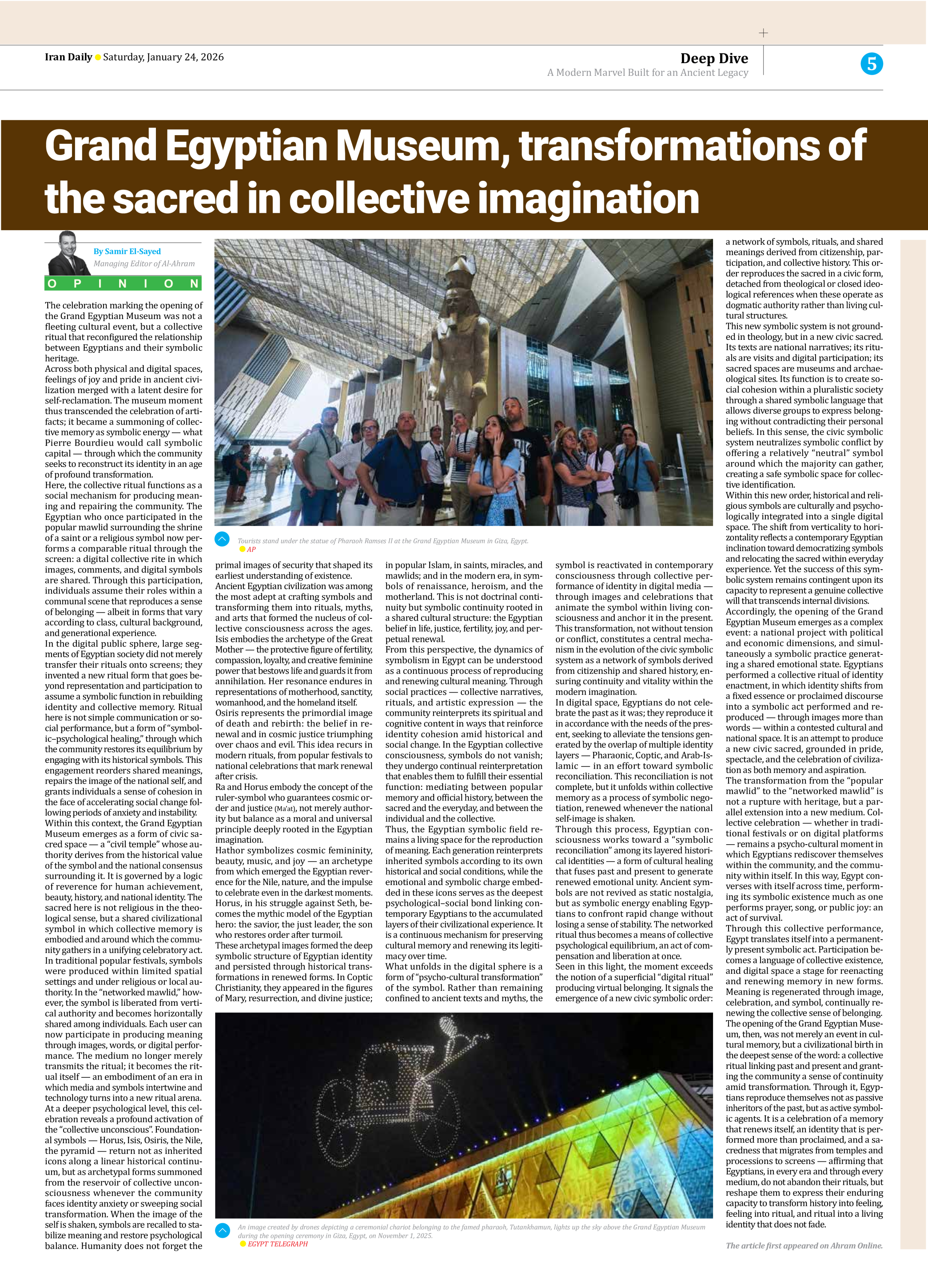


Grand Egyptian Museum, transformations of the sacred in collective imagination
By Samir El-Sayed
Managing Editor of Al-Ahram
The celebration marking the opening of the Grand Egyptian Museum was not a fleeting cultural event, but a collective ritual that reconfigured the relationship between Egyptians and their symbolic heritage.
Across both physical and digital spaces, feelings of joy and pride in ancient civilization merged with a latent desire for self-reclamation. The museum moment thus transcended the celebration of artifacts; it became a summoning of collective memory as symbolic energy — what Pierre Bourdieu would call symbolic capital — through which the community seeks to reconstruct its identity in an age of profound transformation.
Here, the collective ritual functions as a social mechanism for producing meaning and repairing the community. The Egyptian who once participated in the popular mawlid surrounding the shrine of a saint or a religious symbol now performs a comparable ritual through the screen: a digital collective rite in which images, comments, and digital symbols are shared. Through this participation, individuals assume their roles within a communal scene that reproduces a sense of belonging — albeit in forms that vary according to class, cultural background, and generational experience.
In the digital public sphere, large segments of Egyptian society did not merely transfer their rituals onto screens; they invented a new ritual form that goes beyond representation and participation to assume a symbolic function in rebuilding identity and collective memory. Ritual here is not simple communication or social performance, but a form of “symbolic–psychological healing,” through which the community restores its equilibrium by engaging with its historical symbols. This engagement reorders shared meanings, repairs the image of the national self, and grants individuals a sense of cohesion in the face of accelerating social change following periods of anxiety and instability.
Within this context, the Grand Egyptian Museum emerges as a form of civic sacred space — a “civil temple” whose authority derives from the historical value of the symbol and the national consensus surrounding it. It is governed by a logic of reverence for human achievement, beauty, history, and national identity. The sacred here is not religious in the theological sense, but a shared civilizational symbol in which collective memory is embodied and around which the community gathers in a unifying celebratory act.
In traditional popular festivals, symbols were produced within limited spatial settings and under religious or local authority. In the “networked mawlid,” however, the symbol is liberated from vertical authority and becomes horizontally shared among individuals. Each user can now participate in producing meaning through images, words, or digital performance. The medium no longer merely transmits the ritual; it becomes the ritual itself — an embodiment of an era in which media and symbols intertwine and technology turns into a new ritual arena.
At a deeper psychological level, this celebration reveals a profound activation of the “collective unconscious”. Foundational symbols — Horus, Isis, Osiris, the Nile, the pyramid — return not as inherited icons along a linear historical continuum, but as archetypal forms summoned from the reservoir of collective unconsciousness whenever the community faces identity anxiety or sweeping social transformation. When the image of the self is shaken, symbols are recalled to stabilize meaning and restore psychological balance. Humanity does not forget the primal images of security that shaped its earliest understanding of existence.
Ancient Egyptian civilization was among the most adept at crafting symbols and transforming them into rituals, myths, and arts that formed the nucleus of collective consciousness across the ages. Isis embodies the archetype of the Great Mother — the protective figure of fertility, compassion, loyalty, and creative feminine power that bestows life and guards it from annihilation. Her resonance endures in representations of motherhood, sanctity, womanhood, and the homeland itself.
Osiris represents the primordial image of death and rebirth: the belief in renewal and in cosmic justice triumphing over chaos and evil. This idea recurs in modern rituals, from popular festivals to national celebrations that mark renewal after crisis.
Ra and Horus embody the concept of the ruler-symbol who guarantees cosmic order and justice (Ma’at), not merely authority but balance as a moral and universal principle deeply rooted in the Egyptian imagination.
Hathor symbolizes cosmic femininity, beauty, music, and joy — an archetype from which emerged the Egyptian reverence for the Nile, nature, and the impulse to celebrate even in the darkest moments. Horus, in his struggle against Seth, becomes the mythic model of the Egyptian hero: the savior, the just leader, the son who restores order after turmoil.
These archetypal images formed the deep symbolic structure of Egyptian identity and persisted through historical transformations in renewed forms. In Coptic Christianity, they appeared in the figures of Mary, resurrection, and divine justice; in popular Islam, in saints, miracles, and mawlids; and in the modern era, in symbols of renaissance, heroism, and the motherland. This is not doctrinal continuity but symbolic continuity rooted in a shared cultural structure: the Egyptian belief in life, justice, fertility, joy, and perpetual renewal.
From this perspective, the dynamics of symbolism in Egypt can be understood as a continuous process of reproducing and renewing cultural meaning. Through social practices — collective narratives, rituals, and artistic expression — the community reinterprets its spiritual and cognitive content in ways that reinforce identity cohesion amid historical and social change. In the Egyptian collective consciousness, symbols do not vanish; they undergo continual reinterpretation that enables them to fulfill their essential function: mediating between popular memory and official history, between the sacred and the everyday, and between the individual and the collective.
Thus, the Egyptian symbolic field remains a living space for the reproduction of meaning. Each generation reinterprets inherited symbols according to its own historical and social conditions, while the emotional and symbolic charge embedded in these icons serves as the deepest psychological–social bond linking contemporary Egyptians to the accumulated layers of their civilizational experience. It is a continuous mechanism for preserving cultural memory and renewing its legitimacy over time.
What unfolds in the digital sphere is a form of “psycho-cultural transformation” of the symbol. Rather than remaining confined to ancient texts and myths, the symbol is reactivated in contemporary consciousness through collective performance of identity in digital media — through images and celebrations that animate the symbol within living consciousness and anchor it in the present. This transformation, not without tension or conflict, constitutes a central mechanism in the evolution of the civic symbolic system as a network of symbols derived from citizenship and shared history, ensuring continuity and vitality within the modern imagination.
In digital space, Egyptians do not celebrate the past as it was; they reproduce it in accordance with the needs of the present, seeking to alleviate the tensions generated by the overlap of multiple identity layers — Pharaonic, Coptic, and Arab-Islamic — in an effort toward symbolic reconciliation. This reconciliation is not complete, but it unfolds within collective memory as a process of symbolic negotiation, renewed whenever the national self-image is shaken.
Through this process, Egyptian consciousness works toward a “symbolic reconciliation” among its layered historical identities — a form of cultural healing that fuses past and present to generate renewed emotional unity. Ancient symbols are not revived as static nostalgia, but as symbolic energy enabling Egyptians to confront rapid change without losing a sense of stability. The networked ritual thus becomes a means of collective psychological equilibrium, an act of compensation and liberation at once.
Seen in this light, the moment exceeds the notion of a superficial “digital ritual” producing virtual belonging. It signals the emergence of a new civic symbolic order: a network of symbols, rituals, and shared meanings derived from citizenship, participation, and collective history. This order reproduces the sacred in a civic form, detached from theological or closed ideological references when these operate as dogmatic authority rather than living cultural structures.
This new symbolic system is not grounded in theology, but in a new civic sacred. Its texts are national narratives; its rituals are visits and digital participation; its sacred spaces are museums and archaeological sites. Its function is to create social cohesion within a pluralistic society through a shared symbolic language that allows diverse groups to express belonging without contradicting their personal beliefs. In this sense, the civic symbolic system neutralizes symbolic conflict by offering a relatively “neutral” symbol around which the majority can gather, creating a safe symbolic space for collective identification.
Within this new order, historical and religious symbols are culturally and psychologically integrated into a single digital space. The shift from verticality to horizontality reflects a contemporary Egyptian inclination toward democratizing symbols and relocating the sacred within everyday experience. Yet the success of this symbolic system remains contingent upon its capacity to represent a genuine collective will that transcends internal divisions.
Accordingly, the opening of the Grand Egyptian Museum emerges as a complex event: a national project with political and economic dimensions, and simultaneously a symbolic practice generating a shared emotional state. Egyptians performed a collective ritual of identity enactment, in which identity shifts from a fixed essence or proclaimed discourse into a symbolic act performed and reproduced — through images more than words — within a contested cultural and national space. It is an attempt to produce a new civic sacred, grounded in pride, spectacle, and the celebration of civilization as both memory and aspiration.
The transformation from the “popular mawlid” to the “networked mawlid” is not a rupture with heritage, but a parallel extension into a new medium. Collective celebration — whether in traditional festivals or on digital platforms — remains a psycho-cultural moment in which Egyptians rediscover themselves within the community, and the community within itself. In this way, Egypt converses with itself across time, performing its symbolic existence much as one performs prayer, song, or public joy: an act of survival.
Through this collective performance, Egypt translates itself into a permanently present symbolic act. Participation becomes a language of collective existence, and digital space a stage for reenacting and renewing memory in new forms. Meaning is regenerated through image, celebration, and symbol, continually renewing the collective sense of belonging.
The opening of the Grand Egyptian Museum, then, was not merely an event in cultural memory, but a civilizational birth in the deepest sense of the word: a collective ritual linking past and present and granting the community a sense of continuity amid transformation. Through it, Egyptians reproduce themselves not as passive inheritors of the past, but as active symbolic agents. It is a celebration of a memory that renews itself, an identity that is performed more than proclaimed, and a sacredness that migrates from temples and processions to screens — affirming that Egyptians, in every era and through every medium, do not abandon their rituals, but reshape them to express their enduring capacity to transform history into feeling, feeling into ritual, and ritual into a living identity that does not fade.
The article first appeared on Ahram Online.