





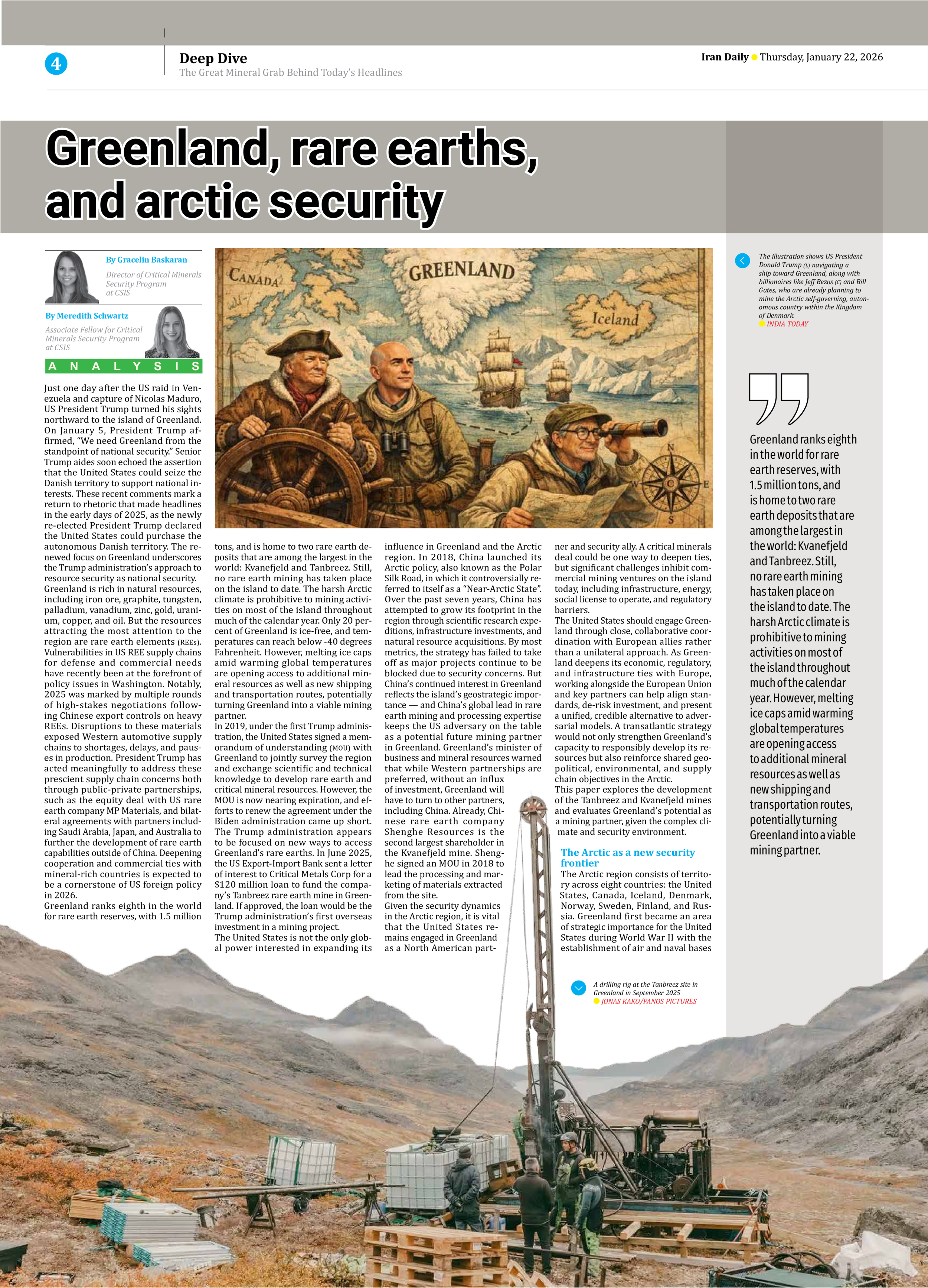


Greenland, rare earths, and arctic security
By Gracelin Baskaran
Director of Critical Minerals Security Program
at CSIS
By Meredith Schwartz
Associate Fellow for Critical Minerals Security Program at CSIS
Just one day after the US raid in Venezuela and capture of Nicolas Maduro, US President Trump turned his sights northward to the island of Greenland. On January 5, President Trump affirmed, “We need Greenland from the standpoint of national security.” Senior Trump aides soon echoed the assertion that the United States could seize the Danish territory to support national interests. These recent comments mark a return to rhetoric that made headlines in the early days of 2025, as the newly re-elected President Trump declared the United States could purchase the autonomous Danish territory. The renewed focus on Greenland underscores the Trump administration’s approach to resource security as national security.
Greenland is rich in natural resources, including iron ore, graphite, tungsten, palladium, vanadium, zinc, gold, uranium, copper, and oil. But the resources attracting the most attention to the region are rare earth elements (REEs). Vulnerabilities in US REE supply chains for defense and commercial needs have recently been at the forefront of policy issues in Washington. Notably, 2025 was marked by multiple rounds of high-stakes negotiations following Chinese export controls on heavy REEs. Disruptions to these materials exposed Western automotive supply chains to shortages, delays, and pauses in production. President Trump has acted meaningfully to address these prescient supply chain concerns both through public-private partnerships, such as the equity deal with US rare earth company MP Materials, and bilateral agreements with partners including Saudi Arabia, Japan, and Australia to further the development of rare earth capabilities outside of China. Deepening cooperation and commercial ties with mineral-rich countries is expected to be a cornerstone of US foreign policy in 2026.
Greenland ranks eighth in the world for rare earth reserves, with 1.5 million tons, and is home to two rare earth deposits that are among the largest in the world: Kvanefjeld and Tanbreez. Still, no rare earth mining has taken place on the island to date. The harsh Arctic climate is prohibitive to mining activities on most of the island throughout much of the calendar year. Only 20 percent of Greenland is ice-free, and temperatures can reach below -40 degrees Fahrenheit. However, melting ice caps amid warming global temperatures are opening access to additional mineral resources as well as new shipping and transportation routes, potentially turning Greenland into a viable mining partner.
In 2019, under the first Trump administration, the United States signed a memorandum of understanding (MOU) with Greenland to jointly survey the region and exchange scientific and technical knowledge to develop rare earth and critical mineral resources. However, the MOU is now nearing expiration, and efforts to renew the agreement under the Biden administration came up short. The Trump administration appears to be focused on new ways to access Greenland’s rare earths. In June 2025, the US Export-Import Bank sent a letter of interest to Critical Metals Corp for a $120 million loan to fund the company’s Tanbreez rare earth mine in Greenland. If approved, the loan would be the Trump administration’s first overseas investment in a mining project.
The United States is not the only global power interested in expanding its influence in Greenland and the Arctic region. In 2018, China launched its Arctic policy, also known as the Polar Silk Road, in which it controversially referred to itself as a “Near-Arctic State”. Over the past seven years, China has attempted to grow its footprint in the region through scientific research expeditions, infrastructure investments, and natural resource acquisitions. By most metrics, the strategy has failed to take off as major projects continue to be blocked due to security concerns. But China’s continued interest in Greenland reflects the island’s geostrategic importance — and China’s global lead in rare earth mining and processing expertise keeps the US adversary on the table as a potential future mining partner in Greenland. Greenland’s minister of business and mineral resources warned that while Western partnerships are preferred, without an influx of investment, Greenland will have to turn to other partners, including China. Already, Chinese rare earth company Shenghe Resources is the second largest shareholder in the Kvanefjeld mine. Shenghe signed an MOU in 2018 to lead the processing and marketing of materials extracted from the site.
Given the security dynamics in the Arctic region, it is vital that the United States remains engaged in Greenland as a North American partner and security ally. A critical minerals deal could be one way to deepen ties, but significant challenges inhibit commercial mining ventures on the island today, including infrastructure, energy, social license to operate, and regulatory barriers.
The United States should engage Greenland through close, collaborative coordination with European allies rather than a unilateral approach. As Greenland deepens its economic, regulatory, and infrastructure ties with Europe, working alongside the European Union and key partners can help align standards, de-risk investment, and present a unified, credible alternative to adversarial models. A transatlantic strategy would not only strengthen Greenland’s capacity to responsibly develop its resources but also reinforce shared geopolitical, environmental, and supply chain objectives in the Arctic.
This paper explores the development of the Tanbreez and Kvanefjeld mines and evaluates Greenland’s potential as a mining partner, given the complex climate and security environment.
The Arctic as a new security frontier
The Arctic region consists of territory across eight countries: the United States, Canada, Iceland, Denmark, Norway, Sweden, Finland, and Russia. Greenland first became an area of strategic importance for the United States during World War II with the establishment of air and naval bases on the island. At the end of the war, these bases continued to serve as key Western posts to protect and defend against potential invasion by the Soviet Union. Today, the Pituffik Space Base (also known as Thule Air Base) is the northernmost US military installation with missile detection and defense as well as space surveillance capabilities.
As Arctic ice caps melt, new emerging shipping routes through the region are creating new economic and geostrategic opportunities for global powers. The Northwest Passage is a series of maritime routes running through Canada’s Arctic Archipelago, connecting the Pacific to the Atlantic Ocean. The passage is currently only navigable for short windows of time each year due to difficult conditions and shifting sea ice. But scientists project that with accelerated global warming and technological advancements, the passage may soon be open for transit every summer, connecting East Asia to Western Europe with a route 7,000 km shorter than the current route through the Panama Canal. Control of these Arctic waters will be key to unlocking the economic and security advantages of the emerging global passage, and Greenland’s advantageous position along this route lends it strategic importance to the United States, China, and any other power looking to access the Northwest Passage and project power globally.
For years, China has attempted to establish a foothold in Greenland through infrastructure investments, but no Chinese investment has come to fruition due to geopolitical concerns. In the last 10 years, China has ventured to invest in Greenland’s airports, an abandoned naval station, and a satellite ground station, but its ambitions have been largely stalled and curtailed by US and Danish stakeholders. While China has yet to build a Polar Silk Road of geopolitical significance, China’s dominant position in rare earth separating and processing offers it an advantage in accessing Greenland’s rare earth resources via processing offtake agreements. The United States is actively looking for ways to counter China’s hold on global REE resources — US officials extensively lobbied the Tanbreez developer to prevent the sale of the deposit to a Chinese buyer. Tanbreez Mining sold the deposit to New York-based Critical Metals Corp for reportedly less than earlier offers from Chinese firms.
Deposits and ore grades
Greenland has two large deposits of rare earth minerals that are at the center of the surge in interest in Greenland’s mineral wealth: the Kvanefjeld and Tanbreez mine sites. Both deposits are located on the southern tip of the island in close proximity to the town of Narsaq. Kvanefjeld is the third-largest known land deposit of REEs, with over 11 million metric tons of reserves and resources, including 370,000 metric tons of heavy rare earths. The project began exploration and prefeasibility under Energy Transition Minerals (formerly Greenland Minerals and Energy) in 2007, completing feasibility and entering the permitting stage in 2015. The feasibility studies revealed high rare earth ore grades of 1.43 percent, well above projects like Brazil’s Serra Verde (0.15 percent) and Texas’s Round Top (0.033 percent) but falling short of the superior grades of Australia’s Mt Weld (6.40 percent), MP Materials’ Mountain Pass (5.96 percent), and China’s Bayan Obo (2.55 percent) (see the table).
The Tanbreez deposit is not as far along in development — only completing its preliminary economic assessment in 2025 — but is also estimated to contain a globally significant deposit of REEs, potentially the world’s largest, at 28.2 million metric tons. Over 27 percent of the project is estimated to consist of heavy rare earths. However, ore grades are estimated to be much lower, at 0.38 percent. Ore grades are especially important to the economic feasibility of a rare earth mine — higher-grade deposits require less material to be mined and are easier to separate and process, equating to lower costs. Nevertheless, the high concentration of valuable heavy rare earths makes Tanbreez an attractive deposit despite lower ore grades.
Social license to operate
While both Kvanefjeld and Tanbreez are globally significant deposits of rare earths, Tanbreez is one of only two mine sites, out of 147 active mineral licenses in all of Greenland, to receive an exploitation license. Intense political opposition to certain kinds of mining due to environmental and safety concerns has obstructed further licensing. REE deposits are commonly co-located with uranium. Mining deposits with uranium yield radioactive waste, creating additional environmental management challenges. Unlike the Tanbreez project, which is co-located with tantalum, niobium, and zirconium, there are an estimated 270,000 tons of uranium co-located in the Kvanefjeld deposit, making it the eighth-largest uranium deposit in the world. The Kvanefjeld project has sought an exploitation license since 2019, but the project’s application has been repeatedly denied due to concerns with the deposit’s uranium content.
In 2021, the Inuit Ataqatigiit party won parliamentary elections, and Greenland’s parliament promptly passed legislation banning exploration and mining of mineral deposits with a uranium concentration over 100 parts per million, effectively blocking the development of the Kvanefjeld rare earth mine, which has a uranium concentration of approximately 300 parts per million. The future of Greenland’s mining industry was a pivotal issue in the 2021 election, which became widely known as the “mining election”. The Inuit Ataqatigiit campaigned heavily for a ban on uranium mining in Greenland to protect the environment, public health, and Greenland’s tourism and fishing industries. The grassroots movement “Uranium? No” gained momentum in the years leading up to the election, organizing protests at the Kvanefjeld mine site with an alliance of sheep farmers, fishermen, and the predominantly indigenous residents of Narsaq. The group’s founding activist, Mariane Paviasen, was elected to the Greenlandic Parliament in 2021 as a member of the Inuit Ataqatigiit party.
As a result of the uranium mining ban, the Kvanefjeld project has been tied up in litigation since 2022. Energy Transition Minerals argues the legislation constitutes expropriation and demands compensation of $11.5 billion, equivalent to nearly four times Greenland’s GDP as of 2023. The uranium mining ban may not be permanent — the ban was originally adopted in the 1950s before being repealed in 2013 and reinstated in 2021 — but the intense local opposition to the Kvanefjeld project will continue to be a long-term barrier to operating.
Infrastructure
Despite Greenland’s promising mineral wealth, there have only been nine active mine sites since World War II. Today, there are only two mining projects operating on the island: the White Mountain anorthosite mine and the small but high-grade Nalunaq gold mine. No rare earth mining has taken place to date. Further development of the mining sector is impeded by inadequate transport and energy infrastructure. The entire island, three times the size of Texas, has only 93 miles of road. Furthermore, Greenland has only 16 ports, each with only limited capacity. The Nuuk port, the island’s largest, carried 2 million tons of cargo in 2021. The closest large port near the Kvanefjeld and Tanbreez mines is the Narsaq port, which handles only 50,000 tons of cargo annually — just 2.5 percent of the Nuuk port. Electricity generation is inconsistent and limited. The largest installed electricity generation capacity is currently 54 MW in the capital city of Nuuk, 290 miles away from Narsaq. Significant investment in energy transmission and capacity will be a necessity for any mining operation.
Viable large-scale rare earth mining in Greenland will require major investments in the enabling infrastructure. China has shown its willingness to invest in Greenland’s infrastructure to support its mining operations as well as its Arctic ambitions, but so far, no major projects have come to fruition. In 2018, the state-owned Chinese Communication Construction company was shortlisted to construct and expand a network of airports in Nuuk, Ilulissat, and Qaqortoq. The project would require a nearly $550 million investment, equivalent to 17 percent of Greenland’s GDP, which was just $3.3 billion as of 2023. The proposed project raised flags with both the United States and Denmark. US Secretary of Defense James Mattis urged the Danish government to interfere in the transaction to prevent China from establishing a foothold in the region. Denmark pulled the bid and financed a large portion of the airport updates itself to block Chinese involvement. While Denmark interfered in the project for national security reasons, growing calls from the Greenlandic people for economic independence may make the island nation more eager to accept foreign investment from China in the future.
The full article was first published by the Center for Strategic and International Studies (CSIS).