





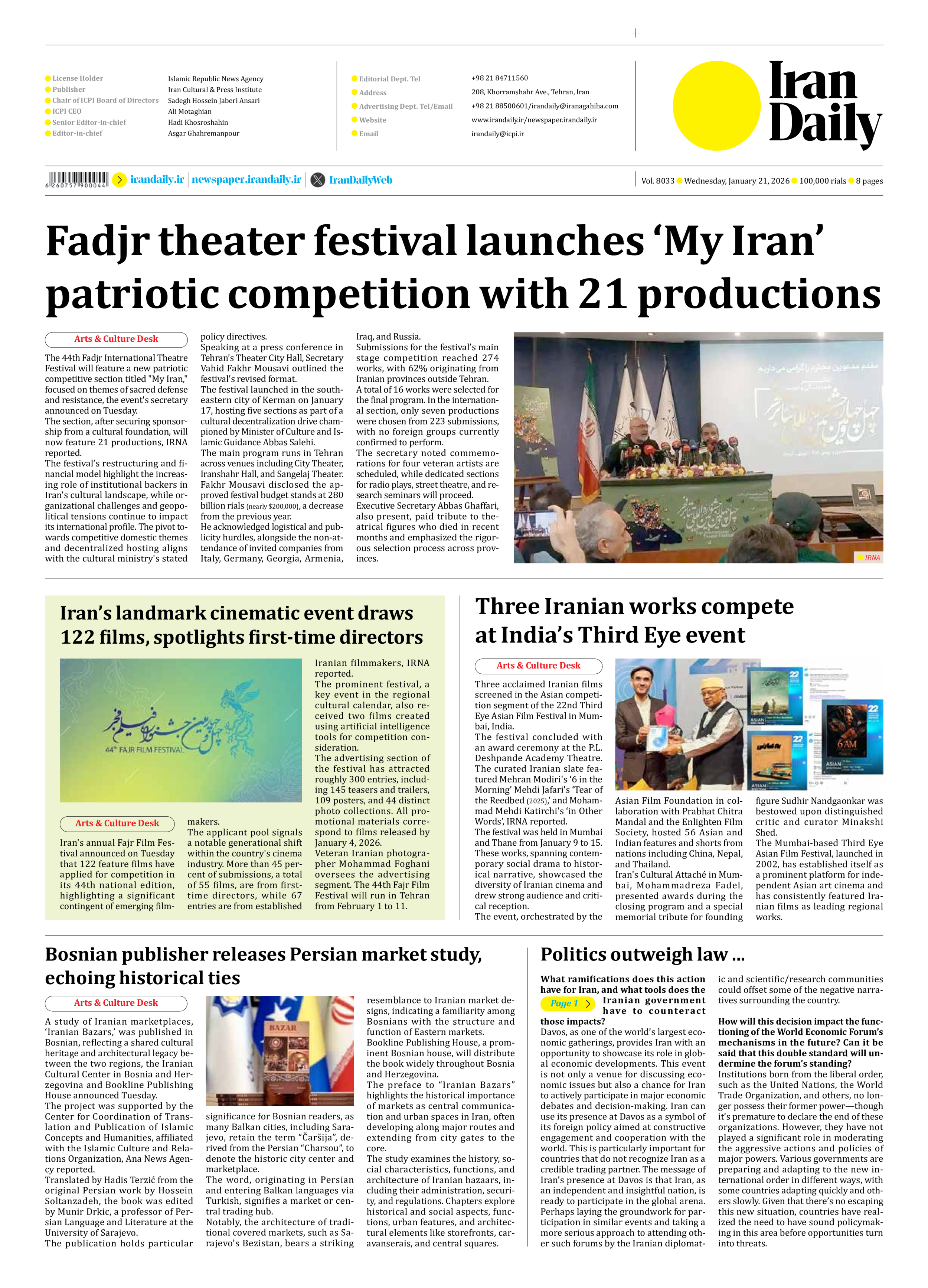


Copy in clipboard...
Bosnian publisher releases Persian market study, echoing historical ties
The project was supported by the Center for Coordination of Translation and Publication of Islamic Concepts and Humanities, affiliated with the Islamic Culture and Relations Organization, Ana News Agency reported.
Translated by Hadis Terzić from the original Persian work by Hossein Soltanzadeh, the book was edited by Munir Drkic, a professor of Persian Language and Literature at the University of Sarajevo.
The publication holds particular significance for Bosnian readers, as many Balkan cities, including Sarajevo, retain the term “Čaršija”, derived from the Persian “Charsou”, to denote the historic city center and marketplace.
The word, originating in Persian and entering Balkan languages via Turkish, signifies a market or central trading hub.
Notably, the architecture of traditional covered markets, such as Sarajevo’s Bezistan, bears a striking resemblance to Iranian market designs, indicating a familiarity among Bosnians with the structure and function of Eastern markets.
Bookline Publishing House, a prominent Bosnian house, will distribute the book widely throughout Bosnia and Herzegovina.
The preface to “Iranian Bazars” highlights the historical importance of markets as central communication and urban spaces in Iran, often developing along major routes and extending from city gates to the core.
The study examines the history, social characteristics, functions, and architecture of Iranian bazaars, including their administration, security, and regulations. Chapters explore historical and social aspects, functions, urban features, and architectural elements like storefronts, caravanserais, and central squares.