







Global implications of US military operation in Venezuela
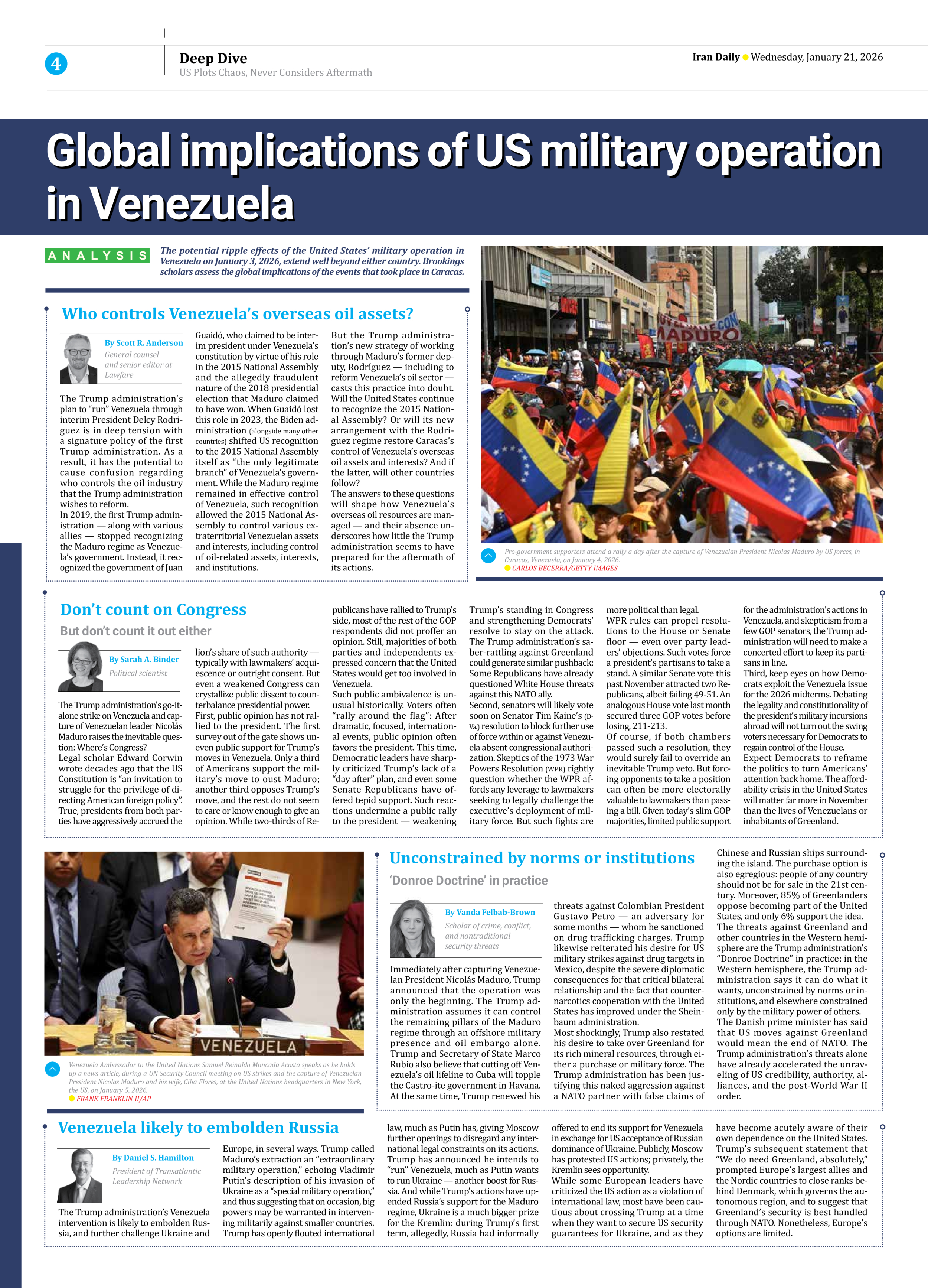
The potential ripple effects of the United States’ military operation in Venezuela on January 3, 2026, extend well beyond either country. Brookings scholars assess the global implications of the events that took place in Caracas.
Who controls Venezuela’s overseas oil assets?
By Scott R. Anderson
General counsel and senior editor at Lawfare
The Trump administration’s plan to “run” Venezuela through interim President Delcy Rodriguez is in deep tension with a signature policy of the first Trump administration. As a result, it has the potential to cause confusion regarding who controls the oil industry that the Trump administration wishes to reform.
In 2019, the first Trump administration — along with various allies — stopped recognizing the Maduro regime as Venezuela’s government. Instead, it recognized the government of Juan Guaidó, who claimed to be interim president under Venezuela’s constitution by virtue of his role in the 2015 National Assembly and the allegedly fraudulent nature of the 2018 presidential election that Maduro claimed to have won. When Guaidó lost this role in 2023, the Biden administration (alongside many other countries) shifted US recognition to the 2015 National Assembly itself as “the only legitimate branch” of Venezuela’s government. While the Maduro regime remained in effective control of Venezuela, such recognition allowed the 2015 National Assembly to control various extraterritorial Venezuelan assets and interests, including control of oil-related assets, interests, and institutions.
But the Trump administration’s new strategy of working through Maduro’s former deputy, Rodríguez — including to reform Venezuela’s oil sector — casts this practice into doubt. Will the United States continue to recognize the 2015 National Assembly? Or will its new arrangement with the Rodriguez regime restore Caracas’s control of Venezuela’s overseas oil assets and interests? And if the latter, will other countries follow?
The answers to these questions will shape how Venezuela’s overseas oil resources are managed — and their absence underscores how little the Trump administration seems to have prepared for the aftermath of its actions.
Don’t count on Congress
But don’t count it out either
By Sarah A. Binder
Political scientist
The Trump administration’s go-it-alone strike on Venezuela and capture of Venezuelan leader Nicolás Maduro raises the inevitable question: Where’s Congress?
Legal scholar Edward Corwin wrote decades ago that the US Constitution is “an invitation to struggle for the privilege of directing American foreign policy”. True, presidents from both parties have aggressively accrued the lion’s share of such authority — typically with lawmakers’ acquiescence or outright consent. But even a weakened Congress can crystallize public dissent to counterbalance presidential power.
First, public opinion has not rallied to the president. The first survey out of the gate shows uneven public support for Trump’s moves in Venezuela. Only a third of Americans support the military’s move to oust Maduro; another third opposes Trump’s move, and the rest do not seem to care or know enough to give an opinion. While two-thirds of Republicans have rallied to Trump’s side, most of the rest of the GOP respondents did not proffer an opinion. Still, majorities of both parties and independents expressed concern that the United States would get too involved in Venezuela.
Such public ambivalence is unusual historically. Voters often “rally around the flag”: After dramatic, focused, international events, public opinion often favors the president. This time, Democratic leaders have sharply criticized Trump’s lack of a “day after” plan, and even some Senate Republicans have offered tepid support. Such reactions undermine a public rally to the president — weakening Trump’s standing in Congress and strengthening Democrats’ resolve to stay on the attack. The Trump administration’s saber-rattling against Greenland could generate similar pushback: Some Republicans have already questioned White House threats against this NATO ally.
Second, senators will likely vote soon on Senator Tim Kaine’s (D-Va.) resolution to block further use of force within or against Venezuela absent congressional authorization. Skeptics of the 1973 War Powers Resolution (WPR) rightly question whether the WPR affords any leverage to lawmakers seeking to legally challenge the executive’s deployment of military force. But such fights are more political than legal.
WPR rules can propel resolutions to the House or Senate floor — even over party leaders’ objections. Such votes force a president’s partisans to take a stand. A similar Senate vote this past November attracted two Republicans, albeit failing 49-51. An analogous House vote last month secured three GOP votes before losing, 211-213.
Of course, if both chambers passed such a resolution, they would surely fail to override an inevitable Trump veto. But forcing opponents to take a position can often be more electorally valuable to lawmakers than passing a bill. Given today’s slim GOP majorities, limited public support for the administration’s actions in Venezuela, and skepticism from a few GOP senators, the Trump administration will need to make a concerted effort to keep its partisans in line.
Third, keep eyes on how Democrats exploit the Venezuela issue for the 2026 midterms. Debating the legality and constitutionality of the president’s military incursions abroad will not turn out the swing voters necessary for Democrats to regain control of the House.
Expect Democrats to reframe the politics to turn Americans’ attention back home. The affordability crisis in the United States will matter far more in November than the lives of Venezuelans or inhabitants of Greenland.
Unconstrained by norms or institutions
‘Donroe Doctrine’ in practice
By Vanda Felbab-Brown
Scholar of crime, conflict, and nontraditional security threats
Immediately after capturing Venezuelan President Nicolás Maduro, Trump announced that the operation was only the beginning. The Trump administration assumes it can control the remaining pillars of the Maduro regime through an offshore military presence and oil embargo alone. Trump and Secretary of State Marco Rubio also believe that cutting off Venezuela’s oil lifeline to Cuba will topple the Castro-ite government in Havana. At the same time, Trump renewed his threats against Colombian President Gustavo Petro — an adversary for some months — whom he sanctioned on drug trafficking charges. Trump likewise reiterated his desire for US military strikes against drug targets in Mexico, despite the severe diplomatic consequences for that critical bilateral relationship and the fact that counternarcotics cooperation with the United States has improved under the Sheinbaum administration.
Most shockingly, Trump also restated his desire to take over Greenland for its rich mineral resources, through either a purchase or military force. The Trump administration has been justifying this naked aggression against a NATO partner with false claims of Chinese and Russian ships surrounding the island. The purchase option is also egregious: people of any country should not be for sale in the 21st century. Moreover, 85% of Greenlanders oppose becoming part of the United States, and only 6% support the idea.
The threats against Greenland and other countries in the Western hemisphere are the Trump administration’s “Donroe Doctrine” in practice: in the Western hemisphere, the Trump administration says it can do what it wants, unconstrained by norms or institutions, and elsewhere constrained only by the military power of others.
The Danish prime minister has said that US moves against Greenland would mean the end of NATO. The Trump administration’s threats alone have already accelerated the unraveling of US credibility, authority, alliances, and the post-World War II order.
Venezuela likely to embolden Russia
By Daniel S. Hamilton
President of Transatlantic Leadership Network
The Trump administration’s Venezuela intervention is likely to embolden Russia, and further challenge Ukraine and Europe, in several ways. Trump called Maduro’s extraction an “extraordinary military operation,” echoing Vladimir Putin’s description of his invasion of Ukraine as a “special military operation,” and thus suggesting that on occasion, big powers may be warranted in intervening militarily against smaller countries. Trump has openly flouted international law, much as Putin has, giving Moscow further openings to disregard any international legal constraints on its actions. Trump has announced he intends to “run” Venezuela, much as Putin wants to run Ukraine — another boost for Russia. And while Trump’s actions have upended Russia’s support for the Maduro regime, Ukraine is a much bigger prize for the Kremlin: during Trump’s first term, allegedly, Russia had informally offered to end its support for Venezuela in exchange for US acceptance of Russian dominance of Ukraine. Publicly, Moscow has protested US actions; privately, the Kremlin sees opportunity.
While some European leaders have criticized the US action as a violation of international law, most have been cautious about crossing Trump at a time when they want to secure US security guarantees for Ukraine, and as they have become acutely aware of their own dependence on the United States. Trump’s subsequent statement that “We do need Greenland, absolutely,” prompted Europe’s largest allies and the Nordic countries to close ranks behind Denmark, which governs the autonomous region, and to suggest that Greenland’s security is best handled through NATO. Nonetheless, Europe’s options are limited.
What China’s Venezuela rhetoric reveals about Beijing’s priorities
By Patricia M. Kim
Expert in Chinese foreign policy
The Trump administration’s actions in Venezuela have provided Beijing with another low-cost opportunity to criticize US behavior on the global stage. Chinese officials have sharply condemned what they describe as US hegemonism, framing Washington’s actions as a violation of international law and Venezuela’s sovereignty and calling for Maduro’s release. Foreign Minister Wang Yi warned pointedly that no country should act as a “world policeman” or “claim itself to be an international judge”.
The intensity of Beijing’s rhetoric, however, should not be mistaken for its strategic commitment to Venezuela itself. Despite years of close political ties, significant oil investments, and billions of dollars in outstanding loans, Venezuela does not constitute a core strategic interest for China. Beijing has shown little appetite for taking concrete action or for positioning itself ahead of Latin American states in responding to the crisis. When asked whether the crisis would alter China’s broader approach to the region, a Chinese Foreign Ministry spokesperson offered boilerplate language about long-standing cooperation and friendship with Latin American countries, without signaling any intent to actively counter US influence on the ground. Beijing’s recent reactions are less about defending Caracas than about allowing the United States to absorb the reputational fallout.
Some have questioned whether US actions in Venezuela could embolden China to act more aggressively in its own neighborhood, particularly toward Taiwan. The Venezuela case is unlikely to alter Beijing’s timelines or military calculations regarding the island. But it does explain why China has invested so heavily in persuading the international community that Taiwan is an “internal affair,” rather than a dispute between two sovereign states. Chinese condemnations of US actions in Venezuela rest explicitly on the principle that it is illegal for one country to use force against another. Defining cross-Strait tensions as a domestic matter is therefore not just semantic; it is about laying the legal and normative groundwork to blunt the kinds of criticisms China already faces — and will continue to face — as it uses coercion against Taiwan.
Concern but silver linings in Moscow
By Steven Pifer
Former US ambassador to Ukraine
The Russian Foreign Ministry quickly condemned the US attack and seizure of Nicolás Maduro and his spouse. It termed the assault an “act of armed aggression” and called for the Maduros’ release.
That should surprise no one. Russia cultivated warm relations with the Hugo Chávez and Maduro regimes. Among other things, Russia served as a major arms supplier, providing S-300 air defense missiles and Su-30 fighter aircraft.
The Kremlin cannot be happy with the situation. First, while Russian Foreign Minister Sergey Lavrov expressed “solidarity with the Venezuelan people,” Moscow likely will offer no more than rhetorical support. That replicates Russian inaction following last June’s US strike on Iranian nuclear facilities. The Russians cannot be happy with that image of weakness.
Second, as in Iran, Russian military equipment did nothing to impede the US assault. Of some 150 aircraft involved in the operation, only one helicopter sustained minor damage from ground fire. These failures hardly serve as an advertisement for future Russian arms sales.
Third, while the two cases hugely differ, pundits already are contrasting the overnight success of the US action with Russia’s “special military operation” against Ukraine, now in its fourth year with no end in sight.
The Kremlin, however, will see silver linings. The dubious legality of the US attack under international law weakens the basis for condemning Russia’s war on Ukraine. Trump’s invocation of the Monroe or “Donroe” doctrine will bolster Russian claims for a regional sphere of influence. Secretary of State Marco Rubio told NBC, “This is the Western Hemisphere. This is where we live. And we’re not going to allow the Western Hemisphere to be a base of operation for adversaries, competitors, and rivals of the United States.” Substitute “Eurasia” for “the Western Hemisphere” and “Russia” for “the United States,” and see how it sounds.
Finally, the Kremlin almost certainly hopes that Trump will stumble into a larger conflict, perhaps even with US boots on the ground, that would further undermine US international legitimacy and distract Washington from Russia’s continuing war against Ukraine.
Venezuela sanctions a lever of choice without much leverage
By Dafna A. Rand and Kari Heerman
Senior fellows at Brookings
The stunning military ouster of Nicolás Maduro underscores a hard truth about modern economic statecraft. For over 20 years, the Venezuelan regime has been subject to an increasingly expansive US sanctions regime as the main alternative to the use of force, targeting individuals, oil revenues, financial channels, and other public and private sector entities. Those sanctions imposed real economic damage and narrowed the regime’s economic options. But they never generated decisive leverage sufficient to force a change in the regime’s core objectives or to improve US security interests; efforts to escalate or ease sanctions over time instead underscored how difficult they are to calibrate in practice.
In part, this is because Maduro’s regime adapted, using technology and third-country networks to shift activity into alternative channels and push the burden of sanctions onto intermediaries and foreign firms, while insulating the leadership itself. This kind of sanctions avoidance does not erase pressure but shifts it — allowing regimes to reroute activity through costlier and less transparent channels rather than change course.
The geopolitical lesson is sobering. Sanctions remain a valuable tool for imposing some costs and signaling US (and international) opprobrium. And we are only beginning to learn about the impacts over time of relatively new individualized sanctions, which targeted nearly 1,000 Venezuelans since the 2010s. In Venezuela, Russia, Iran, and elsewhere, however, sanctions are blunted when regimes can externalize pressure and wait out economic pain; they work best when embedded in diplomatic strategies that can translate cost imposition into political outcomes. Venezuela reminds us that economic leverage depends not just on scale, but on strategy — and on realism about what sanctions can and cannot achieve.
Potential friction with China
By Douglas A. Rediker
Nonresident senior fellow at Brookings
After the American raid on Venezuela, there was immediate excitement around the economic opportunities Venezuela now offers, and not just in the oil sector. Venezuela and PDVSA defaulted bonds surged, with investors effectively pricing in a sanctions unwind and a path to restructuring. But the “day after” problem in Venezuela is not only political. It is also contractual, litigious, and creditor-driven. Analysts estimate roughly $60 billion in defaulted bonds and total external obligations around $150 billion–$170 billion once PDVSA liabilities, bilateral claims, and legal judgments are included. The International Monetary Fund’s (IMF) October 2025 World Economic Outlook puts Venezuela’s 2025 nominal GDP at about $82.77 billion, implying a debt-to-GDP ratio in the 180%–200% range, even before one argues about data quality.
And then there is China, which may be the most underpriced friction point in this entire story. China will not be a passive stakeholder. Beijing has long-standing oil-for-loans arrangements with Venezuela, remains a major customer for Venezuelan crude, and still receives barrels linked to debt repayment. While opaque, analysts estimate Venezuela’s remaining debt to China exceeds $10 billion, with estimates of cumulative historical Chinese financing in the range of $60 billion since 2005, though broader official-sector credit tallies are higher. Regardless of the actual amounts, China has meaningful residual claims, an ability to litigate and obstruct, and a strategic incentive to prevent the United States from establishing a new political, economic, and/or energy regime and creditor hierarchy in Caracas.
Unlike in other recent sovereign debt restructurings, China is likely to argue that any prospective impairment of its Venezuelan claims and interests was not primarily caused by Venezuelan policy choices. They were caused by a US military intervention that aims to reorganize control of the oil sector and, implicitly, future export revenues. This provides Beijing with reasons to be confrontational, not cooperative. In Zambia, China’s role as the key official creditor slowed the process and created long delays in resolving restructuring issues and finalizing IMF support. Venezuela should be assumed to be much harder: larger political stakes, murkier claims, more assets exposed to court action, and a creditor (China) that may see reputational and strategic costs in “accepting” losses caused by US action.
Post-sanctions Venezuela could eventually generate large returns. But the nearer-term reality is a high-friction debt and claims environment, with China positioned to insist on repayment and to contest any US-led attempt to reorder the country’s balance sheet on Washington’s terms.
The full article was first published by the Brookings Institution.