





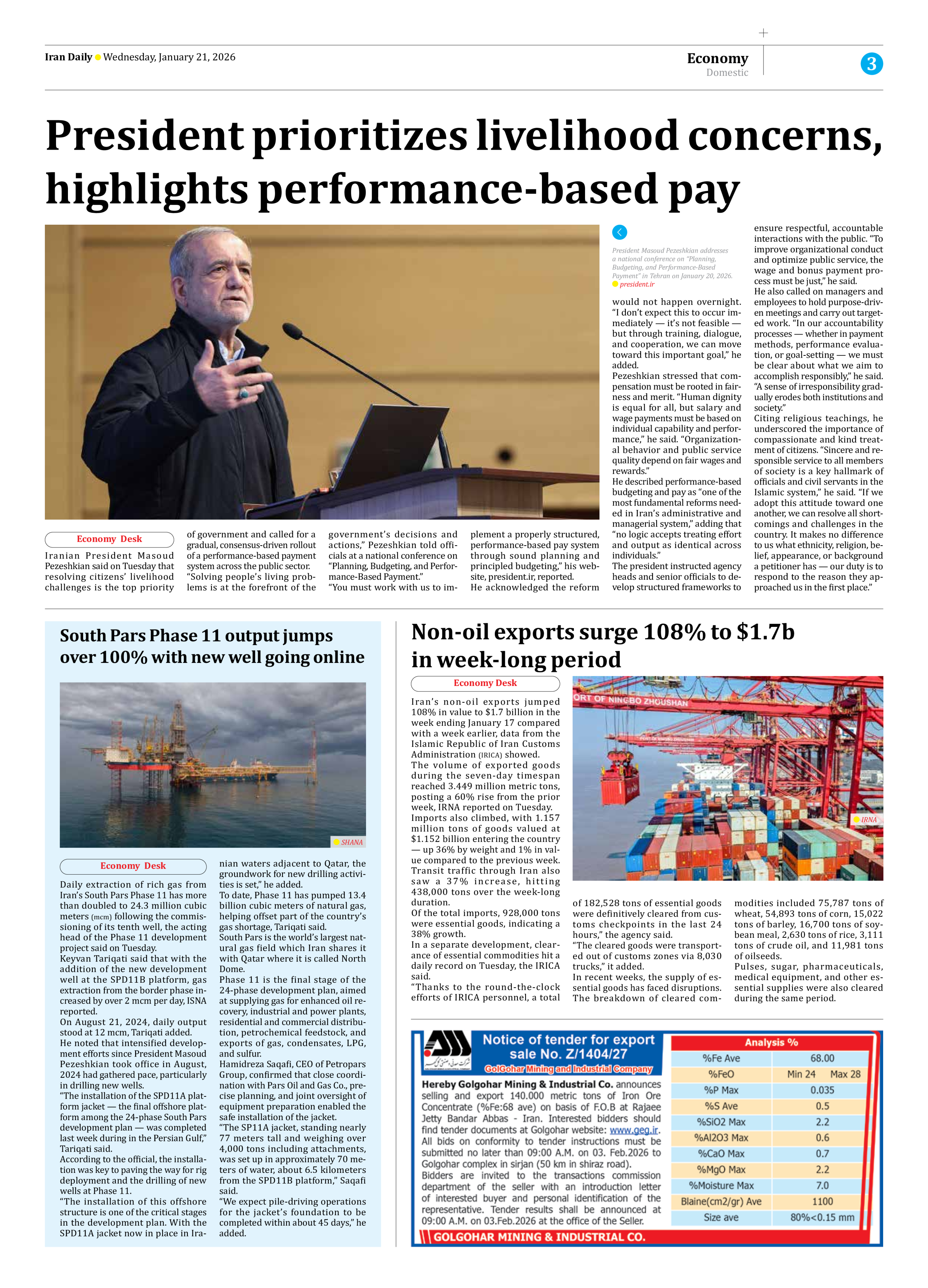


President prioritizes livelihood concerns, highlights performance-based pay
Iranian President Masoud Pezeshkian said on Tuesday that resolving citizens’ livelihood challenges is the top priority of government and called for a gradual, consensus-driven rollout of a performance-based payment system across the public sector.
“Solving people’s living problems is at the forefront of the government’s decisions and actions,” Pezeshkian told officials at a national conference on “Planning, Budgeting, and Performance-Based Payment.”
“You must work with us to implement a properly structured, performance-based pay system through sound planning and principled budgeting,” his website, president.ir, reported.
He acknowledged the reform would not happen overnight. “I don’t expect this to occur immediately — it’s not feasible — but through training, dialogue, and cooperation, we can move toward this important goal,” he added.
Pezeshkian stressed that compensation must be rooted in fairness and merit. “Human dignity is equal for all, but salary and wage payments must be based on individual capability and performance,” he said. “Organizational behavior and public service quality depend on fair wages and rewards.”
He described performance-based budgeting and pay as “one of the most fundamental reforms needed in Iran’s administrative and managerial system,” adding that “no logic accepts treating effort and output as identical across individuals.”
The president instructed agency heads and senior officials to develop structured frameworks to ensure respectful, accountable interactions with the public. “To improve organizational conduct and optimize public service, the wage and bonus payment process must be just,” he said.
He also called on managers and employees to hold purpose-driven meetings and carry out targeted work. “In our accountability processes — whether in payment methods, performance evaluation, or goal-setting — we must be clear about what we aim to accomplish responsibly,” he said. “A sense of irresponsibility gradually erodes both institutions and society.”
Citing religious teachings, he underscored the importance of compassionate and kind treatment of citizens. “Sincere and responsible service to all members of society is a key hallmark of officials and civil servants in the Islamic system,” he said. “If we adopt this attitude toward one another, we can resolve all shortcomings and challenges in the country. It makes no difference to us what ethnicity, religion, belief, appearance, or background a petitioner has — our duty is to respond to the reason they approached us in the first place.”