







US intervention in Iran’s unrest flagrant violation of int’l law
The overt interference of the United States of America in Iran’s internal affairs, coupled with the unending threats from President Donald Trump against Iran, have diverted the trajectory of domestic protests and transmuted them into a novel pretext for escalating pressure upon Tehran. Within the contemporary conjuncture, a vigilance and statecraft, both domestically and amongst regional nations, more distinct than ever is requisite, so that under its aegis, we may traverse the arduous path which the Israeli regime and America have prepared for Iran and the region. Present realities in West Asia evince the intertwinement of security among nations more than ever before, and perhaps it is precisely for this reason that Badr al-Busaidi, the Omani foreign minister, during his recent visit to Tehran, emphasized that “regional security is ensured through the participation, cooperation, and coordination of all regional countries.” In this same meeting, Abbas Araghchi, Iran’s foreign minister, also stressed that “the independent sovereignty of nations is a cardinal principle of international law, and the internal affairs of countries will not be resolved except through internal deliberation; no party possesses the right to intervene or prescribe outcomes in the internal matters of any other nation.” To scrutinize the US’s objectives regarding intervention in Iran’s internal affairs, as well as the regional approach to this degree of interventionism, Hossein Noushabadi, Iran’s former ambassador to Oman, provided his insights in the text below.
By Hossein Noushabadi
Former Iranian ambassador to Oman
The Islamic Republic of Iran has perpetually communicated its profound disquiet concerning the overt interventions of certain nations, particularly the United States of America and its president, to international institutions and global assemblies. The duplicitous and insidious ingress of the American government and the Zionist regime in support of internal rioters and criminals has been executed with the objective of fomenting schism within Iranian society and debilitating national solidarity. The declarations of certain odious personages, such as the prime minister of the Zionist regime and radical, extremist American officials, inciting rioters with promises of support and encouraging armed terrorists toward violent and criminal comportment, manifest the sinister intention of America and the Zionist regime to exploit the subversive activities of rioters.
It is axiomatic that, pursuant to international norms, the United Nations Charter, and global organizations, belligerent and interventionist postures regarding the internal affairs of nations constitute an egregious violation of the foundational principles of the United Nations and a manifest encroachment upon international law — specifically, a violation of the principles of Iran’s national and territorial sovereignty — and, in practice, constitute an incitement to violence and terrorism against Iranian citizens.
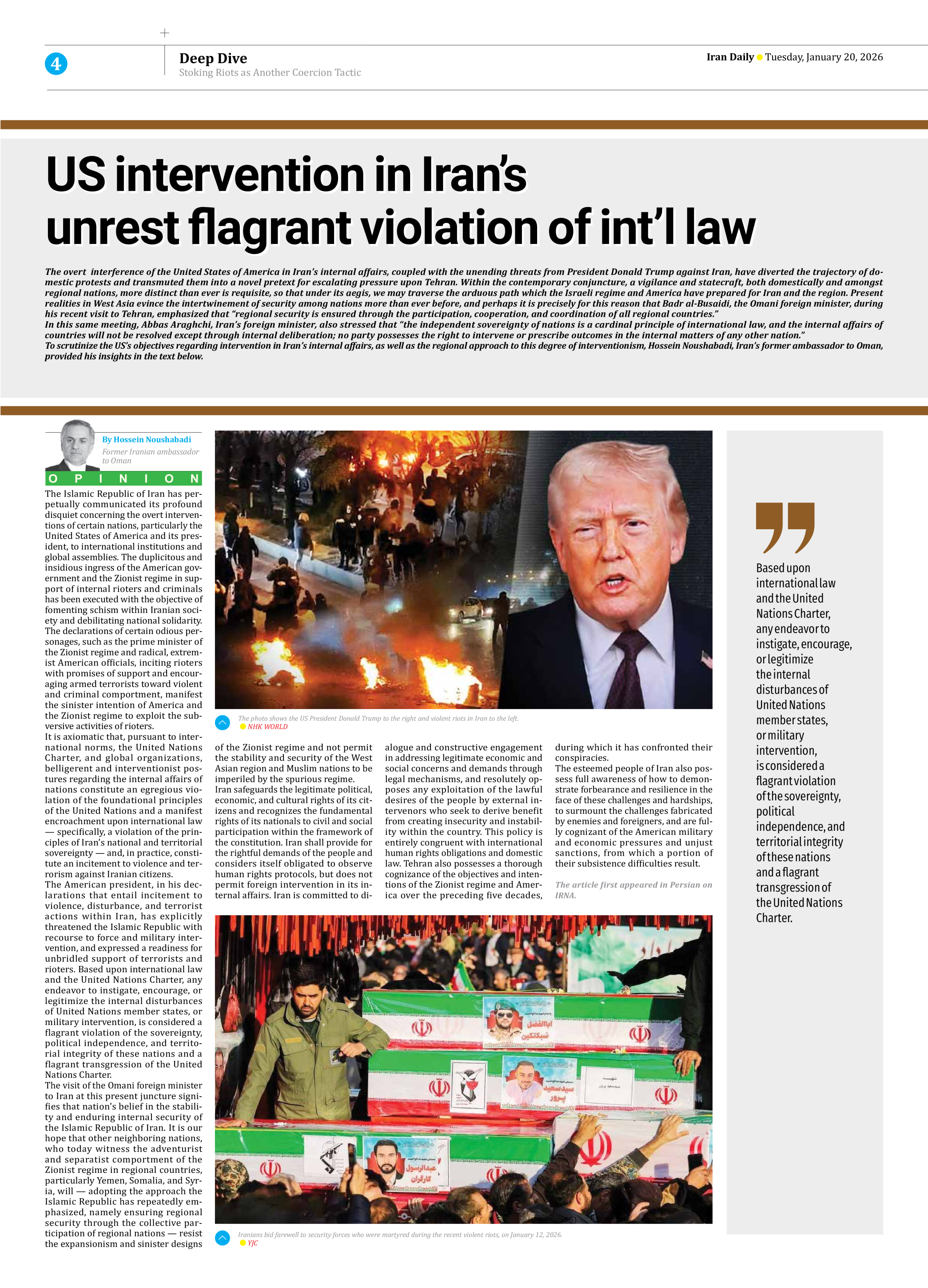
The American president, in his declarations that entail incitement to violence, disturbance, and terrorist actions within Iran, has explicitly threatened the Islamic Republic with recourse to force and military intervention, and expressed a readiness for unbridled support of terrorists and rioters. Based upon international law and the United Nations Charter, any endeavor to instigate, encourage, or legitimize the internal disturbances of United Nations member states, or military intervention, is considered a flagrant violation of the sovereignty, political independence, and territorial integrity of these nations and a flagrant transgression of the United Nations Charter.
The visit of the Omani foreign minister to Iran at this present juncture signifies that nation’s belief in the stability and enduring internal security of the Islamic Republic of Iran. It is our hope that other neighboring nations, who today witness the adventurist and separatist comportment of the Zionist regime in regional countries, particularly Yemen, Somalia, and Syria, will — adopting the approach the Islamic Republic has repeatedly emphasized, namely ensuring regional security through the collective participation of regional nations — resist the expansionism and sinister designs of the Zionist regime and not permit the stability and security of the West Asian region and Muslim nations to be imperiled by the spurious regime.
Iran safeguards the legitimate political, economic, and cultural rights of its citizens and recognizes the fundamental rights of its nationals to civil and social participation within the framework of the constitution. Iran shall provide for the rightful demands of the people and considers itself obligated to observe human rights protocols, but does not permit foreign intervention in its internal affairs. Iran is committed to dialogue and constructive engagement in addressing legitimate economic and social concerns and demands through legal mechanisms, and resolutely opposes any exploitation of the lawful desires of the people by external intervenors who seek to derive benefit from creating insecurity and instability within the country. This policy is entirely congruent with international human rights obligations and domestic law. Tehran also possesses a thorough cognizance of the objectives and intentions of the Zionist regime and America over the preceding five decades, during which it has confronted their conspiracies.
The esteemed people of Iran also possess full awareness of how to demonstrate forbearance and resilience in the face of these challenges and hardships, to surmount the challenges fabricated by enemies and foreigners, and are fully cognizant of the American military and economic pressures and unjust sanctions, from which a portion of their subsistence difficulties result.
The article first appeared in Persian on IRNA.