







Rasht translates culture into cuisine
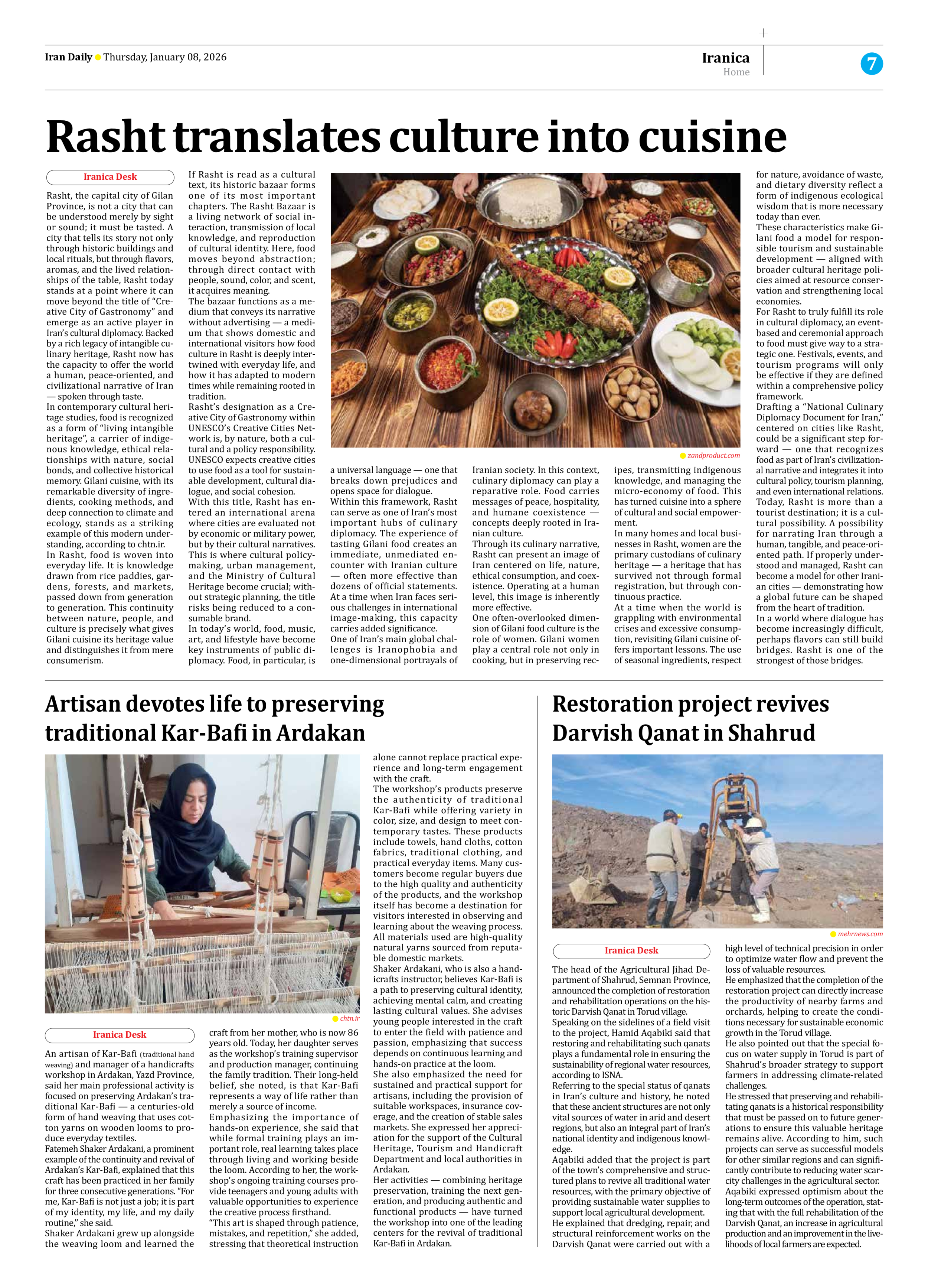
Rasht, the capital city of Gilan Province, is not a city that can be understood merely by sight or sound; it must be tasted. A city that tells its story not only through historic buildings and local rituals, but through flavors, aromas, and the lived relationships of the table, Rasht today stands at a point where it can move beyond the title of “Creative City of Gastronomy” and emerge as an active player in Iran’s cultural diplomacy. Backed by a rich legacy of intangible culinary heritage, Rasht now has the capacity to offer the world a human, peace-oriented, and civilizational narrative of Iran — spoken through taste.
In contemporary cultural heritage studies, food is recognized as a form of “living intangible heritage”, a carrier of indigenous knowledge, ethical relationships with nature, social bonds, and collective historical memory. Gilani cuisine, with its remarkable diversity of ingredients, cooking methods, and deep connection to climate and ecology, stands as a striking example of this modern understanding, according to chtn.ir.
In Rasht, food is woven into everyday life. It is knowledge drawn from rice paddies, gardens, forests, and markets, passed down from generation to generation. This continuity between nature, people, and culture is precisely what gives Gilani cuisine its heritage value and distinguishes it from mere consumerism.
If Rasht is read as a cultural text, its historic bazaar forms one of its most important chapters. The Rasht Bazaar is a living network of social interaction, transmission of local knowledge, and reproduction of cultural identity. Here, food moves beyond abstraction; through direct contact with people, sound, color, and scent, it acquires meaning.
The bazaar functions as a medium that conveys its narrative without advertising — a medium that shows domestic and international visitors how food culture in Rasht is deeply intertwined with everyday life, and how it has adapted to modern times while remaining rooted in tradition.
Rasht’s designation as a Creative City of Gastronomy within UNESCO’s Creative Cities Network is, by nature, both a cultural and a policy responsibility. UNESCO expects creative cities to use food as a tool for sustainable development, cultural dialogue, and social cohesion.
With this title, Rasht has entered an international arena where cities are evaluated not by economic or military power, but by their cultural narratives. This is where cultural policymaking, urban management, and the Ministry of Cultural Heritage become crucial; without strategic planning, the title risks being reduced to a consumable brand.
In today’s world, food, music, art, and lifestyle have become key instruments of public diplomacy. Food, in particular, is a universal language — one that breaks down prejudices and opens space for dialogue.
Within this framework, Rasht can serve as one of Iran’s most important hubs of culinary diplomacy. The experience of tasting Gilani food creates an immediate, unmediated encounter with Iranian culture — often more effective than dozens of official statements. At a time when Iran faces serious challenges in international image-making, this capacity carries added significance.
One of Iran’s main global challenges is Iranophobia and one-dimensional portrayals of Iranian society. In this context, culinary diplomacy can play a reparative role. Food carries messages of peace, hospitality, and humane coexistence — concepts deeply rooted in Iranian culture.
Through its culinary narrative, Rasht can present an image of Iran centered on life, nature, ethical consumption, and coexistence. Operating at a human level, this image is inherently more effective.
One often-overlooked dimension of Gilani food culture is the role of women. Gilani women play a central role not only in cooking, but in preserving recipes, transmitting indigenous knowledge, and managing the micro-economy of food. This has turned cuisine into a sphere of cultural and social empowerment.
In many homes and local businesses in Rasht, women are the primary custodians of culinary heritage — a heritage that has survived not through formal registration, but through continuous practice.
At a time when the world is grappling with environmental crises and excessive consumption, revisiting Gilani cuisine offers important lessons. The use of seasonal ingredients, respect for nature, avoidance of waste, and dietary diversity reflect a form of indigenous ecological wisdom that is more necessary today than ever.
These characteristics make Gilani food a model for responsible tourism and sustainable development — aligned with broader cultural heritage policies aimed at resource conservation and strengthening local economies.
For Rasht to truly fulfill its role in cultural diplomacy, an event-based and ceremonial approach to food must give way to a strategic one. Festivals, events, and tourism programs will only be effective if they are defined within a comprehensive policy framework.
Drafting a “National Culinary Diplomacy Document for Iran,” centered on cities like Rasht, could be a significant step forward — one that recognizes food as part of Iran’s civilizational narrative and integrates it into cultural policy, tourism planning, and even international relations.
Today, Rasht is more than a tourist destination; it is a cultural possibility. A possibility for narrating Iran through a human, tangible, and peace-oriented path. If properly understood and managed, Rasht can become a model for other Iranian cities — demonstrating how a global future can be shaped from the heart of tradition.
In a world where dialogue has become increasingly difficult, perhaps flavors can still build bridges. Rasht is one of the strongest of those bridges.