





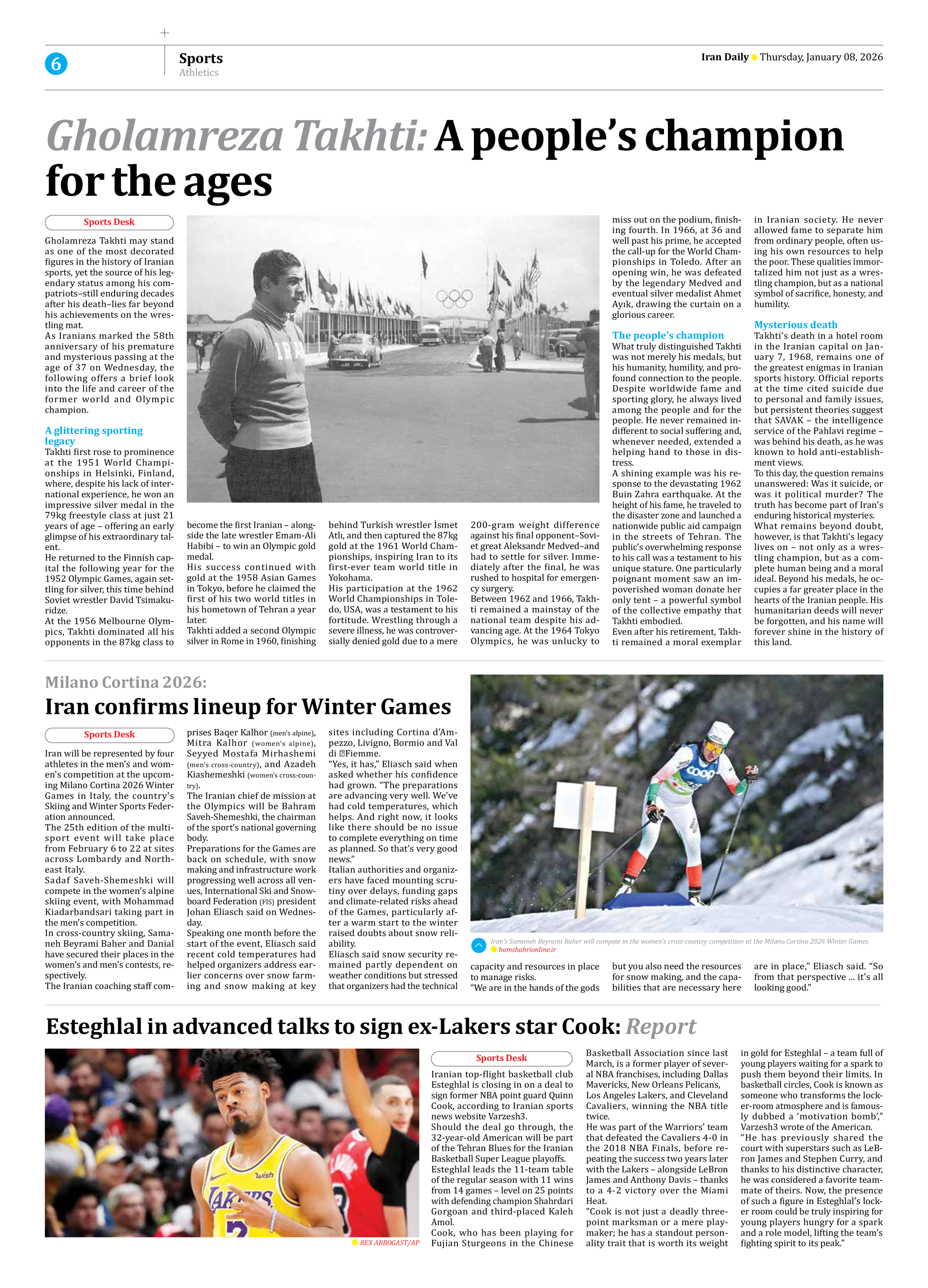


Gholamreza Takhti: A people’s champion for the ages
Gholamreza Takhti may stand as one of the most decorated figures in the history of Iranian sports, yet the source of his legendary status among his compatriots–still enduring decades after his death–lies far beyond his achievements on the wrestling mat.
As Iranians marked the 58th anniversary of his premature and mysterious passing at the age of 37 on Wednesday, the following offers a brief look into the life and career of the former world and Olympic champion.
A glittering sporting legacy
Takhti first rose to prominence at the 1951 World Championships in Helsinki, Finland, where, despite his lack of international experience, he won an impressive silver medal in the 79kg freestyle class at just 21 years of age – offering an early glimpse of his extraordinary talent.
He returned to the Finnish capital the following year for the 1952 Olympic Games, again settling for silver, this time behind Soviet wrestler David Tsimakuridze.
At the 1956 Melbourne Olympics, Takhti dominated all his opponents in the 87kg class to become the first Iranian – alongside the late wrestler Emam-Ali Habibi – to win an Olympic gold medal.
His success continued with gold at the 1958 Asian Games in Tokyo, before he claimed the first of his two world titles in his hometown of Tehran a year later.
Takhti added a second Olympic silver in Rome in 1960, finishing behind Turkish wrestler İsmet Atlı, and then captured the 87kg gold at the 1961 World Championships, inspiring Iran to its first-ever team world title in Yokohama.
His participation at the 1962 World Championships in Toledo, USA, was a testament to his fortitude. Wrestling through a severe illness, he was controversially denied gold due to a mere 200-gram weight difference against his final opponent–Soviet great Aleksandr Medved–and had to settle for silver. Immediately after the final, he was rushed to hospital for emergency surgery.
Between 1962 and 1966, Takhti remained a mainstay of the national team despite his advancing age. At the 1964 Tokyo Olympics, he was unlucky to miss out on the podium, finishing fourth. In 1966, at 36 and well past his prime, he accepted the call-up for the World Championships in Toledo. After an opening win, he was defeated by the legendary Medved and eventual silver medalist Ahmet Ayık, drawing the curtain on a glorious career.
The people’s champion
What truly distinguished Takhti was not merely his medals, but his humanity, humility, and profound connection to the people. Despite worldwide fame and sporting glory, he always lived among the people and for the people. He never remained indifferent to social suffering and, whenever needed, extended a helping hand to those in distress.
A shining example was his response to the devastating 1962 Buin Zahra earthquake. At the height of his fame, he traveled to the disaster zone and launched a nationwide public aid campaign in the streets of Tehran. The public’s overwhelming response to his call was a testament to his unique stature. One particularly poignant moment saw an impoverished woman donate her only tent – a powerful symbol of the collective empathy that Takhti embodied.
Even after his retirement, Takhti remained a moral exemplar in Iranian society. He never allowed fame to separate him from ordinary people, often using his own resources to help the poor. These qualities immortalized him not just as a wrestling champion, but as a national symbol of sacrifice, honesty, and humility.
Mysterious death
Takhti’s death in a hotel room in the Iranian capital on January 7, 1968, remains one of the greatest enigmas in Iranian sports history. Official reports at the time cited suicide due to personal and family issues, but persistent theories suggest that SAVAK – the intelligence service of the Pahlavi regime – was behind his death, as he was known to hold anti-establishment views.
To this day, the question remains unanswered: Was it suicide, or was it political murder? The truth has become part of Iran’s enduring historical mysteries.
What remains beyond doubt, however, is that Takhti’s legacy lives on – not only as a wrestling champion, but as a complete human being and a moral ideal. Beyond his medals, he occupies a far greater place in the hearts of the Iranian people. His humanitarian deeds will never be forgotten, and his name will forever shine in the history of this land.