





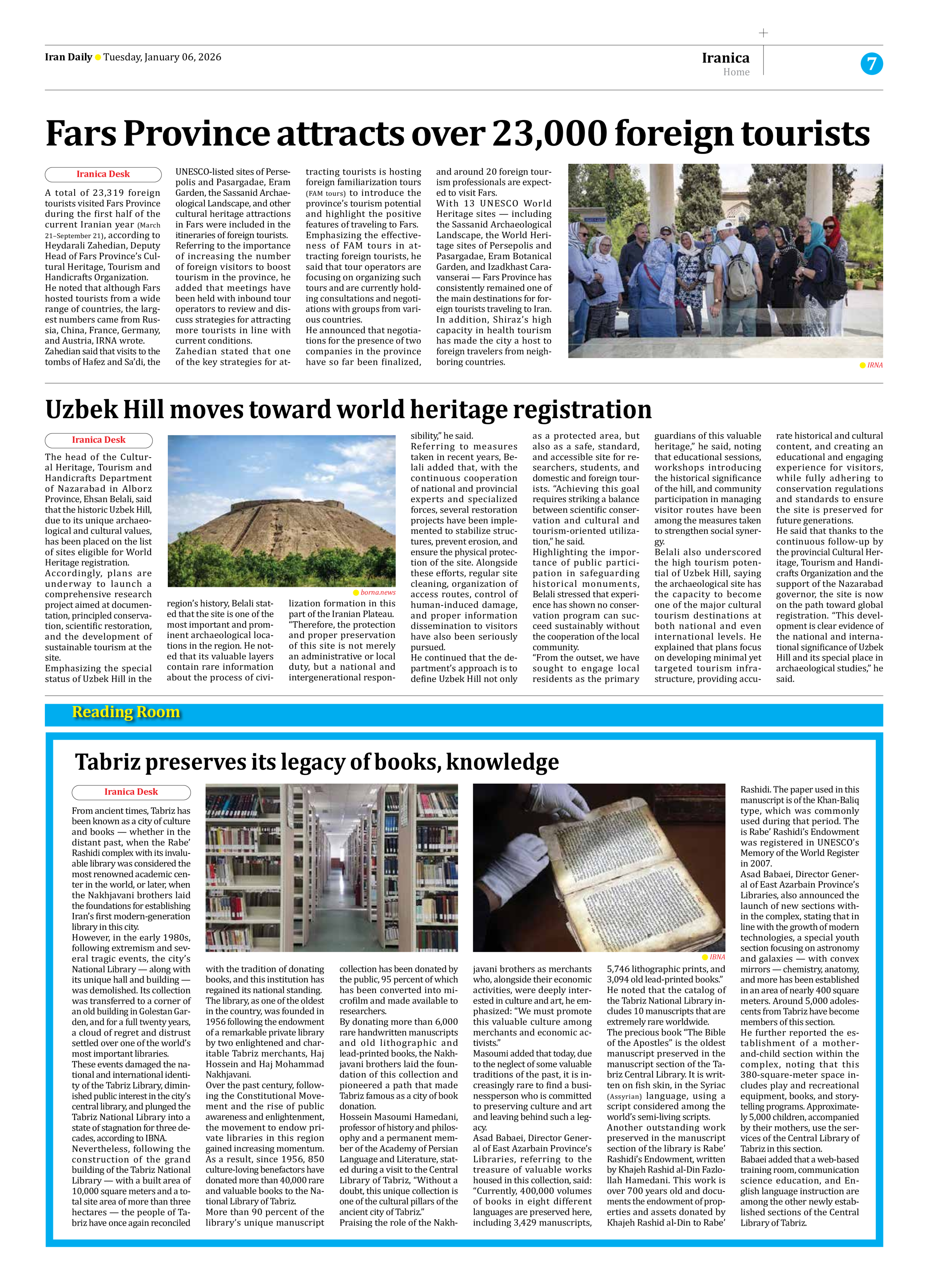


Reading Room
Tabriz preserves its legacy of books, knowledge
From ancient times, Tabriz has been known as a city of culture and books — whether in the distant past, when the Rabe’ Rashidi complex with its invaluable library was considered the most renowned academic center in the world, or later, when the Nakhjavani brothers laid the foundations for establishing Iran’s first modern-generation library in this city.
However, in the early 1980s, following extremism and several tragic events, the city’s National Library — along with its unique hall and building — was demolished. Its collection was transferred to a corner of an old building in Golestan Garden, and for a full twenty years, a cloud of regret and distrust settled over one of the world’s most important libraries.
These events damaged the national and international identity of the Tabriz Library, diminished public interest in the city’s central library, and plunged the Tabriz National Library into a state of stagnation for three decades, according to IBNA.
Nevertheless, following the construction of the grand building of the Tabriz National Library — with a built area of 10,000 square meters and a total site area of more than three hectares — the people of Tabriz have once again reconciled with the tradition of donating books, and this institution has regained its national standing.
The library, as one of the oldest in the country, was founded in 1956 following the endowment of a remarkable private library by two enlightened and charitable Tabriz merchants, Haj Hossein and Haj Mohammad Nakhjavani.
Over the past century, following the Constitutional Movement and the rise of public awareness and enlightenment, the movement to endow private libraries in this region gained increasing momentum. As a result, since 1956, 850 culture-loving benefactors have donated more than 40,000 rare and valuable books to the National Library of Tabriz.
More than 90 percent of the library’s unique manuscript collection has been donated by the public, 95 percent of which has been converted into microfilm and made available to researchers.
By donating more than 6,000 rare handwritten manuscripts and old lithographic and lead-printed books, the Nakhjavani brothers laid the foundation of this collection and pioneered a path that made Tabriz famous as a city of book donation.
Hossein Masoumi Hamedani, professor of history and philosophy and a permanent member of the Academy of Persian Language and Literature, stated during a visit to the Central Library of Tabriz, “Without a doubt, this unique collection is one of the cultural pillars of the ancient city of Tabriz.”
Praising the role of the Nakhjavani brothers as merchants who, alongside their economic activities, were deeply interested in culture and art, he emphasized: “We must promote this valuable culture among merchants and economic activists.”
Masoumi added that today, due to the neglect of some valuable traditions of the past, it is increasingly rare to find a businessperson who is committed to preserving culture and art and leaving behind such a legacy.
Asad Babaei, Director General of East Azarbain Province’s Libraries, referring to the treasure of valuable works housed in this collection, said: “Currently, 400,000 volumes of books in eight different languages are preserved here, including 3,429 manuscripts, 5,746 lithographic prints, and 3,094 old lead-printed books.”
He noted that the catalog of the Tabriz National Library includes 10 manuscripts that are extremely rare worldwide.
The precious book “The Bible of the Apostles” is the oldest manuscript preserved in the manuscript section of the Tabriz Central Library. It is written on fish skin, in the Syriac (Assyrian) language, using a script considered among the world’s semi-living scripts.
Another outstanding work preserved in the manuscript section of the library is Rabe’ Rashidi’s Endowment, written by Khajeh Rashid al-Din Fazlollah Hamedani. This work is over 700 years old and documents the endowment of properties and assets donated by Khajeh Rashid al-Din to Rabe’ Rashidi. The paper used in this manuscript is of the Khan-Baliq type, which was commonly used during that period. The is Rabe’ Rashidi’s Endowment was registered in UNESCO’s Memory of the World Register in 2007.
Asad Babaei, Director General of East Azarbain Province’s Libraries, also announced the launch of new sections within the complex, stating that in line with the growth of modern technologies, a special youth section focusing on astronomy and galaxies — with convex mirrors — chemistry, anatomy, and more has been established in an area of nearly 400 square meters. Around 5,000 adolescents from Tabriz have become members of this section.
He further reported the establishment of a mother-and-child section within the complex, noting that this 380-square-meter space includes play and recreational equipment, books, and storytelling programs. Approximately 5,000 children, accompanied by their mothers, use the services of the Central Library of Tabriz in this section.
Babaei added that a web-based training room, communication science education, and English language instruction are among the other newly established sections of the Central Library of Tabriz.