







Iran taps arid regions for sustainable tourism push
Iran’s deserts are being positioned as focal points for tourism and cultural preservation, cultural, Heritage, tourism and Handicrafts Minister Reza Salehi-Amiri said, emphasizing the role of arid regions in national tourism governance.
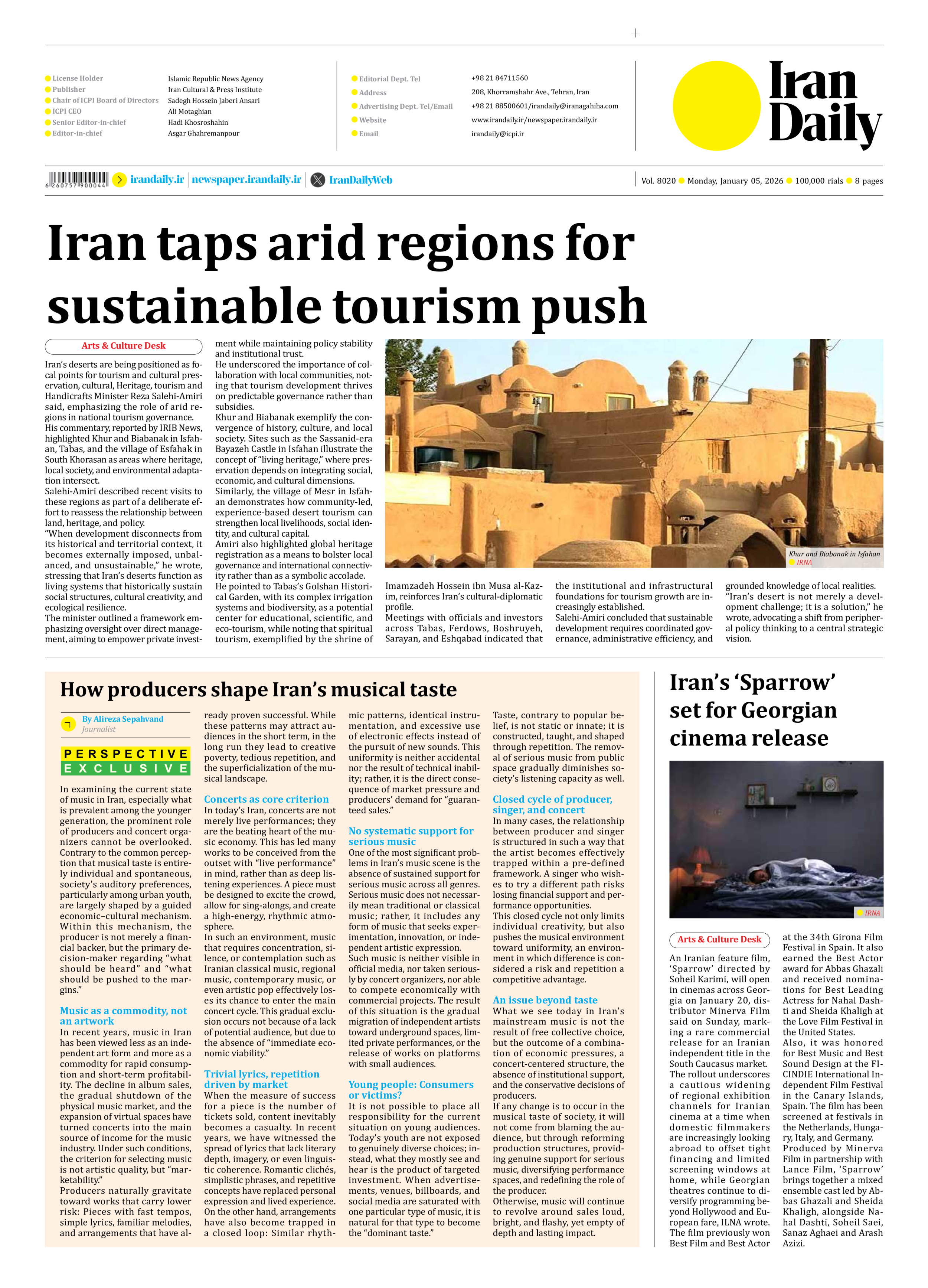
His commentary, reported by IRIB News, highlighted Khur and Biabanak in Isfahan, Tabas, and the village of Esfahak in South Khorasan as areas where heritage, local society, and environmental adaptation intersect.
Salehi-Amiri described recent visits to these regions as part of a deliberate effort to reassess the relationship between land, heritage, and policy.
“When development disconnects from its historical and territorial context, it becomes externally imposed, unbalanced, and unsustainable,” he wrote, stressing that Iran’s deserts function as living systems that historically sustain social structures, cultural creativity, and ecological resilience.
The minister outlined a framework emphasizing oversight over direct management, aiming to empower private investment while maintaining policy stability and institutional trust.
He underscored the importance of collaboration with local communities, noting that tourism development thrives on predictable governance rather than subsidies.
Khur and Biabanak exemplify the convergence of history, culture, and local society. Sites such as the Sassanid-era Bayazeh Castle in Isfahan illustrate the concept of “living heritage,” where preservation depends on integrating social, economic, and cultural dimensions.
Similarly, the village of Mesr in Isfahan demonstrates how community-led, experience-based desert tourism can strengthen local livelihoods, social identity, and cultural capital.
Amiri also highlighted global heritage registration as a means to bolster local governance and international connectivity rather than as a symbolic accolade.
He pointed to Tabas’s Golshan Historical Garden, with its complex irrigation systems and biodiversity, as a potential center for educational, scientific, and eco-tourism, while noting that spiritual tourism, exemplified by the shrine of Imamzadeh Hossein ibn Musa al-Kazim, reinforces Iran’s cultural-diplomatic profile.
Meetings with officials and investors across Tabas, Ferdows, Boshruyeh, Sarayan, and Eshqabad indicated that the institutional and infrastructural foundations for tourism growth are increasingly established.
Salehi-Amiri concluded that sustainable development requires coordinated governance, administrative efficiency, and grounded knowledge of local realities.
“Iran’s desert is not merely a development challenge; it is a solution,” he wrote, advocating a shift from peripheral policy thinking to a central strategic vision.