





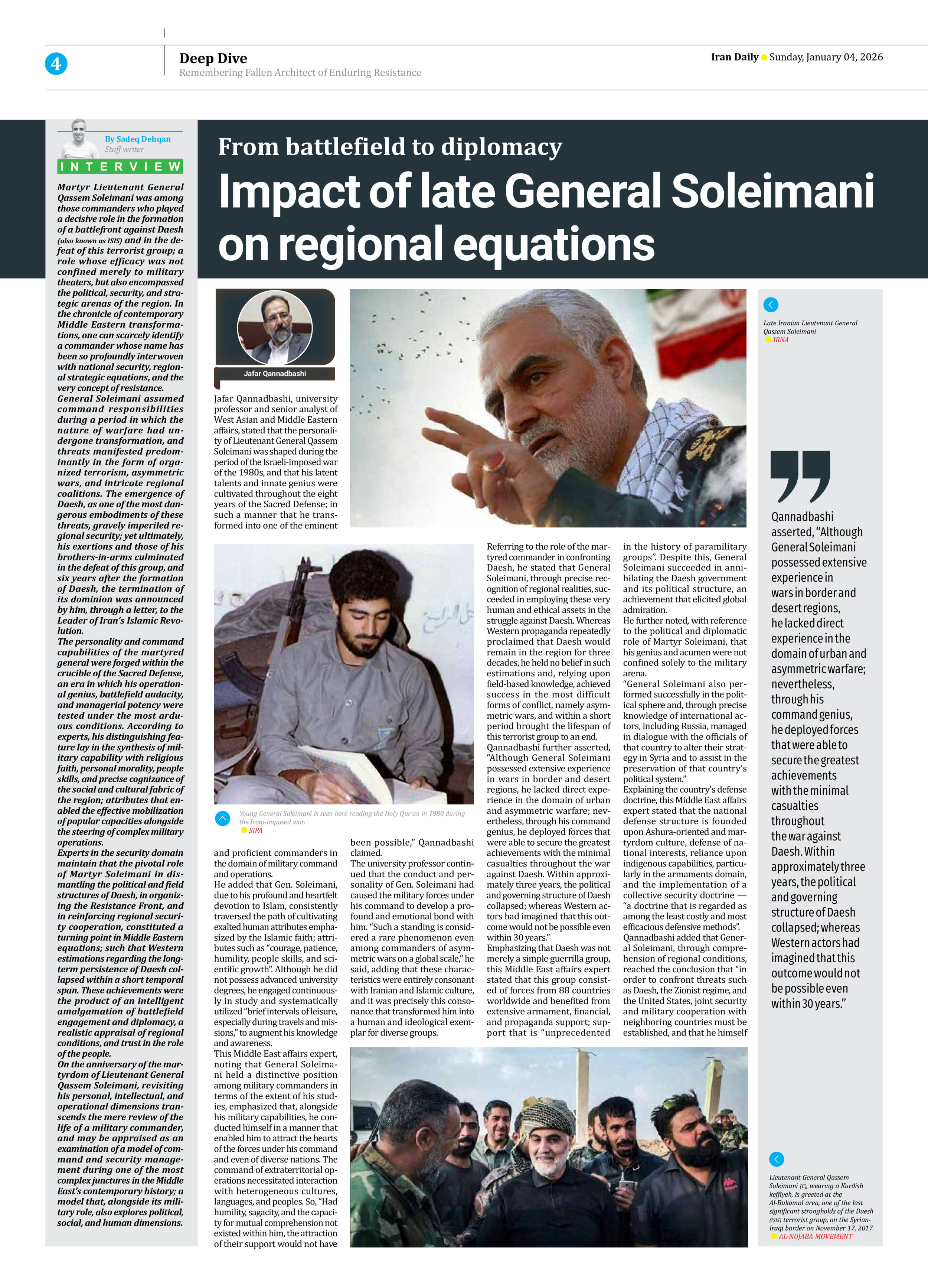


From battlefield to diplomacy
Impact of late General Soleimani on regional equations
Martyr Lieutenant General Qassem Soleimani was among those commanders who played a decisive role in the formation of a battlefront against Daesh (also known as ISIS) and in the defeat of this terrorist group; a role whose efficacy was not confined merely to military theaters, but also encompassed the political, security, and strategic arenas of the region. In the chronicle of contemporary Middle Eastern transformations, one can scarcely identify a commander whose name has been so profoundly interwoven with national security, regional strategic equations, and the very concept of resistance. General Soleimani assumed command responsibilities during a period in which the nature of warfare had undergone transformation, and threats manifested predominantly in the form of organized terrorism, asymmetric wars, and intricate regional coalitions. The emergence of Daesh, as one of the most dangerous embodiments of these threats, gravely imperiled regional security; yet ultimately, his exertions and those of his brothers-in-arms culminated in the defeat of this group, and six years after the formation of Daesh, the termination of its dominion was announced by him, through a letter, to the Leader of Iran’s Islamic Revolution. The personality and command capabilities of the martyred general were forged within the crucible of the Sacred Defense, an era in which his operational genius, battlefield audacity, and managerial potency were tested under the most arduous conditions. According to experts, his distinguishing feature lay in the synthesis of military capability with religious faith, personal morality, people skills, and precise cognizance of the social and cultural fabric of the region; attributes that enabled the effective mobilization of popular capacities alongside the steering of complex military operations. Experts in the security domain maintain that the pivotal role of Martyr Soleimani in dismantling the political and field structures of Daesh, in organizing the Resistance Front, and in reinforcing regional security cooperation, constituted a turning point in Middle Eastern equations; such that Western estimations regarding the long-term persistence of Daesh collapsed within a short temporal span. These achievements were the product of an intelligent amalgamation of battlefield engagement and diplomacy, a realistic appraisal of regional conditions, and trust in the role of the people. On the anniversary of the martyrdom of Lieutenant General Qassem Soleimani, revisiting his personal, intellectual, and operational dimensions transcends the mere review of the life of a military commander, and may be appraised as an examination of a model of command and security management during one of the most complex junctures in the Middle East’s contemporary history; a model that, alongside its military role, also explores political, social, and human dimensions.
By Sadeq Dehqan
Staff writer
Jafar Qannadbashi, university professor and senior analyst of West Asian and Middle Eastern affairs, stated that the personality of Lieutenant General Qassem Soleimani was shaped during the period of the Israeli-imposed war of the 1980s, and that his latent talents and innate genius were cultivated throughout the eight years of the Sacred Defense; in such a manner that he transformed into one of the eminent and proficient commanders in the domain of military command and operations.
He added that Gen. Soleimani, due to his profound and heartfelt devotion to Islam, consistently traversed the path of cultivating exalted human attributes emphasized by the Islamic faith; attributes such as “courage, patience, humility, people skills, and scientific growth”. Although he did not possess advanced university degrees, he engaged continuously in study and systematically utilized “brief intervals of leisure, especially during travels and missions,” to augment his knowledge and awareness.
This Middle East affairs expert, noting that General Soleimani held a distinctive position among military commanders in terms of the extent of his studies, emphasized that, alongside his military capabilities, he conducted himself in a manner that enabled him to attract the hearts of the forces under his command and even of diverse nations. The command of extraterritorial operations necessitated interaction with heterogeneous cultures, languages, and peoples. So, “Had humility, sagacity, and the capacity for mutual comprehension not existed within him, the attraction of their support would not have been possible,” Qannadbashi claimed.
The university professor continued that the conduct and personality of Gen. Soleimani had caused the military forces under his command to develop a profound and emotional bond with him. “Such a standing is considered a rare phenomenon even among commanders of asymmetric wars on a global scale,” he said, adding that these characteristics were entirely consonant with Iranian and Islamic culture, and it was precisely this consonance that transformed him into a human and ideological exemplar for diverse groups.
Referring to the role of the martyred commander in confronting Daesh, he stated that General Soleimani, through precise recognition of regional realities, succeeded in employing these very human and ethical assets in the struggle against Daesh. Whereas Western propaganda repeatedly proclaimed that Daesh would remain in the region for three decades, he held no belief in such estimations and, relying upon field-based knowledge, achieved success in the most difficult forms of conflict, namely asymmetric wars, and within a short period brought the lifespan of this terrorist group to an end.
Qannadbashi further asserted, “Although General Soleimani possessed extensive experience in wars in border and desert regions, he lacked direct experience in the domain of urban and asymmetric warfare; nevertheless, through his command genius, he deployed forces that were able to secure the greatest achievements with the minimal casualties throughout the war against Daesh. Within approximately three years, the political and governing structure of Daesh collapsed; whereas Western actors had imagined that this outcome would not be possible even within 30 years.”
Emphasizing that Daesh was not merely a simple guerrilla group, this Middle East affairs expert stated that this group consisted of forces from 88 countries worldwide and benefited from extensive armament, financial, and propaganda support; support that is “unprecedented in the history of paramilitary groups”. Despite this, General Soleimani succeeded in annihilating the Daesh government and its political structure, an achievement that elicited global admiration.
He further noted, with reference to the political and diplomatic role of Martyr Soleimani, that his genius and acumen were not confined solely to the military arena.
“General Soleimani also performed successfully in the political sphere and, through precise knowledge of international actors, including Russia, managed in dialogue with the officials of that country to alter their strategy in Syria and to assist in the preservation of that country’s political system.”
Explaining the country’s defense doctrine, this Middle East affairs expert stated that the national defense structure is founded upon Ashura-oriented and martyrdom culture, defense of national interests, reliance upon indigenous capabilities, particularly in the armaments domain, and the implementation of a collective security doctrine — “a doctrine that is regarded as among the least costly and most efficacious defensive methods”.
Qannadbashi added that General Soleimani, through comprehension of regional conditions, reached the conclusion that “in order to confront threats such as Daesh, the Zionist regime, and the United States, joint security and military cooperation with neighboring countries must be established, and that he himself effectively laid the cornerstone of these collaborations”. Through field presence, familiarity with local languages and cultures, and the creation of operational mechanisms, he succeeded in bringing successful examples of such cooperation into reality.
He remarked that victories such as the 33-day Lebanon war, “in which General Soleimani was among the principal designers and executors,” played a significant role in strengthening the morale of Resistance forces and in instilling hope for confronting Daesh. “Each battlefield victory generated augmented energy for the continuation of the path.”
In conclusion, Qannadbashi emphasized that those who criticize Iran’s regional presence, if acquainted with the logic of collective security pacts and reliance upon indigenous capabilities, would attain a clearer understanding of this strategy. According to him, “The military genius and prudence of General Soleimani enabled Iran to move past the Daesh threat with minimal cost and without entering direct war; an issue that lucidly demonstrates the divergence between the Islamic Republic’s approach and that of certain regional countries.”
Shadab Asgari, writer and military affairs expert, referring to the role and position of Lieutenant General Qassem Soleimani in regional developments, stated that Martyr Soleimani was among the prominent and influential figures in the struggle against terrorism, particularly the Daesh faction, who not only in the military arena, but also in the political domain, “fulfilled the role of a powerful operational commander and succeeded in exerting influence simultaneously in both arenas”. He further noted that the charismatic personality of Gen. Soleimani on battlefields transformed him into a distinguished planner for confronting enemies.
“Despite his extensive fame in Iran and global media, he never succumbed to arrogance or hubris and always appeared with humility among his brothers-in-arms and the populace. This attribute, accompanied by his faith, courage, intelligence, and perspicacity over 40 years of activity, made him a model that the Leader of Iran’s Revolution referred to as the ‘Soleimani School’; a school capable of nurturing youth into similar exemplars.”
Asgari added that the struggle against arrogance constituted the general’s central ideology, an ideology that recognized no borders, “from the Sacred Defense period to the wars of Lebanon and Gaza”. His presence neutralized conspiracies against the Islamic world and transformed threats such as Daesh into opportunities for the unity of the Islamic Ummah. “Through intelligent designs, he established the nucleus of Resistance in Syria and Iraq, trained forces, and infused the spirit of self-confidence into combatants,” Asgari maintained.
He further added that General Soleimani, through utilizing experiences from the Sacred Defense period (1980–1988) and security missions in the country’s southeast, particularly in Sistan and Baluchestan, had arrived at the understanding that overcoming the enemy without reliance upon the people is impossible.
“Similar to the approach of Imam Khomeini (PBUH) in the victory of the Islamic Revolution, he invested in the principle of the people. Contrary to the United States, the Zionist regime, and certain administrations that concentrate upon elites and formal structures, he would penetrate the various layers of societies and, through his conduct and speech, secure the trust and companionship of its people.”
This military affairs expert asserted that the secret of Martyr Soleimani’s success in confronting Daesh lay in reliance upon popular mobilization. In countries such as Lebanon, Syria, and Iraq, through “organization, unification, and assignment of responsibility to popular forces,” including the Popular Mobilization Forces in Iraq, Resistance forces in Syria, and Hezbollah in Lebanon, he brought the real power of nations onto the stage because “without the will and desire of the people, no sustainable transformation takes shape”.
Asgari stated, “With the formation of Daesh and the efforts of this group to establish a self-proclaimed caliphate through violence and terror, the Islamic Republic of Iran undertook effective actions at political and military levels, across national, regional, and international dimensions. Martyr Soleimani, with a profound understanding of regional conditions, entered the field and, through the creation of popular and military coalitions, particularly in Syria and Iraq, played a decisive role in containing and defeating this group.”
He added that at a juncture when Daesh had dominated vast portions of Iraq and Syria and many political and military officials in the region and the world considered the fall of Damascus and Baghdad inevitable, Martyr Soleimani, with trust in God and reliance upon the people, brought the people onto the stage and, through steadfastness against Daesh and its supporters, prevented the realization of that scenario. This occurred while years later, with the weakening of the bond between the Syrian government and its people, the groundwork for defeat against weaker groups was laid out.
Maintaining that Martyr Soleimani was among the most influential political and military figures of the past four decades in the region, this Middle East affairs expert said that through “high political intelligence and field command power,” both during the imposed war and in altering regional equations, he played a central role in confronting arrogant, takfiri, and terrorist groups. The general’s active and field-based presence in Syria, Iraq, and Lebanon shifted the political and security equations of the region in favor of Islamic nations and the Resistance Axis, he stressed.
Asgari continued that General Soleimani, through the application of precise and intelligent tactics, removed dozens of terrorist factions from the region’s operational theater and redirected the focus of the Resistance Axis toward confronting takfiri groups. “His field movements perceptibly transformed the region’s political atmosphere.”
Referring to the personal characteristics of Martyr Soleimani, he stated that the general was a mujahid who spent his entire life on the path of jihad “in the cause of God” and in support of the oppressed of the world.
“From command during the eight-year war with Iraq, to combating armed groups and smugglers on the country’s eastern borders, and subsequently to commanding the Quds Force of the Islamic Revolution’s Guards Corps, he consistently displayed a synthesis of military command, political prudence, Islamic ethics, humility, and responsibility.”
This expert said that his humane and Islamic treatment even toward enemy captives, exemplary courage on the battlefield, precision in strategic planning, intelligent utilization of opportunities, and simple and humble lifestyle, fashioned Martyr Soleimani into a charismatic and influential personality at domestic and international levels.
Emphasizing the role of Martyr Soleimani in the destruction of Daesh, Asgari noted that through coordination with local forces, the Syrian army, and the creation of joint security cooperation within the Resistance Axis, he prevented the expansion of terrorism, reduced the influence of the United States and the Zionist regime, and formed a unified front against external threats. “His role in the liberation of Mosul, the stabilization of security in Iraq and Syria, and support for resistance in Lebanon and Palestine is undeniable, the expert added.
He also referred to the human and transregional dimensions of Martyr Soleimani’s activities, stating that “Martyr Soleimani regarded the Islamic world and freedom-seeking nations as a single body” and believed that “lasting peace and security are realized only through transcending sectarian demarcations and expanding brotherhood among nations”.
In conclusion, this expert noted that some criticize the regional presence of Martyr Soleimani, but according to defensive doctrines, the provision of national security at times necessitates confronting threats beyond borders. Ultimately, Asgari added, the United States, through the assassination of Martyr Soleimani, sought to obstruct the continuation of a path whose infrastructures and strategies in the region had culminated to the detriment of that country’s interests and those of its allies.