





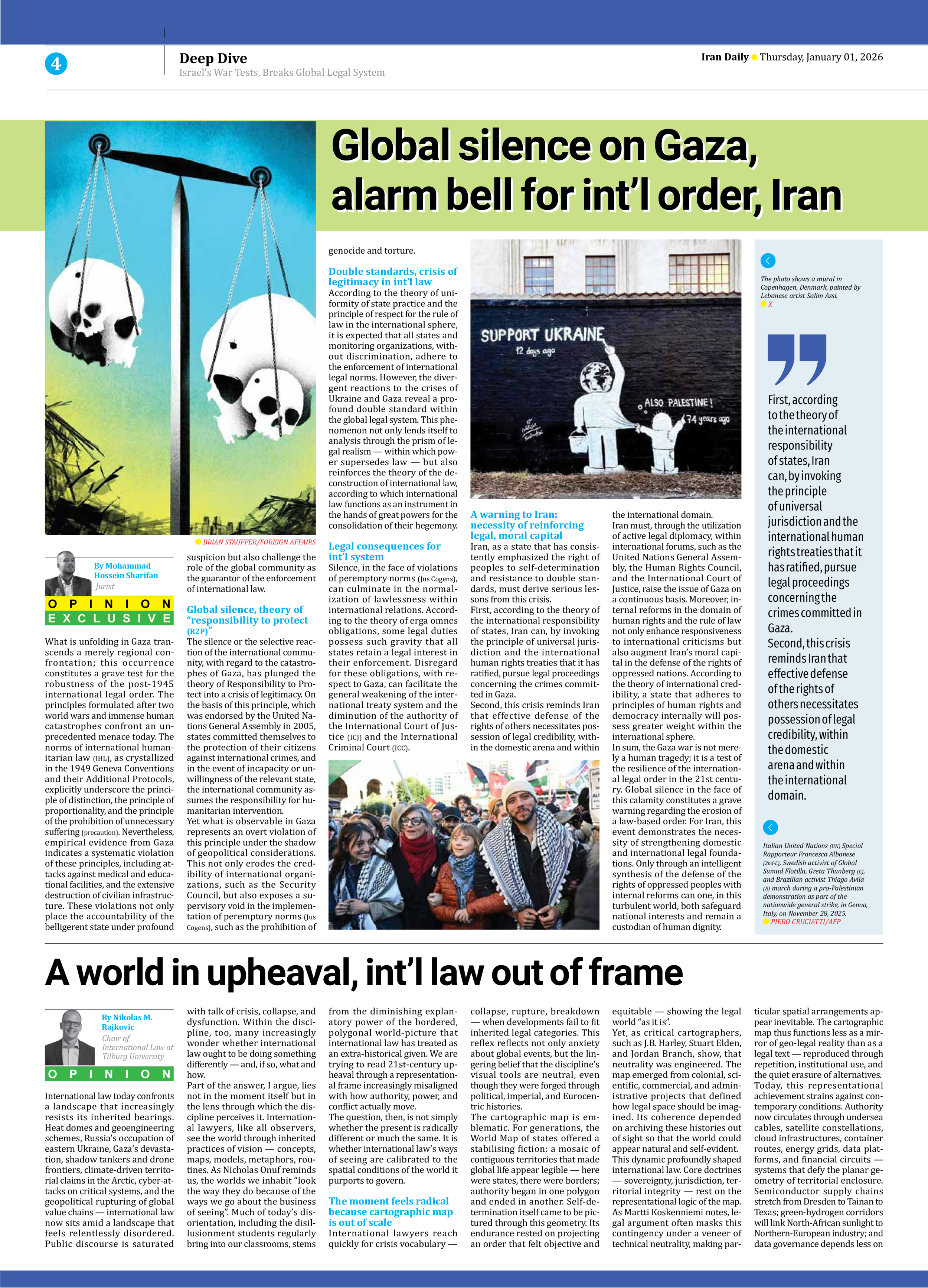


Global silence on Gaza, alarm bell for int’l order, Iran
By Mohammad Hossein Sharifan
Jurist
What is unfolding in Gaza transcends a merely regional confrontation; this occurrence constitutes a grave test for the robustness of the post-1945 international legal order. The principles formulated after two world wars and immense human catastrophes confront an unprecedented menace today. The norms of international humanitarian law (IHL), as crystallized in the 1949 Geneva Conventions and their Additional Protocols, explicitly underscore the principle of distinction, the principle of proportionality, and the principle of the prohibition of unnecessary suffering (precaution). Nevertheless, empirical evidence from Gaza indicates a systematic violation of these principles, including attacks against medical and educational facilities, and the extensive destruction of civilian infrastructure. These violations not only place the accountability of the belligerent state under profound suspicion but also challenge the role of the global community as the guarantor of the enforcement of international law.
Global silence, theory of “responsibility to protect (R2P)”
The silence or the selective reaction of the international community, with regard to the catastrophes of Gaza, has plunged the theory of Responsibility to Protect into a crisis of legitimacy. On the basis of this principle, which was endorsed by the United Nations General Assembly in 2005, states committed themselves to the protection of their citizens against international crimes, and in the event of incapacity or unwillingness of the relevant state, the international community assumes the responsibility for humanitarian intervention.
Yet what is observable in Gaza represents an overt violation of this principle under the shadow of geopolitical considerations. This not only erodes the credibility of international organizations, such as the Security Council, but also exposes a supervisory void in the implementation of peremptory norms (Jus Cogens), such as the prohibition of genocide and torture.
Double standards, crisis of legitimacy in int’l law
According to the theory of uniformity of state practice and the principle of respect for the rule of law in the international sphere, it is expected that all states and monitoring organizations, without discrimination, adhere to the enforcement of international legal norms. However, the divergent reactions to the crises of Ukraine and Gaza reveal a profound double standard within the global legal system. This phenomenon not only lends itself to analysis through the prism of legal realism — within which power supersedes law — but also reinforces the theory of the deconstruction of international law, according to which international law functions as an instrument in the hands of great powers for the consolidation of their hegemony.
Legal consequences for int’l system
Silence, in the face of violations of peremptory norms (Jus Cogens), can culminate in the normalization of lawlessness within international relations. According to the theory of erga omnes obligations, some legal duties possess such gravity that all states retain a legal interest in their enforcement. Disregard for these obligations, with respect to Gaza, can facilitate the general weakening of the international treaty system and the diminution of the authority of the International Court of Justice (ICJ) and the International Criminal Court (ICC).
A warning to Iran: necessity of reinforcing legal, moral capital
Iran, as a state that has consistently emphasized the right of peoples to self-determination and resistance to double standards, must derive serious lessons from this crisis.
First, according to the theory of the international responsibility of states, Iran can, by invoking the principle of universal jurisdiction and the international human rights treaties that it has ratified, pursue legal proceedings concerning the crimes committed in Gaza.
Second, this crisis reminds Iran that effective defense of the rights of others necessitates possession of legal credibility, within the domestic arena and within the international domain.
Iran must, through the utilization of active legal diplomacy, within international forums, such as the United Nations General Assembly, the Human Rights Council, and the International Court of Justice, raise the issue of Gaza on a continuous basis. Moreover, internal reforms in the domain of human rights and the rule of law not only enhance responsiveness to international criticisms but also augment Iran’s moral capital in the defense of the rights of oppressed nations. According to the theory of international credibility, a state that adheres to principles of human rights and democracy internally will possess greater weight within the international sphere.
In sum, the Gaza war is not merely a human tragedy; it is a test of the resilience of the international legal order in the 21st century. Global silence in the face of this calamity constitutes a grave warning regarding the erosion of a law-based order. For Iran, this event demonstrates the necessity of strengthening domestic and international legal foundations. Only through an intelligent synthesis of the defense of the rights of oppressed peoples with internal reforms can one, in this turbulent world, both safeguard national interests and remain a custodian of human dignity.