





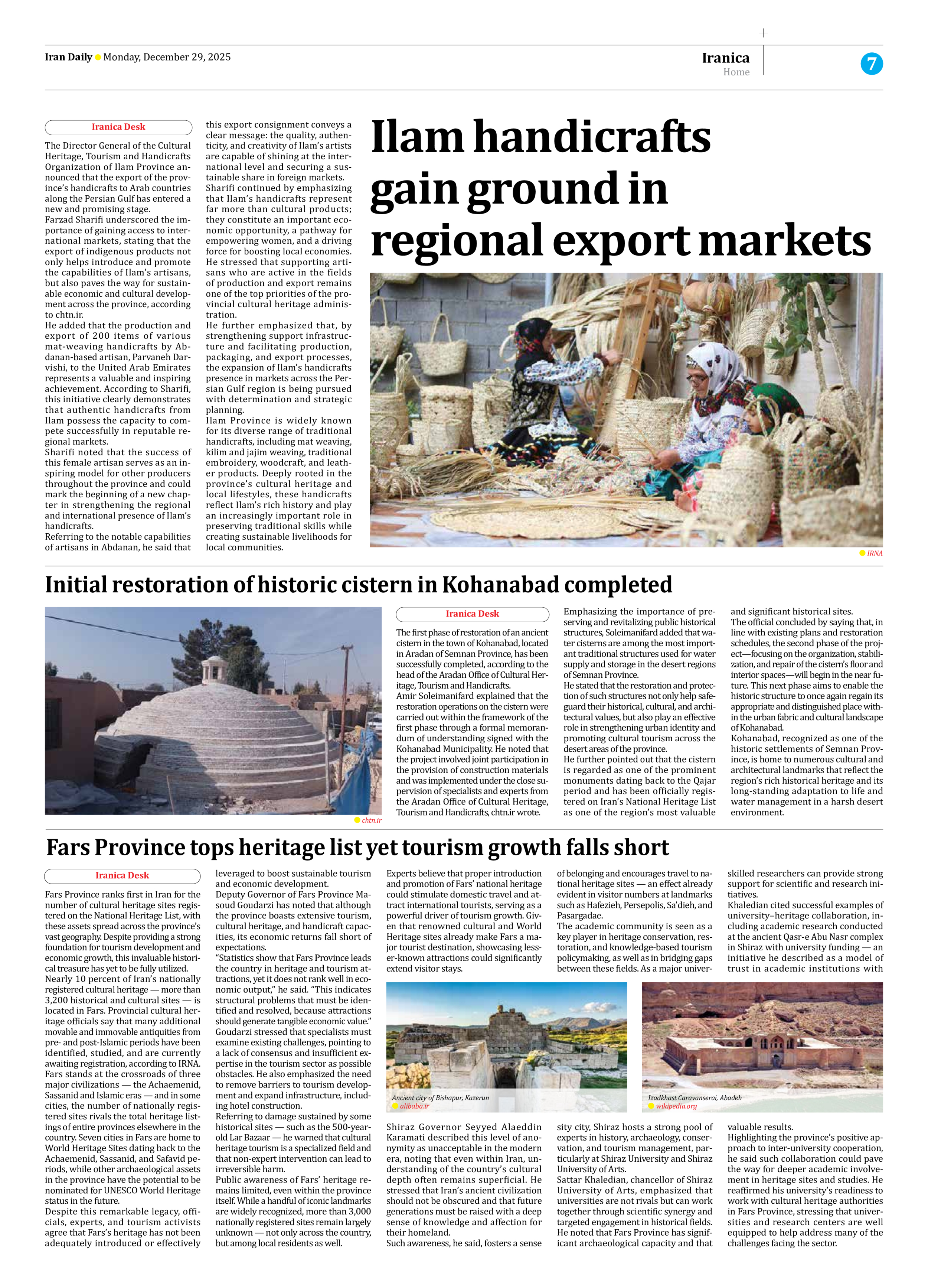


Fars Province tops heritage list yet tourism growth falls short
Fars Province ranks first in Iran for the number of cultural heritage sites registered on the National Heritage List, with these assets spread across the province’s vast geography. Despite providing a strong foundation for tourism development and economic growth, this invaluable historical treasure has yet to be fully utilized.
Nearly 10 percent of Iran’s nationally registered cultural heritage — more than 3,200 historical and cultural sites — is located in Fars. Provincial cultural heritage officials say that many additional movable and immovable antiquities from pre- and post-Islamic periods have been identified, studied, and are currently awaiting registration, according to IRNA.
Fars stands at the crossroads of three major civilizations — the Achaemenid, Sassanid and Islamic eras — and in some cities, the number of nationally registered sites rivals the total heritage listings of entire provinces elsewhere in the country. Seven cities in Fars are home to World Heritage Sites dating back to the Achaemenid, Sassanid, and Safavid periods, while other archaeological assets in the province have the potential to be nominated for UNESCO World Heritage status in the future.
Despite this remarkable legacy, officials, experts, and tourism activists agree that Fars’s heritage has not been adequately introduced or effectively leveraged to boost sustainable tourism and economic development.
Deputy Governor of Fars Province Masoud Goudarzi has noted that although the province boasts extensive tourism, cultural heritage, and handicraft capacities, its economic returns fall short of expectations.
“Statistics show that Fars Province leads the country in heritage and tourism attractions, yet it does not rank well in economic output,” he said. “This indicates structural problems that must be identified and resolved, because attractions should generate tangible economic value.”
Goudarzi stressed that specialists must examine existing challenges, pointing to a lack of consensus and insufficient expertise in the tourism sector as possible obstacles. He also emphasized the need to remove barriers to tourism development and expand infrastructure, including hotel construction.
Referring to damage sustained by some historical sites — such as the 500-year-old Lar Bazaar — he warned that cultural heritage tourism is a specialized field and that non-expert intervention can lead to irreversible harm.
Public awareness of Fars’ heritage remains limited, even within the province itself. While a handful of iconic landmarks are widely recognized, more than 3,000 nationally registered sites remain largely unknown — not only across the country, but among local residents as well.
Experts believe that proper introduction and promotion of Fars’ national heritage could stimulate domestic travel and attract international tourists, serving as a powerful driver of tourism growth. Given that renowned cultural and World Heritage sites already make Fars a major tourist destination, showcasing lesser-known attractions could significantly extend visitor stays.
Shiraz Governor Seyyed Alaeddin Karamati described this level of anonymity as unacceptable in the modern era, noting that even within Iran, understanding of the country’s cultural depth often remains superficial. He stressed that Iran’s ancient civilization should not be obscured and that future generations must be raised with a deep sense of knowledge and affection for their homeland.
Such awareness, he said, fosters a sense of belonging and encourages travel to national heritage sites — an effect already evident in visitor numbers at landmarks such as Hafezieh, Persepolis, Sa’dieh, and Pasargadae.
The academic community is seen as a key player in heritage conservation, restoration, and knowledge-based tourism policymaking, as well as in bridging gaps between these fields. As a major university city, Shiraz hosts a strong pool of experts in history, archaeology, conservation, and tourism management, particularly at Shiraz University and Shiraz University of Arts.
Sattar Khaledian, chancellor of Shiraz University of Arts, emphasized that universities are not rivals but can work together through scientific synergy and targeted engagement in historical fields. He noted that Fars Province has significant archaeological capacity and that skilled researchers can provide strong support for scientific and research initiatives.
Khaledian cited successful examples of university–heritage collaboration, including academic research conducted at the ancient Qasr-e Abu Nasr complex in Shiraz with university funding — an initiative he described as a model of trust in academic institutions with valuable results.
Highlighting the province’s positive approach to inter-university cooperation, he said such collaboration could pave the way for deeper academic involvement in heritage sites and studies. He reaffirmed his university’s readiness to work with cultural heritage authorities in Fars Province, stressing that universities and research centers are well equipped to help address many of the challenges facing the sector.