







Pezeshkian pushes shift to people-led environmental protection
Iranian President Masoud Pezeshkian on Saturday called for a structural overhaul of Iran’s environmental governance, arguing that durable protection hinges on devolving responsibility to communities, producers and other direct stakeholders rather than relying on top-down state regulation.
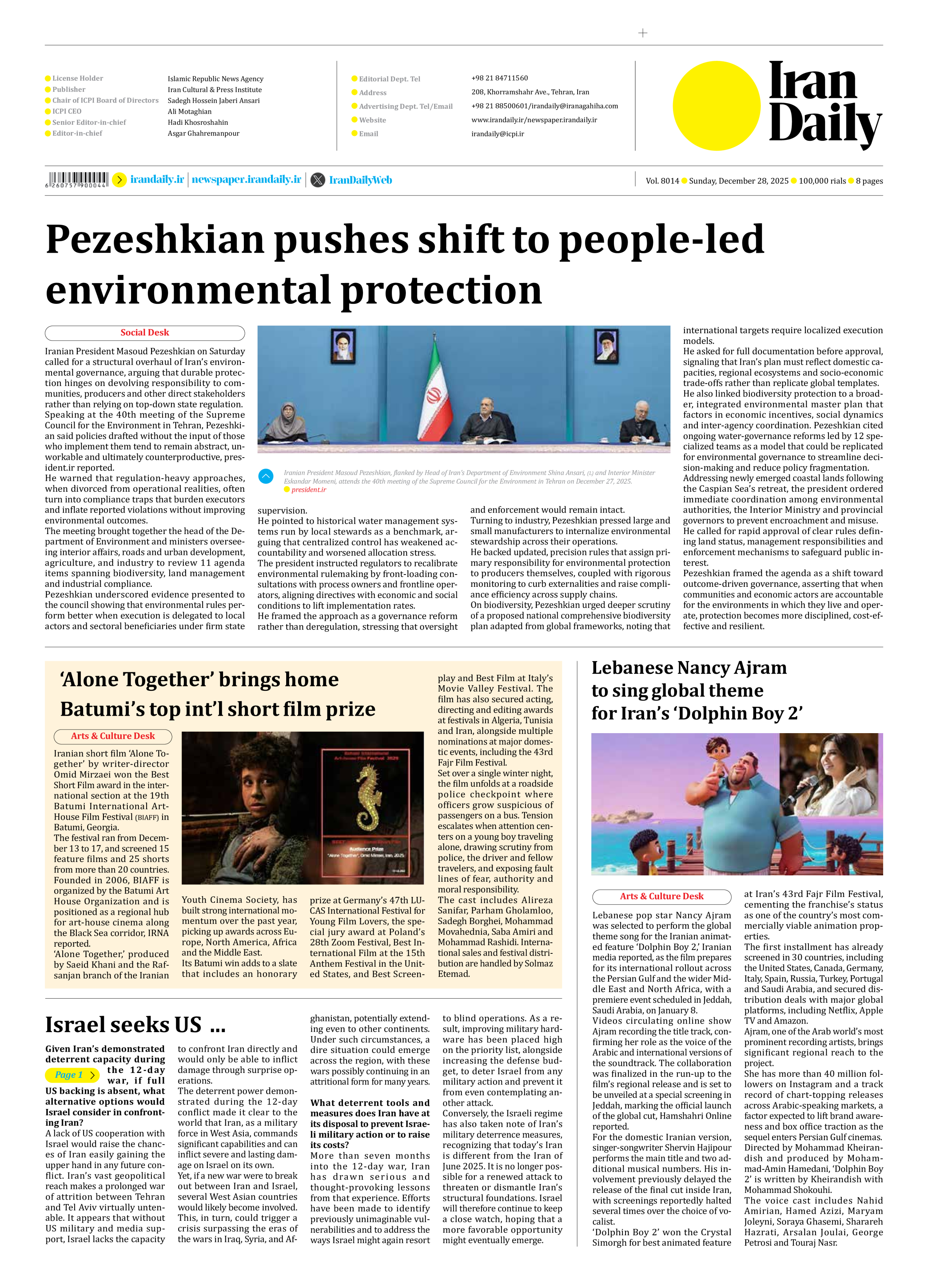
Speaking at the 40th meeting of the Supreme Council for the Environment in Tehran, Pezeshkian said policies drafted without the input of those who implement them tend to remain abstract, unworkable and ultimately counterproductive, president.ir reported.
He warned that regulation-heavy approaches, when divorced from operational realities, often turn into compliance traps that burden executors and inflate reported violations without improving environmental outcomes.
The meeting brought together the head of the Department of Environment and ministers overseeing interior affairs, roads and urban development, agriculture, and industry to review 11 agenda items spanning biodiversity, land management and industrial compliance.
Pezeshkian underscored evidence presented to the council showing that environmental rules perform better when execution is delegated to local actors and sectoral beneficiaries under firm state supervision.
He pointed to historical water management systems run by local stewards as a benchmark, arguing that centralized control has weakened accountability and worsened allocation stress.
The president instructed regulators to recalibrate environmental rulemaking by front-loading consultations with process owners and frontline operators, aligning directives with economic and social conditions to lift implementation rates.
He framed the approach as a governance reform rather than deregulation, stressing that oversight and enforcement would remain intact.
Turning to industry, Pezeshkian pressed large and small manufacturers to internalize environmental stewardship across their operations.
He backed updated, precision rules that assign primary responsibility for environmental protection to producers themselves, coupled with rigorous monitoring to curb externalities and raise compliance efficiency across supply chains.
On biodiversity, Pezeshkian urged deeper scrutiny of a proposed national comprehensive biodiversity plan adapted from global frameworks, noting that international targets require localized execution models.
He asked for full documentation before approval, signaling that Iran’s plan must reflect domestic capacities, regional ecosystems and socio-economic trade-offs rather than replicate global templates.
He also linked biodiversity protection to a broader, integrated environmental master plan that factors in economic incentives, social dynamics and inter-agency coordination. Pezeshkian cited ongoing water-governance reforms led by 12 specialized teams as a model that could be replicated for environmental governance to streamline decision-making and reduce policy fragmentation.
Addressing newly emerged coastal lands following the Caspian Sea’s retreat, the president ordered immediate coordination among environmental authorities, the Interior Ministry and provincial governors to prevent encroachment and misuse.
He called for rapid approval of clear rules defining land status, management responsibilities and enforcement mechanisms to safeguard public interest.
Pezeshkian framed the agenda as a shift toward outcome-driven governance, asserting that when communities and economic actors are accountable for the environments in which they live and operate, protection becomes more disciplined, cost-effective and resilient.