





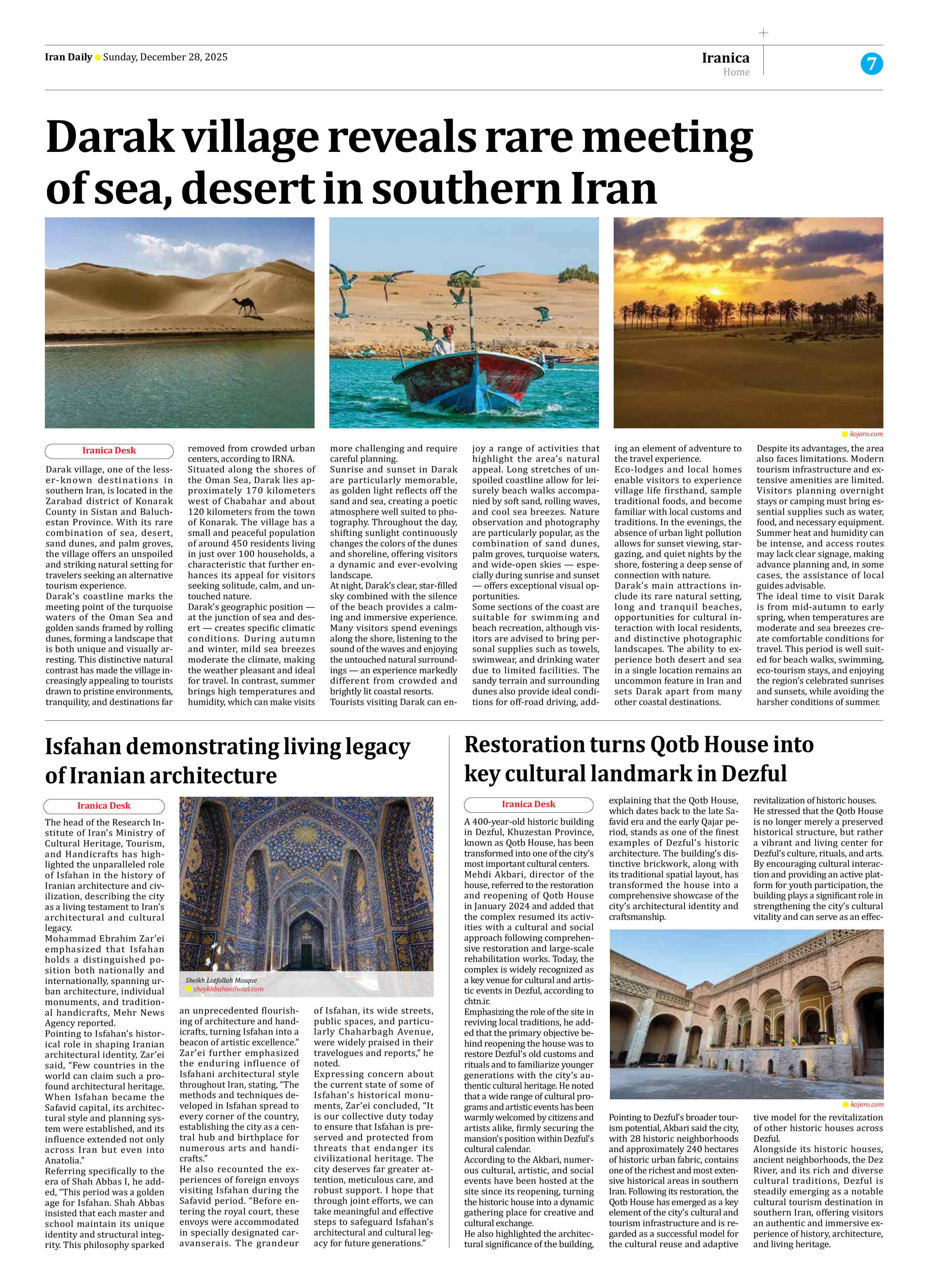


Isfahan demonstrating living legacy of Iranian architecture
The head of the Research Institute of Iran’s Ministry of Cultural Heritage, Tourism, and Handicrafts has highlighted the unparalleled role of Isfahan in the history of Iranian architecture and civilization, describing the city as a living testament to Iran’s architectural and cultural legacy.
Mohammad Ebrahim Zar’ei emphasized that Isfahan holds a distinguished position both nationally and internationally, spanning urban architecture, individual monuments, and traditional handicrafts, Mehr News Agency reported.
Pointing to Isfahan’s historical role in shaping Iranian architectural identity, Zar’ei said, “Few countries in the world can claim such a profound architectural heritage. When Isfahan became the Safavid capital, its architectural style and planning system were established, and its influence extended not only across Iran but even into Anatolia.”
Referring specifically to the era of Shah Abbas I, he added, “This period was a golden age for Isfahan. Shah Abbas insisted that each master and school maintain its unique identity and structural integrity. This philosophy sparked an unprecedented flourishing of architecture and handicrafts, turning Isfahan into a beacon of artistic excellence.”
Zar’ei further emphasized the enduring influence of Isfahani architectural style throughout Iran, stating, “The methods and techniques developed in Isfahan spread to every corner of the country, establishing the city as a central hub and birthplace for numerous arts and handicrafts.”
He also recounted the experiences of foreign envoys visiting Isfahan during the Safavid period. “Before entering the royal court, these envoys were accommodated in specially designated caravanserais. The grandeur of Isfahan, its wide streets, public spaces, and particularly Chaharbagh Avenue, were widely praised in their travelogues and reports,” he noted.
Expressing concern about the current state of some of Isfahan’s historical monuments, Zar’ei concluded, “It is our collective duty today to ensure that Isfahan is preserved and protected from threats that endanger its civilizational heritage. The city deserves far greater attention, meticulous care, and robust support. I hope that through joint efforts, we can take meaningful and effective steps to safeguard Isfahan’s architectural and cultural legacy for future generations.”