





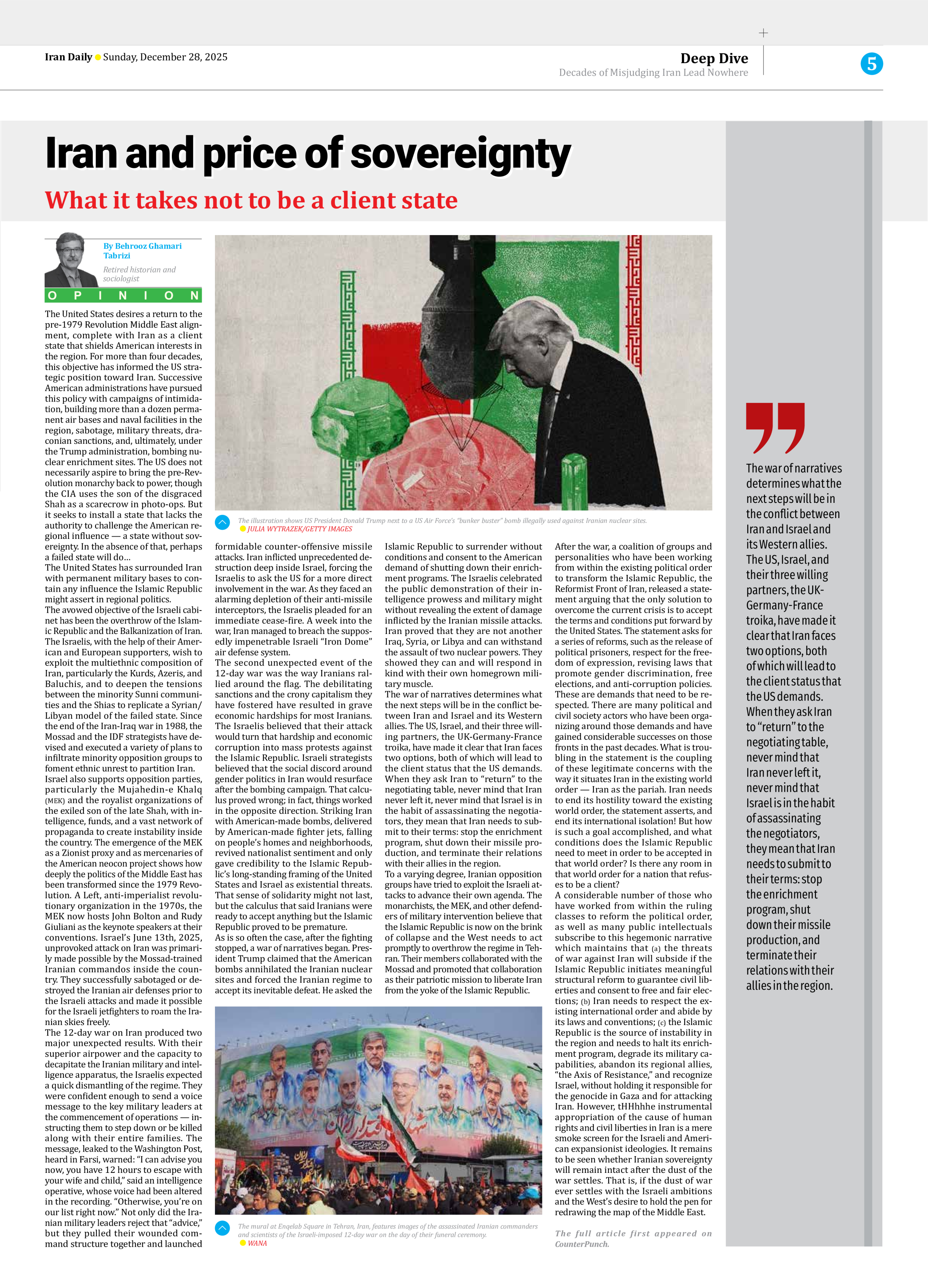


Iran and price of sovereignty
What it takes not to be a client state
By Behrooz Ghamari Tabrizi
Retired historian and sociologist
The United States desires a return to the pre-1979 Revolution Middle East alignment, complete with Iran as a client state that shields American interests in the region. For more than four decades, this objective has informed the US strategic position toward Iran. Successive American administrations have pursued this policy with campaigns of intimidation, building more than a dozen permanent air bases and naval facilities in the region, sabotage, military threats, draconian sanctions, and, ultimately, under the Trump administration, bombing nuclear enrichment sites. The US does not necessarily aspire to bring the pre-Revolution monarchy back to power, though the CIA uses the son of the disgraced Shah as a scarecrow in photo-ops. But it seeks to install a state that lacks the authority to challenge the American regional influence — a state without sovereignty. In the absence of that, perhaps a failed state will do…
The United States has surrounded Iran with permanent military bases to contain any influence the Islamic Republic might assert in regional politics.
The avowed objective of the Israeli cabinet has been the overthrow of the Islamic Republic and the Balkanization of Iran. The Israelis, with the help of their American and European supporters, wish to exploit the multiethnic composition of Iran, particularly the Kurds, Azeris, and Baluchis, and to deepen the tensions between the minority Sunni communities and the Shias to replicate a Syrian/Libyan model of the failed state. Since the end of the Iran-Iraq war in 1988, the Mossad and the IDF strategists have devised and executed a variety of plans to infiltrate minority opposition groups to foment ethnic unrest to partition Iran.
Israel also supports opposition parties, particularly the Mujahedin-e Khalq (MEK) and the royalist organizations of the exiled son of the late Shah, with intelligence, funds, and a vast network of propaganda to create instability inside the country. The emergence of the MEK as a Zionist proxy and as mercenaries of the American neocon project shows how deeply the politics of the Middle East has been transformed since the 1979 Revolution. A Left, anti-imperialist revolutionary organization in the 1970s, the MEK now hosts John Bolton and Rudy Giuliani as the keynote speakers at their conventions. Israel’s June 13th, 2025, unprovoked attack on Iran was primarily made possible by the Mossad-trained Iranian commandos inside the country. They successfully sabotaged or destroyed the Iranian air defenses prior to the Israeli attacks and made it possible for the Israeli jetfighters to roam the Iranian skies freely.
The 12-day war on Iran produced two major unexpected results. With their superior airpower and the capacity to decapitate the Iranian military and intelligence apparatus, the Israelis expected a quick dismantling of the regime. They were confident enough to send a voice message to the key military leaders at the commencement of operations — instructing them to step down or be killed along with their entire families. The message, leaked to the Washington Post, heard in Farsi, warned: “I can advise you now, you have 12 hours to escape with your wife and child,” said an intelligence operative, whose voice had been altered in the recording. “Otherwise, you’re on our list right now.” Not only did the Iranian military leaders reject that “advice,” but they pulled their wounded command structure together and launched formidable counter-offensive missile attacks. Iran inflicted unprecedented destruction deep inside Israel, forcing the Israelis to ask the US for a more direct involvement in the war. As they faced an alarming depletion of their anti-missile interceptors, the Israelis pleaded for an immediate cease-fire. A week into the war, Iran managed to breach the supposedly impenetrable Israeli “Iron Dome” air defense system.
The second unexpected event of the 12-day war was the way Iranians rallied around the flag. The debilitating sanctions and the crony capitalism they have fostered have resulted in grave economic hardships for most Iranians. The Israelis believed that their attack would turn that hardship and economic corruption into mass protests against the Islamic Republic. Israeli strategists believed that the social discord around gender politics in Iran would resurface after the bombing campaign. That calculus proved wrong; in fact, things worked in the opposite direction. Striking Iran with American-made bombs, delivered by American-made fighter jets, falling on people’s homes and neighborhoods, revived nationalist sentiment and only gave credibility to the Islamic Republic’s long-standing framing of the United States and Israel as existential threats. That sense of solidarity might not last, but the calculus that said Iranians were ready to accept anything but the Islamic Republic proved to be premature.
As is so often the case, after the fighting stopped, a war of narratives began. President Trump claimed that the American bombs annihilated the Iranian nuclear sites and forced the Iranian regime to accept its inevitable defeat. He asked the Islamic Republic to surrender without conditions and consent to the American demand of shutting down their enrichment programs. The Israelis celebrated the public demonstration of their intelligence prowess and military might without revealing the extent of damage inflicted by the Iranian missile attacks. Iran proved that they are not another Iraq, Syria, or Libya and can withstand the assault of two nuclear powers. They showed they can and will respond in kind with their own homegrown military muscle.
The war of narratives determines what the next steps will be in the conflict between Iran and Israel and its Western allies. The US, Israel, and their three willing partners, the UK-Germany-France troika, have made it clear that Iran faces two options, both of which will lead to the client status that the US demands. When they ask Iran to “return” to the negotiating table, never mind that Iran never left it, never mind that Israel is in the habit of assassinating the negotiators, they mean that Iran needs to submit to their terms: stop the enrichment program, shut down their missile production, and terminate their relations with their allies in the region.
To a varying degree, Iranian opposition groups have tried to exploit the Israeli attacks to advance their own agenda. The monarchists, the MEK, and other defenders of military intervention believe that the Islamic Republic is now on the brink of collapse and the West needs to act promptly to overthrow the regime in Tehran. Their members collaborated with the Mossad and promoted that collaboration as their patriotic mission to liberate Iran from the yoke of the Islamic Republic.
After the war, a coalition of groups and personalities who have been working from within the existing political order to transform the Islamic Republic, the Reformist Front of Iran, released a statement arguing that the only solution to overcome the current crisis is to accept the terms and conditions put forward by the United States. The statement asks for a series of reforms, such as the release of political prisoners, respect for the freedom of expression, revising laws that promote gender discrimination, free elections, and anti-corruption policies. These are demands that need to be respected. There are many political and civil society actors who have been organizing around those demands and have gained considerable successes on those fronts in the past decades. What is troubling in the statement is the coupling of these legitimate concerns with the way it situates Iran in the existing world order — Iran as the pariah. Iran needs to end its hostility toward the existing world order, the statement asserts, and end its international isolation! But how is such a goal accomplished, and what conditions does the Islamic Republic need to meet in order to be accepted in that world order? Is there any room in that world order for a nation that refuses to be a client?
A considerable number of those who have worked from within the ruling classes to reform the political order, as well as many public intellectuals subscribe to this hegemonic narrative which maintains that (a) the threats of war against Iran will subside if the Islamic Republic initiates meaningful structural reform to guarantee civil liberties and consent to free and fair elections; (b) Iran needs to respect the existing international order and abide by its laws and conventions; (c) the Islamic Republic is the source of instability in the region and needs to halt its enrichment program, degrade its military capabilities, abandon its regional allies, “the Axis of Resistance,” and recognize Israel, without holding it responsible for the genocide in Gaza and for attacking Iran. However, tHHhhhe instrumental appropriation of the cause of human rights and civil liberties in Iran is a mere smoke screen for the Israeli and American expansionist ideologies. It remains to be seen whether Iranian sovereignty will remain intact after the dust of the war settles. That is, if the dust of war ever settles with the Israeli ambitions and the West’s desire to hold the pen for redrawing the map of the Middle East.
The full article first appeared on
CounterPunch.