







When narratives make negotiation impossible
Iran, West, and politics of misunderstanding
By Asgar Ghahremanpour
Editor-in-chief
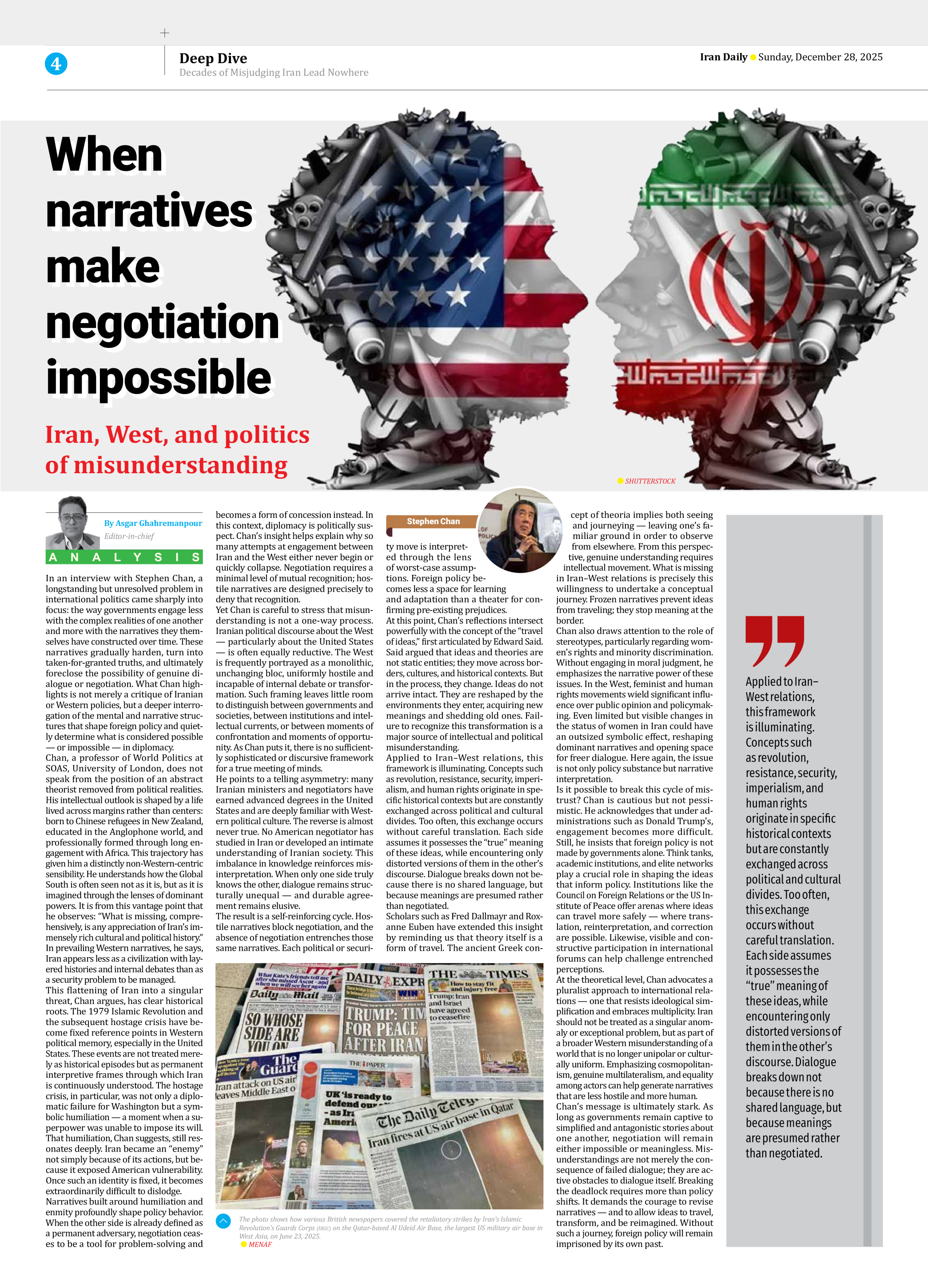
In an interview with Stephen Chan, a longstanding but unresolved problem in international politics came sharply into focus: the way governments engage less with the complex realities of one another and more with the narratives they themselves have constructed over time. These narratives gradually harden, turn into taken-for-granted truths, and ultimately foreclose the possibility of genuine dialogue or negotiation. What Chan highlights is not merely a critique of Iranian or Western policies, but a deeper interrogation of the mental and narrative structures that shape foreign policy and quietly determine what is considered possible — or impossible — in diplomacy.
Chan, a professor of World Politics at SOAS, University of London, does not speak from the position of an abstract theorist removed from political realities. His intellectual outlook is shaped by a life lived across margins rather than centers: born to Chinese refugees in New Zealand, educated in the Anglophone world, and professionally formed through long engagement with Africa. This trajectory has given him a distinctly non-Western-centric sensibility. He understands how the Global South is often seen not as it is, but as it is imagined through the lenses of dominant powers. It is from this vantage point that he observes: “What is missing, comprehensively, is any appreciation of Iran’s immensely rich cultural and political history.” In prevailing Western narratives, he says, Iran appears less as a civilization with layered histories and internal debates than as a security problem to be managed.
This flattening of Iran into a singular threat, Chan argues, has clear historical roots. The 1979 Islamic Revolution and the subsequent hostage crisis have become fixed reference points in Western political memory, especially in the United States. These events are not treated merely as historical episodes but as permanent interpretive frames through which Iran is continuously understood. The hostage crisis, in particular, was not only a diplomatic failure for Washington but a symbolic humiliation — a moment when a superpower was unable to impose its will. That humiliation, Chan suggests, still resonates deeply. Iran became an “enemy” not simply because of its actions, but because it exposed American vulnerability. Once such an identity is fixed, it becomes extraordinarily difficult to dislodge.
Narratives built around humiliation and enmity profoundly shape policy behavior. When the other side is already defined as a permanent adversary, negotiation ceases to be a tool for problem-solving and becomes a form of concession instead. In this context, diplomacy is politically suspect. Chan’s insight helps explain why so many attempts at engagement between Iran and the West either never begin or quickly collapse. Negotiation requires a minimal level of mutual recognition; hostile narratives are designed precisely to deny that recognition.
Yet Chan is careful to stress that misunderstanding is not a one-way process. Iranian political discourse about the West — particularly about the United States — is often equally reductive. The West is frequently portrayed as a monolithic, unchanging bloc, uniformly hostile and incapable of internal debate or transformation. Such framing leaves little room to distinguish between governments and societies, between institutions and intellectual currents, or between moments of confrontation and moments of opportunity. As Chan puts it, there is no sufficiently sophisticated or discursive framework for a true meeting of minds.
He points to a telling asymmetry: many Iranian ministers and negotiators have earned advanced degrees in the United States and are deeply familiar with Western political culture. The reverse is almost never true. No American negotiator has studied in Iran or developed an intimate understanding of Iranian society. This imbalance in knowledge reinforces misinterpretation. When only one side truly knows the other, dialogue remains structurally unequal — and durable agreement remains elusive.
The result is a self-reinforcing cycle. Hostile narratives block negotiation, and the absence of negotiation entrenches those same narratives. Each political or security move is interpreted through the lens of worst-case assumptions. Foreign policy becomes less a space for learning and adaptation than a theater for confirming pre-existing prejudices.
At this point, Chan’s reflections intersect powerfully with the concept of the “travel of ideas,” first articulated by Edward Said. Said argued that ideas and theories are not static entities; they move across borders, cultures, and historical contexts. But in the process, they change. Ideas do not arrive intact. They are reshaped by the environments they enter, acquiring new meanings and shedding old ones. Failure to recognize this transformation is a major source of intellectual and political misunderstanding.
Applied to Iran–West relations, this framework is illuminating. Concepts such as revolution, resistance, security, imperialism, and human rights originate in specific historical contexts but are constantly exchanged across political and cultural divides. Too often, this exchange occurs without careful translation. Each side assumes it possesses the “true” meaning of these ideas, while encountering only distorted versions of them in the other’s discourse. Dialogue breaks down not because there is no shared language, but because meanings are presumed rather than negotiated.
Scholars such as Fred Dallmayr and Roxanne Euben have extended this insight by reminding us that theory itself is a form of travel. The ancient Greek concept of theoria implies both seeing and journeying — leaving one’s familiar ground in order to observe from elsewhere. From this perspective, genuine understanding requires intellectual movement. What is missing in Iran–West relations is precisely this willingness to undertake a conceptual journey. Frozen narratives prevent ideas from traveling; they stop meaning at the border.
Chan also draws attention to the role of stereotypes, particularly regarding women’s rights and minority discrimination. Without engaging in moral judgment, he emphasizes the narrative power of these issues. In the West, feminist and human rights movements wield significant influence over public opinion and policymaking. Even limited but visible changes in the status of women in Iran could have an outsized symbolic effect, reshaping dominant narratives and opening space for freer dialogue. Here again, the issue is not only policy substance but narrative interpretation.
Is it possible to break this cycle of mistrust? Chan is cautious but not pessimistic. He acknowledges that under administrations such as Donald Trump’s, engagement becomes more difficult. Still, he insists that foreign policy is not made by governments alone. Think tanks, academic institutions, and elite networks play a crucial role in shaping the ideas that inform policy. Institutions like the Council on Foreign Relations or the US Institute of Peace offer arenas where ideas can travel more safely — where translation, reinterpretation, and correction are possible. Likewise, visible and constructive participation in international forums can help challenge entrenched perceptions.
At the theoretical level, Chan advocates a pluralist approach to international relations — one that resists ideological simplification and embraces multiplicity. Iran should not be treated as a singular anomaly or exceptional problem, but as part of a broader Western misunderstanding of a world that is no longer unipolar or culturally uniform. Emphasizing cosmopolitanism, genuine multilateralism, and equality among actors can help generate narratives that are less hostile and more human.
Chan’s message is ultimately stark. As long as governments remain captive to simplified and antagonistic stories about one another, negotiation will remain either impossible or meaningless. Misunderstandings are not merely the consequence of failed dialogue; they are active obstacles to dialogue itself. Breaking the deadlock requires more than policy shifts. It demands the courage to revise narratives — and to allow ideas to travel, transform, and be reimagined. Without such a journey, foreign policy will remain imprisoned by its own past.