







Copy in clipboard...
Minister: Education, culture, not oil, will drive Iran’s future
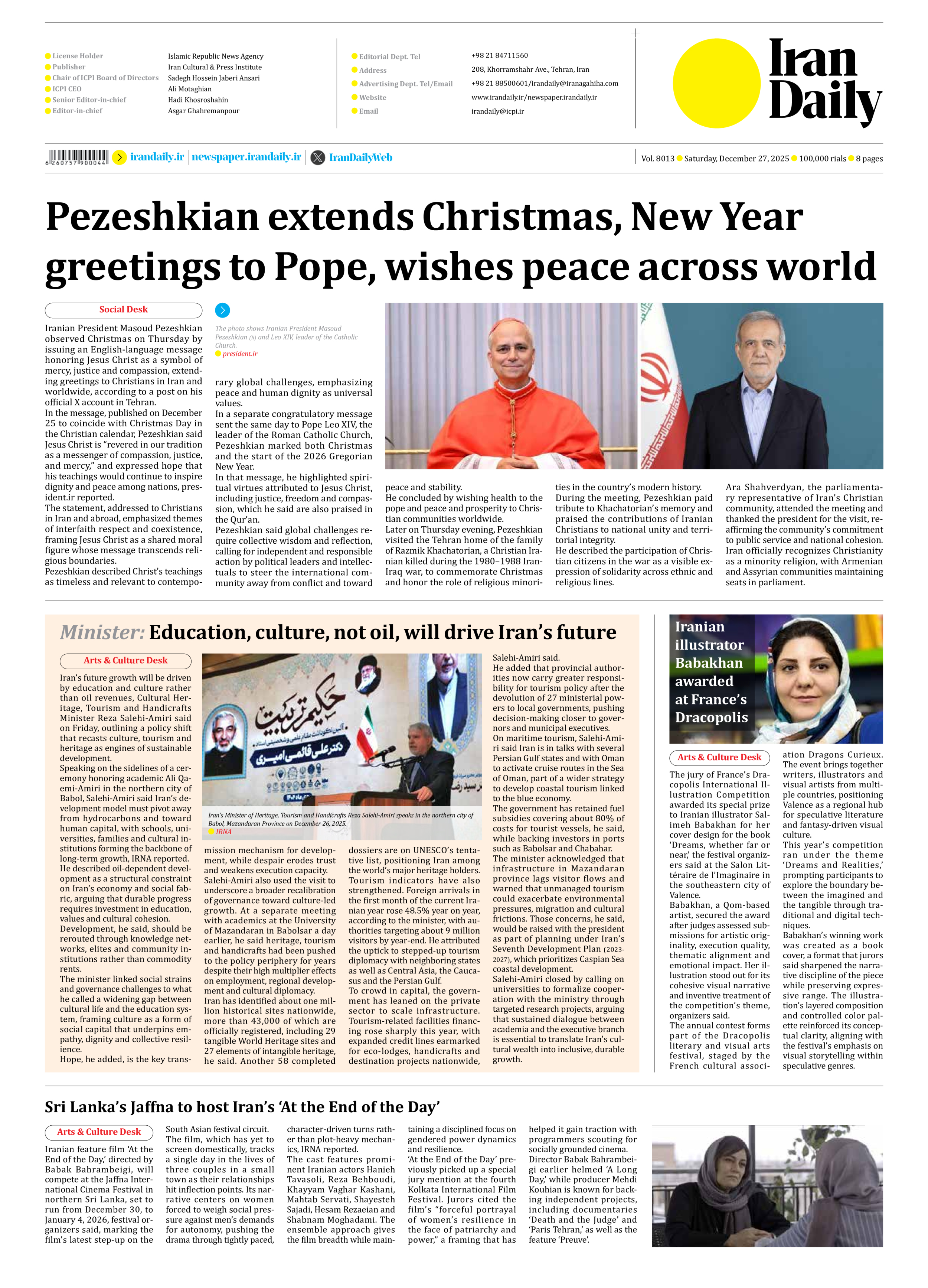
Speaking on the sidelines of a ceremony honoring academic Ali Qaemi-Amiri in the northern city of Babol, Salehi-Amiri said Iran’s development model must pivot away from hydrocarbons and toward human capital, with schools, universities, families and cultural institutions forming the backbone of long-term growth, IRNA reported.
He described oil-dependent development as a structural constraint on Iran’s economy and social fabric, arguing that durable progress requires investment in education, values and cultural cohesion.
Development, he said, should be rerouted through knowledge networks, elites and community institutions rather than commodity rents.
The minister linked social strains and governance challenges to what he called a widening gap between cultural life and the education system, framing culture as a form of social capital that underpins empathy, dignity and collective resilience.
Hope, he added, is the key transmission mechanism for development, while despair erodes trust and weakens execution capacity.
Salehi-Amiri also used the visit to underscore a broader recalibration of governance toward culture-led growth. At a separate meeting with academics at the University of Mazandaran in Babolsar a day earlier, he said heritage, tourism and handicrafts had been pushed to the policy periphery for years despite their high multiplier effects on employment, regional development and cultural diplomacy.
Iran has identified about one million historical sites nationwide, more than 43,000 of which are officially registered, including 29 tangible World Heritage sites and 27 elements of intangible heritage, he said. Another 58 completed dossiers are on UNESCO’s tentative list, positioning Iran among the world’s major heritage holders.
Tourism indicators have also strengthened. Foreign arrivals in the first month of the current Iranian year rose 48.5% year on year, according to the minister, with authorities targeting about 9 million visitors by year-end. He attributed the uptick to stepped-up tourism diplomacy with neighboring states as well as Central Asia, the Caucasus and the Persian Gulf.
To crowd in capital, the government has leaned on the private sector to scale infrastructure. Tourism-related facilities financing rose sharply this year, with expanded credit lines earmarked for eco-lodges, handicrafts and destination projects nationwide, Salehi-Amiri said.
He added that provincial authorities now carry greater responsibility for tourism policy after the devolution of 27 ministerial powers to local governments, pushing decision-making closer to governors and municipal executives.
On maritime tourism, Salehi-Amiri said Iran is in talks with several Persian Gulf states and with Oman to activate cruise routes in the Sea of Oman, part of a wider strategy to develop coastal tourism linked to the blue economy.
The government has retained fuel subsidies covering about 80% of costs for tourist vessels, he said, while backing investors in ports such as Babolsar and Chabahar.
The minister acknowledged that infrastructure in Mazandaran province lags visitor flows and warned that unmanaged tourism could exacerbate environmental pressures, migration and cultural frictions. Those concerns, he said, would be raised with the president as part of planning under Iran’s Seventh Development Plan (2023-2027), which prioritizes Caspian Sea coastal development.
Salehi-Amiri closed by calling on universities to formalize cooperation with the ministry through targeted research projects, arguing that sustained dialogue between academia and the executive branch is essential to translate Iran’s cultural wealth into inclusive, durable growth.