







Tehran’s interests in Central Asia
Goals, challenges, and opportunities
By Muhammad Shamauddinov
Expert on international affairs
On December 11 of this year, the president of Iran made an official visit to Kazakhstan in Astana, highlighting Tehran’s growing focus on Central Asia amid intensifying global competition. For Kazakhstan and its neighbors, the visit underscored why the region matters to Iran and the opportunities and constraints shaping that engagement.
Central Asia has become an increasingly dynamic arena, firmly on the radar of major powers. Over the past year, high-level summits in the C5+1 format were held with the European Union (EU), China, Russia, and the United States, followed by Japan on December 19–20. Turkey and Azerbaijan have also strengthened their presence, including through the October summit of the Organization of Turkic States (OTS) and Azerbaijan’s accession as a full member of the consultative meetings of Central Asian heads of state.
Therefore, Iran cannot afford to ignore developments north of its borders. Growing international attention to Central Asia is prompting Tehran to intensify its political, economic, and diplomatic engagement in the region.
One of Iran’s primary interests in Central Asia is to ease its long-standing political, diplomatic, and economic isolation. Strengthening its position in Central Asia would provide Tehran with the diplomatic support it urgently needs and, to some extent, an economic breakthrough from the blockade.
During talks in Astana, President Kassym-Jomart Tokayev and Iranian President Masoud Pezeshkian expressed concern over the escalation of international conflicts and the impact of sanctions. Tokayev noted that Kazakhstan’s and Iran’s positions often align on the international stage. While no specific situations were cited, such statements carry particular weight for Tehran in the context of its recent war with Israel and the US and the broader tensions that persist.
Sanctions continue to constrain Iran’s trade and economy, increasing the importance of access to Central Asian markets and the development of transport and logistics links. During the visit, the two leaders agreed to increase bilateral trade to $3 billion, up from $340 million in 2024. Pezeshkian said trade had grown by 40%, while Tokayev noted that more than 350 enterprises with Iranian capital operate in Kazakhstan.
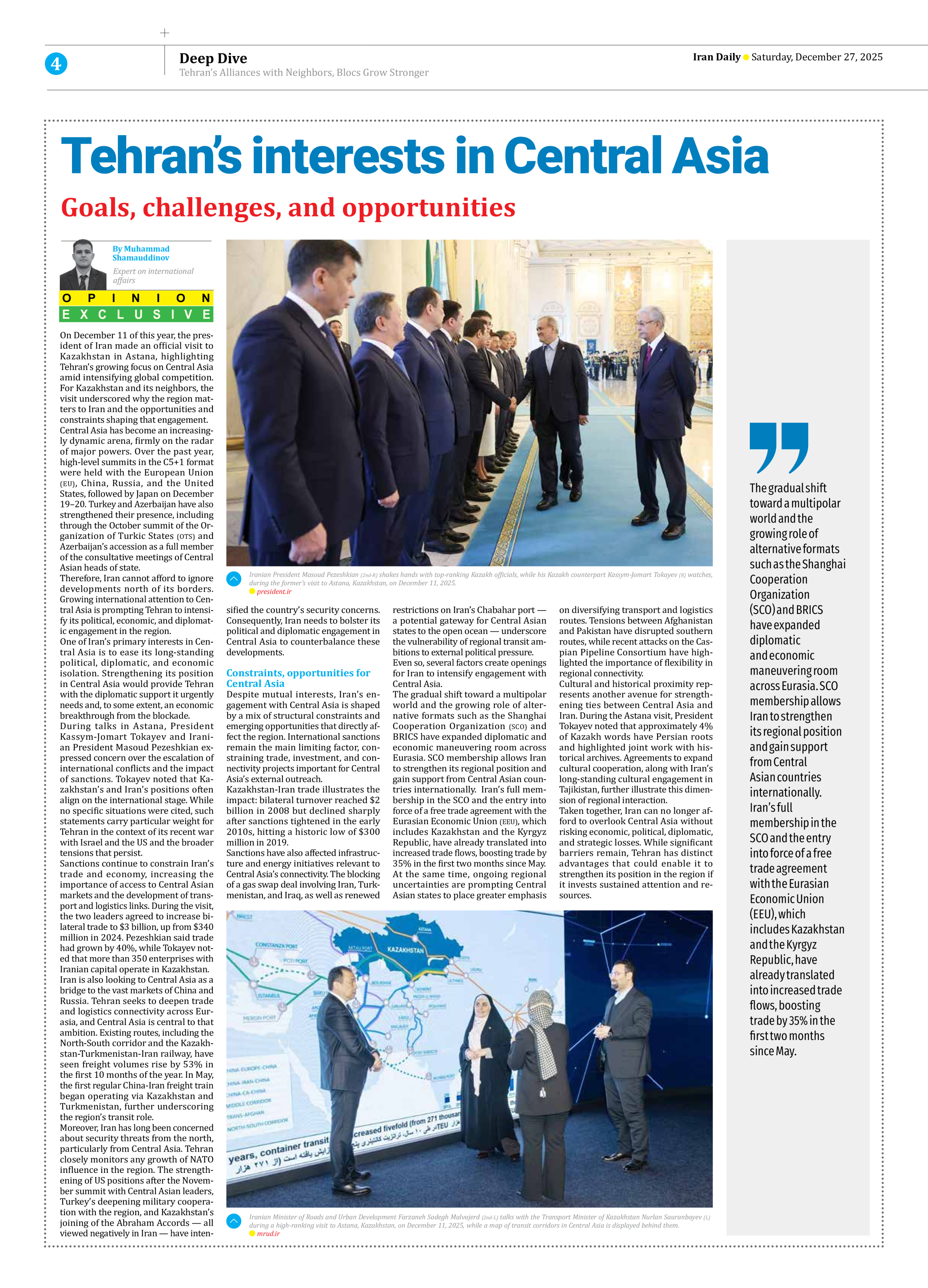
Iran is also looking to Central Asia as a bridge to the vast markets of China and Russia. Tehran seeks to deepen trade and logistics connectivity across Eurasia, and Central Asia is central to that ambition. Existing routes, including the North-South corridor and the Kazakhstan-Turkmenistan-Iran railway, have seen freight volumes rise by 53% in the first 10 months of the year. In May, the first regular China-Iran freight train began operating via Kazakhstan and Turkmenistan, further underscoring the region’s transit role.
Moreover, Iran has long been concerned about security threats from the north, particularly from Central Asia. Tehran closely monitors any growth of NATO influence in the region. The strengthening of US positions after the November summit with Central Asian leaders, Turkey’s deepening military cooperation with the region, and Kazakhstan’s joining of the Abraham Accords — all viewed negatively in Iran — have intensified the country’s security concerns. Consequently, Iran needs to bolster its political and diplomatic engagement in Central Asia to counterbalance these developments.
Constraints, opportunities for Central Asia
Despite mutual interests, Iran’s engagement with Central Asia is shaped by a mix of structural constraints and emerging opportunities that directly affect the region. International sanctions remain the main limiting factor, constraining trade, investment, and connectivity projects important for Central Asia’s external outreach.
Kazakhstan-Iran trade illustrates the impact: bilateral turnover reached $2 billion in 2008 but declined sharply after sanctions tightened in the early 2010s, hitting a historic low of $300 million in 2019.
Sanctions have also affected infrastructure and energy initiatives relevant to Central Asia’s connectivity. The blocking of a gas swap deal involving Iran, Turkmenistan, and Iraq, as well as renewed restrictions on Iran’s Chabahar port — a potential gateway for Central Asian states to the open ocean — underscore the vulnerability of regional transit ambitions to external political pressure.
Even so, several factors create openings for Iran to intensify engagement with Central Asia.
The gradual shift toward a multipolar world and the growing role of alternative formats such as the Shanghai Cooperation Organization (SCO) and BRICS have expanded diplomatic and economic maneuvering room across Eurasia. SCO membership allows Iran to strengthen its regional position and gain support from Central Asian countries internationally. Iran’s full membership in the SCO and the entry into force of a free trade agreement with the Eurasian Economic Union (EEU), which includes Kazakhstan and the Kyrgyz Republic, have already translated into increased trade flows, boosting trade by 35% in the first two months since May.
At the same time, ongoing regional uncertainties are prompting Central Asian states to place greater emphasis on diversifying transport and logistics routes. Tensions between Afghanistan and Pakistan have disrupted southern routes, while recent attacks on the Caspian Pipeline Consortium have highlighted the importance of flexibility in regional connectivity.
Cultural and historical proximity represents another avenue for strengthening ties between Central Asia and Iran. During the Astana visit, President Tokayev noted that approximately 4% of Kazakh words have Persian roots and highlighted joint work with historical archives. Agreements to expand cultural cooperation, along with Iran’s long-standing cultural engagement in Tajikistan, further illustrate this dimension of regional interaction.
Taken together, Iran can no longer afford to overlook Central Asia without risking economic, political, diplomatic, and strategic losses. While significant barriers remain, Tehran has distinct advantages that could enable it to strengthen its position in the region if it invests sustained attention and resources.