







Veep: Expanded energy trade to turn Iran into regional hub
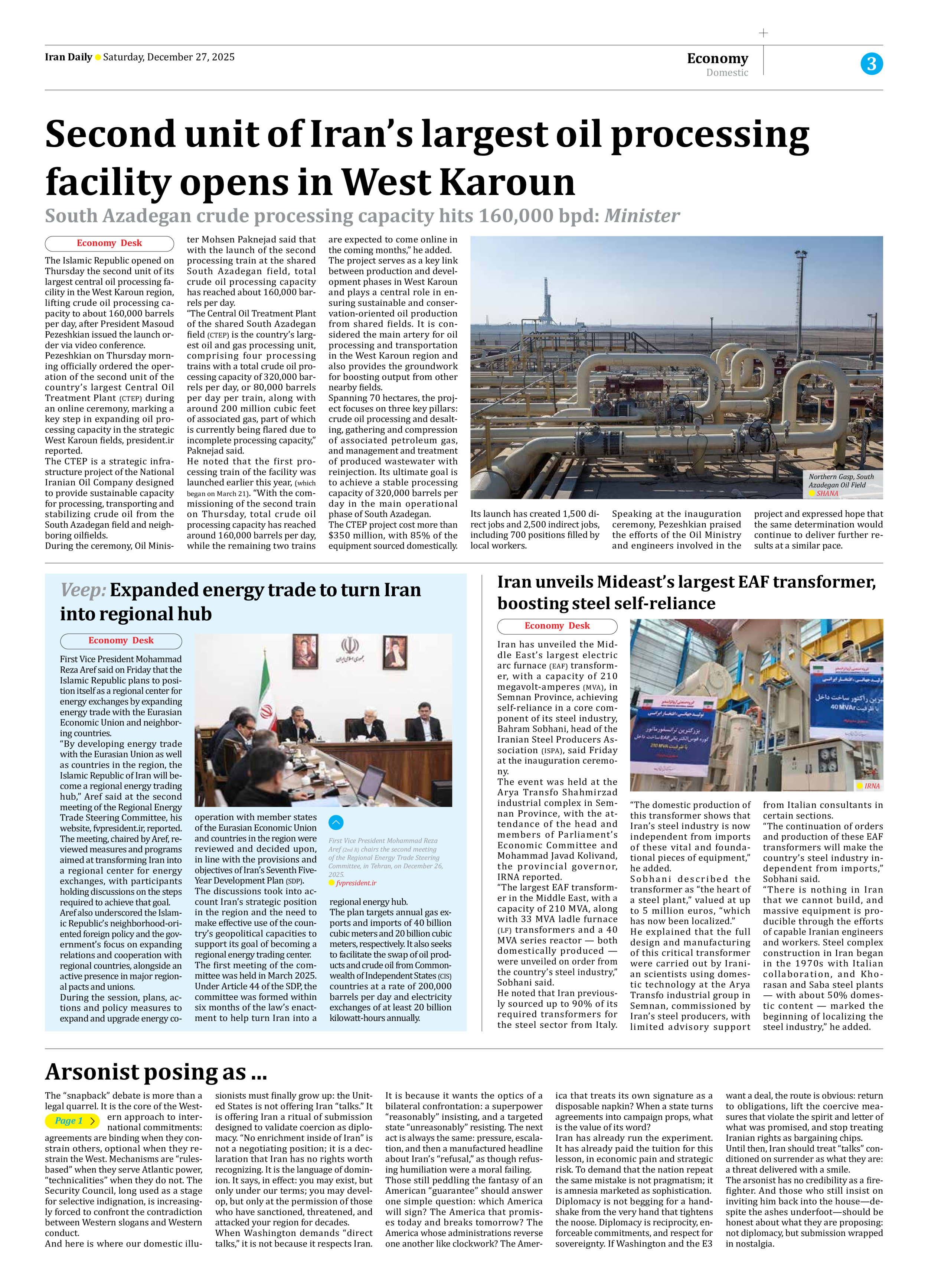
First Vice President Mohammad Reza Aref said on Friday that the Islamic Republic plans to position itself as a regional center for energy exchanges by expanding energy trade with the Eurasian Economic Union and neighboring countries.
“By developing energy trade with the Eurasian Union as well as countries in the region, the Islamic Republic of Iran will become a regional energy trading hub,” Aref said at the second meeting of the Regional Energy Trade Steering Committee, his website, fvpresident.ir, reported.
The meeting, chaired by Aref, reviewed measures and programs aimed at transforming Iran into a regional center for energy exchanges, with participants holding discussions on the steps required to achieve that goal.
Aref also underscored the Islamic Republic’s neighborhood-oriented foreign policy and the government’s focus on expanding relations and cooperation with regional countries, alongside an active presence in major regional pacts and unions.
During the session, plans, actions and policy measures to expand and upgrade energy cooperation with member states of the Eurasian Economic Union and countries in the region were reviewed and decided upon, in line with the provisions and objectives of Iran’s Seventh Five-Year Development Plan (SDP).
The discussions took into account Iran’s strategic position in the region and the need to make effective use of the country’s geopolitical capacities to support its goal of becoming a regional energy trading center.
The first meeting of the committee was held in March 2025. Under Article 44 of the SDP, the committee was formed within six months of the law’s enactment to help turn Iran into a regional energy hub.
The plan targets annual gas exports and imports of 40 billion cubic meters and 20 billion cubic meters, respectively. It also seeks to facilitate the swap of oil products and crude oil from Commonwealth of Independent States (CIS) countries at a rate of 200,000 barrels per day and electricity exchanges of at least 20 billion kilowatt-hours annually.