





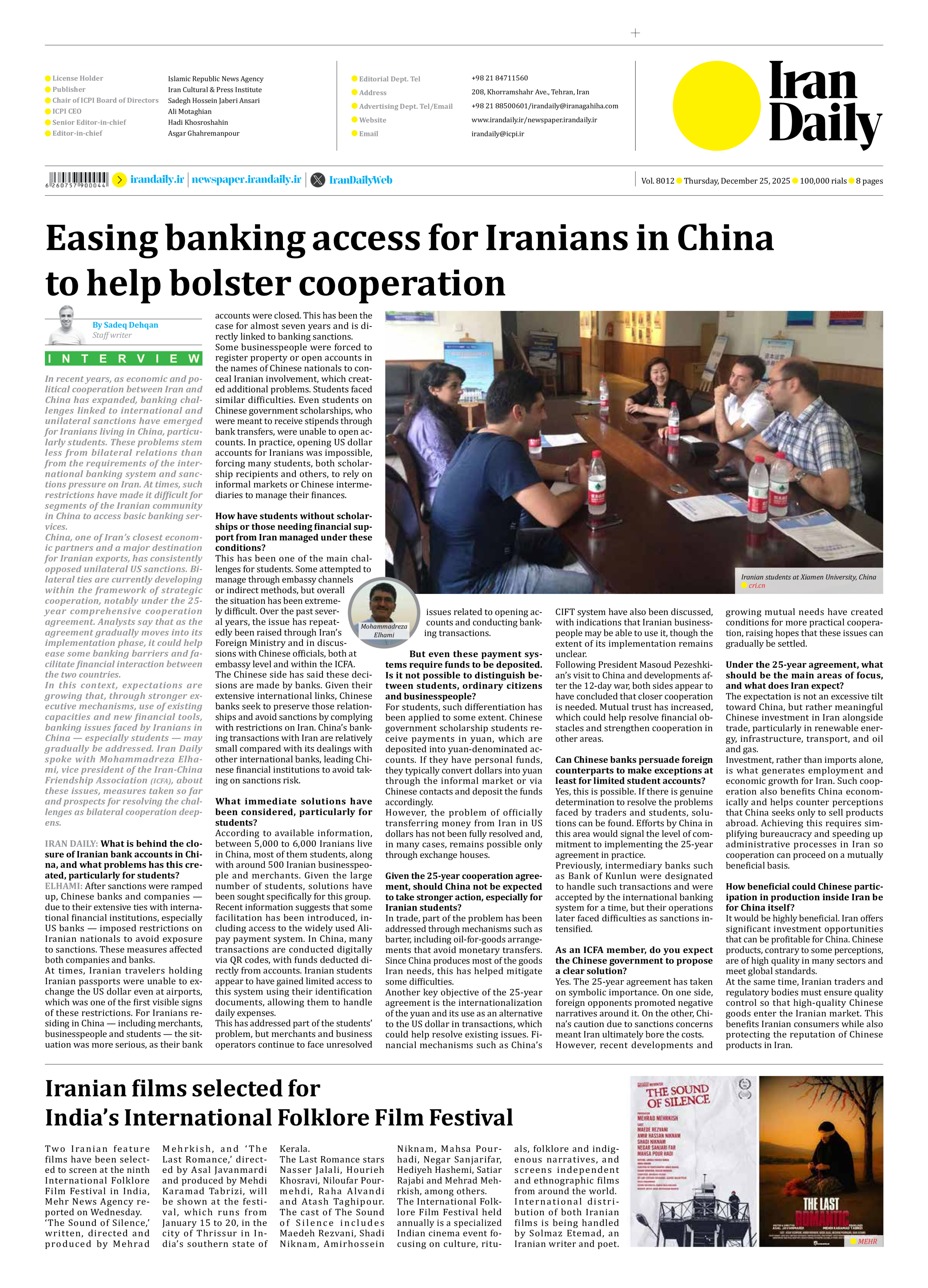


Easing banking access for Iranians in China to help bolster cooperation
By Sadeq Dehqan
Staff writer
In recent years, as economic and political cooperation between Iran and China has expanded, banking challenges linked to international and unilateral sanctions have emerged for Iranians living in China, particularly students. These problems stem less from bilateral relations than from the requirements of the international banking system and sanctions pressure on Iran. At times, such restrictions have made it difficult for segments of the Iranian community in China to access basic banking services.
China, one of Iran’s closest economic partners and a major destination for Iranian exports, has consistently opposed unilateral US sanctions. Bilateral ties are currently developing within the framework of strategic cooperation, notably under the 25-year comprehensive cooperation agreement. Analysts say that as the agreement gradually moves into its implementation phase, it could help ease some banking barriers and facilitate financial interaction between the two countries.
In this context, expectations are growing that, through stronger executive mechanisms, use of existing capacities and new financial tools, banking issues faced by Iranians in China — especially students — may gradually be addressed. Iran Daily spoke with Mohammadreza Elhami, vice president of the Iran-China Friendship Association (ICFA), about these issues, measures taken so far and prospects for resolving the challenges as bilateral cooperation deepens.
IRAN DAILY: What is behind the closure of Iranian bank accounts in China, and what problems has this created, particularly for students?
ELHAMI: After sanctions were ramped up, Chinese banks and companies — due to their extensive ties with international financial institutions, especially US banks — imposed restrictions on Iranian nationals to avoid exposure to sanctions. These measures affected both companies and banks.
At times, Iranian travelers holding Iranian passports were unable to exchange the US dollar even at airports, which was one of the first visible signs of these restrictions. For Iranians residing in China — including merchants, businesspeople and students — the situation was more serious, as their bank accounts were closed. This has been the case for almost seven years and is directly linked to banking sanctions.
Some businesspeople were forced to register property or open accounts in the names of Chinese nationals to conceal Iranian involvement, which created additional problems. Students faced similar difficulties. Even students on Chinese government scholarships, who were meant to receive stipends through bank transfers, were unable to open accounts. In practice, opening US dollar accounts for Iranians was impossible, forcing many students, both scholarship recipients and others, to rely on informal markets or Chinese intermediaries to manage their finances.
How have students without scholarships or those needing financial support from Iran managed under these conditions?
This has been one of the main challenges for students. Some attempted to manage through embassy channels or indirect methods, but overall the situation has been extremely difficult. Over the past several years, the issue has repeatedly been raised through Iran’s Foreign Ministry and in discussions with Chinese officials, both at embassy level and within the ICFA.
The Chinese side has said these decisions are made by banks. Given their extensive international links, Chinese banks seek to preserve those relationships and avoid sanctions by complying with restrictions on Iran. China’s banking transactions with Iran are relatively small compared with its dealings with other international banks, leading Chinese financial institutions to avoid taking on sanctions risk.
What immediate solutions have been considered, particularly for students?
According to available information, between 5,000 to 6,000 Iranians live in China, most of them students, along with around 500 Iranian businesspeople and merchants. Given the large number of students, solutions have been sought specifically for this group.
Recent information suggests that some facilitation has been introduced, including access to the widely used Alipay payment system. In China, many transactions are conducted digitally via QR codes, with funds deducted directly from accounts. Iranian students appear to have gained limited access to this system using their identification documents, allowing them to handle daily expenses.
This has addressed part of the students’ problem, but merchants and business operators continue to face unresolved issues related to opening accounts and conducting banking transactions.
But even these payment systems require funds to be deposited. Is it not possible to distinguish between students, ordinary citizens and businesspeople?
For students, such differentiation has been applied to some extent. Chinese government scholarship students receive payments in yuan, which are deposited into yuan-denominated accounts. If they have personal funds, they typically convert dollars into yuan through the informal market or via Chinese contacts and deposit the funds accordingly.
However, the problem of officially transferring money from Iran in US dollars has not been fully resolved and, in many cases, remains possible only through exchange houses.
Given the 25-year cooperation agreement, should China not be expected to take stronger action, especially for Iranian students?
In trade, part of the problem has been addressed through mechanisms such as barter, including oil-for-goods arrangements that avoid monetary transfers. Since China produces most of the goods Iran needs, this has helped mitigate some difficulties.
Another key objective of the 25-year agreement is the internationalization of the yuan and its use as an alternative to the US dollar in transactions, which could help resolve existing issues. Financial mechanisms such as China’s CIFT system have also been discussed, with indications that Iranian businesspeople may be able to use it, though the extent of its implementation remains unclear.
Following President Masoud Pezeshkian’s visit to China and developments after the 12-day war, both sides appear to have concluded that closer cooperation is needed. Mutual trust has increased, which could help resolve financial obstacles and strengthen cooperation in other areas.
Can Chinese banks persuade foreign counterparts to make exceptions at least for limited student accounts?
Yes, this is possible. If there is genuine determination to resolve the problems faced by traders and students, solutions can be found. Efforts by China in this area would signal the level of commitment to implementing the 25-year agreement in practice.
Previously, intermediary banks such as Bank of Kunlun were designated to handle such transactions and were accepted by the international banking system for a time, but their operations later faced difficulties as sanctions intensified.
As an ICFA member, do you expect the Chinese government to propose a clear solution?
Yes. The 25-year agreement has taken on symbolic importance. On one side, foreign opponents promoted negative narratives around it. On the other, China’s caution due to sanctions concerns meant Iran ultimately bore the costs.
However, recent developments and growing mutual needs have created conditions for more practical cooperation, raising hopes that these issues can gradually be settled.
Under the 25-year agreement, what should be the main areas of focus, and what does Iran expect?
The expectation is not an excessive tilt toward China, but rather meaningful Chinese investment in Iran alongside trade, particularly in renewable energy, infrastructure, transport, and oil and gas.
Investment, rather than imports alone, is what generates employment and economic growth for Iran. Such cooperation also benefits China economically and helps counter perceptions that China seeks only to sell products abroad. Achieving this requires simplifying bureaucracy and speeding up administrative processes in Iran so cooperation can proceed on a mutually beneficial basis.
How beneficial could Chinese participation in production inside Iran be for China itself?
It would be highly beneficial. Iran offers significant investment opportunities that can be profitable for China. Chinese products, contrary to some perceptions, are of high quality in many sectors and meet global standards.
At the same time, Iranian traders and regulatory bodies must ensure quality control so that high-quality Chinese goods enter the Iranian market. This benefits Iranian consumers while also protecting the reputation of Chinese products in Iran.