







Iran-US differences will not be resolved by renaming negotiations: Expert
Employing ‘diplomatic dexterity’ imperative
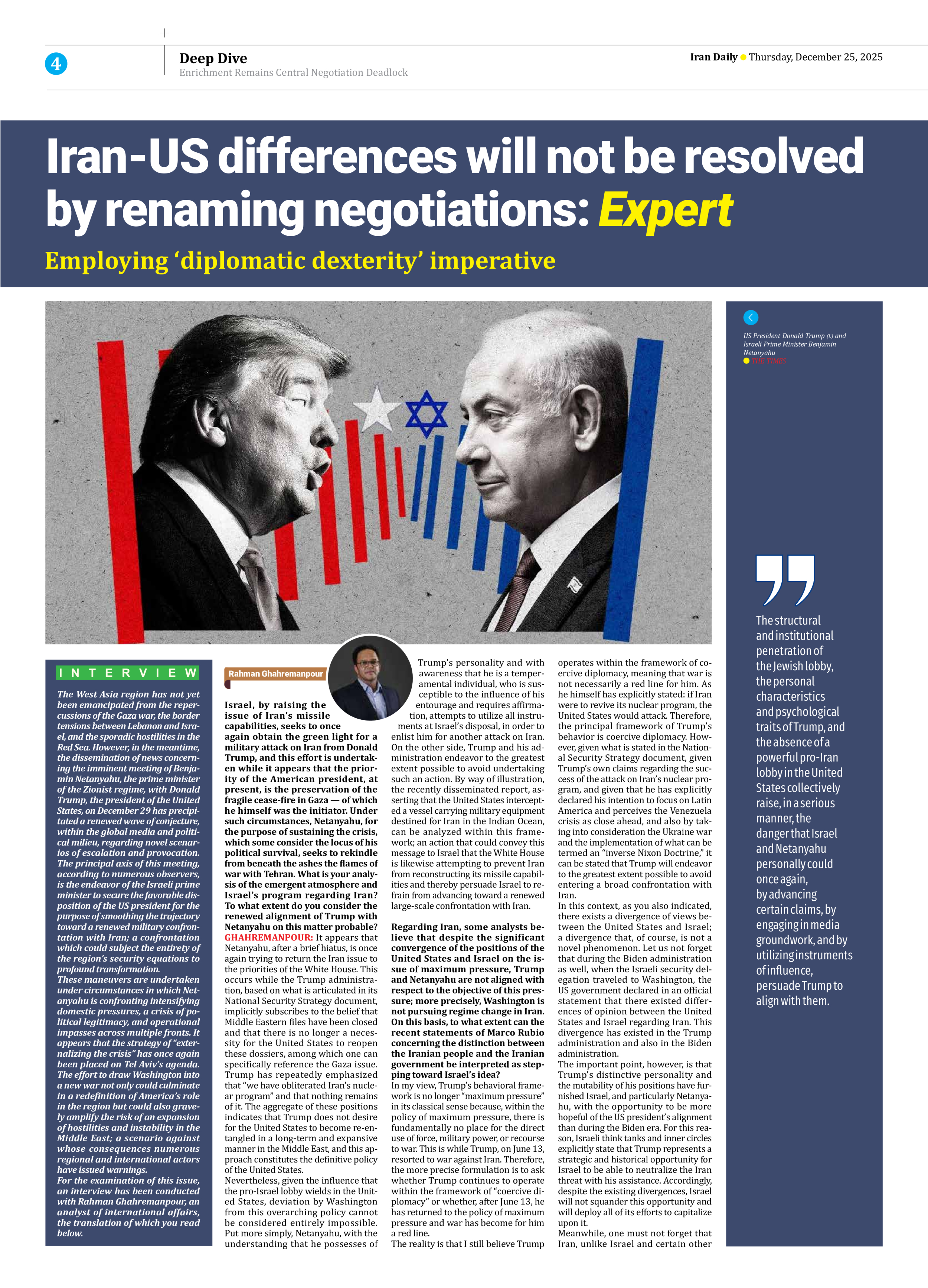
The West Asia region has not yet been emancipated from the repercussions of the Gaza war, the border tensions between Lebanon and Israel, and the sporadic hostilities in the Red Sea. However, in the meantime, the dissemination of news concerning the imminent meeting of Benjamin Netanyahu, the prime minister of the Zionist regime, with Donald Trump, the president of the United States, on December 29 has precipitated a renewed wave of conjecture, within the global media and political milieu, regarding novel scenarios of escalation and provocation. The principal axis of this meeting, according to numerous observers, is the endeavor of the Israeli prime minister to secure the favorable disposition of the US president for the purpose of smoothing the trajectory toward a renewed military confrontation with Iran; a confrontation which could subject the entirety of the region’s security equations to profound transformation. These maneuvers are undertaken under circumstances in which Netanyahu is confronting intensifying domestic pressures, a crisis of political legitimacy, and operational impasses across multiple fronts. It appears that the strategy of “externalizing the crisis” has once again been placed on Tel Aviv’s agenda. The effort to draw Washington into a new war not only could culminate in a redefinition of America’s role in the region but could also gravely amplify the risk of an expansion of hostilities and instability in the Middle East; a scenario against whose consequences numerous regional and international actors have issued warnings. For the examination of this issue, an interview has been conducted with Rahman Ghahremanpour, an analyst of international affairs, the translation of which you read below.
Israel, by raising the issue of Iran’s missile capabilities, seeks to once again obtain the green light for a military attack on Iran from Donald Trump, and this effort is undertaken while it appears that the priority of the American president, at present, is the preservation of the fragile cease-fire in Gaza — of which he himself was the initiator. Under such circumstances, Netanyahu, for the purpose of sustaining the crisis, which some consider the locus of his political survival, seeks to rekindle from beneath the ashes the flames of war with Tehran. What is your analysis of the emergent atmosphere and Israel’s program regarding Iran? To what extent do you consider the renewed alignment of Trump with Netanyahu on this matter probable?
GHAHREMANPOUR: It appears that Netanyahu, after a brief hiatus, is once again trying to return the Iran issue to the priorities of the White House. This occurs while the Trump administration, based on what is articulated in its National Security Strategy document, implicitly subscribes to the belief that Middle Eastern files have been closed and that there is no longer a necessity for the United States to reopen these dossiers, among which one can specifically reference the Gaza issue. Trump has repeatedly emphasized that “we have obliterated Iran’s nuclear program” and that nothing remains of it. The aggregate of these positions indicates that Trump does not desire for the United States to become re-entangled in a long-term and expansive manner in the Middle East, and this approach constitutes the definitive policy of the United States.
Nevertheless, given the influence that the pro-Israel lobby wields in the United States, deviation by Washington from this overarching policy cannot be considered entirely impossible. Put more simply, Netanyahu, with the understanding that he possesses of Trump’s personality and with awareness that he is a temperamental individual, who is susceptible to the influence of his entourage and requires affirmation, attempts to utilize all instruments at Israel’s disposal, in order to enlist him for another attack on Iran. On the other side, Trump and his administration endeavor to the greatest extent possible to avoid undertaking such an action. By way of illustration, the recently disseminated report, asserting that the United States intercepted a vessel carrying military equipment destined for Iran in the Indian Ocean, can be analyzed within this framework; an action that could convey this message to Israel that the White House is likewise attempting to prevent Iran from reconstructing its missile capabilities and thereby persuade Israel to refrain from advancing toward a renewed large-scale confrontation with Iran.
Regarding Iran, some analysts believe that despite the significant convergence of the positions of the United States and Israel on the issue of maximum pressure, Trump and Netanyahu are not aligned with respect to the objective of this pressure; more precisely, Washington is not pursuing regime change in Iran. On this basis, to what extent can the recent statements of Marco Rubio concerning the distinction between the Iranian people and the Iranian government be interpreted as stepping toward Israel’s idea?
In my view, Trump’s behavioral framework is no longer “maximum pressure” in its classical sense because, within the policy of maximum pressure, there is fundamentally no place for the direct use of force, military power, or recourse to war. This is while Trump, on June 13, resorted to war against Iran. Therefore, the more precise formulation is to ask whether Trump continues to operate within the framework of “coercive diplomacy” or whether, after June 13, he has returned to the policy of maximum pressure and war has become for him a red line.
The reality is that I still believe Trump operates within the framework of coercive diplomacy, meaning that war is not necessarily a red line for him. As he himself has explicitly stated: if Iran were to revive its nuclear program, the United States would attack. Therefore, the principal framework of Trump’s behavior is coercive diplomacy. However, given what is stated in the National Security Strategy document, given Trump’s own claims regarding the success of the attack on Iran’s nuclear program, and given that he has explicitly declared his intention to focus on Latin America and perceives the Venezuela crisis as close ahead, and also by taking into consideration the Ukraine war and the implementation of what can be termed an “inverse Nixon Doctrine,” it can be stated that Trump will endeavor to the greatest extent possible to avoid entering a broad confrontation with Iran.
In this context, as you also indicated, there exists a divergence of views between the United States and Israel; a divergence that, of course, is not a novel phenomenon. Let us not forget that during the Biden administration as well, when the Israeli security delegation traveled to Washington, the US government declared in an official statement that there existed differences of opinion between the United States and Israel regarding Iran. This divergence has existed in the Trump administration and also in the Biden administration.
The important point, however, is that Trump’s distinctive personality and the mutability of his positions have furnished Israel, and particularly Netanyahu, with the opportunity to be more hopeful of the US president’s alignment than during the Biden era. For this reason, Israeli think tanks and inner circles explicitly state that Trump represents a strategic and historical opportunity for Israel to be able to neutralize the Iran threat with his assistance. Accordingly, despite the existing divergences, Israel will not squander this opportunity and will deploy all of its efforts to capitalize upon it.
Meanwhile, one must not forget that Iran, unlike Israel and certain other countries, lacks a powerful lobby in the United States, and its voice is not properly heard. The voice that is heard from Iran in the United States is predominantly that of regime-change opposition groups, which, in some instances, even share interests with Israel and support war at times. For this reason, this situation constitutes a serious danger for Iran. Mere opposition or episodic non-alignment by Trump with Israel regarding Netanyahu’s Middle Eastern objectives cannot lead us to the conclusion that the possibility of Trump’s alignment with Israel no longer exists or that Netanyahu will be incapable of aligning him.
The structural and institutional penetration of the Jewish lobby, the personal characteristics and psychological traits of Trump, and the absence of a powerful pro-Iran lobby in the United States collectively raise, in a serious manner, the danger that Israel and Netanyahu personally could once again, by advancing certain claims, by engaging in media groundwork, and by utilizing instruments of influence, persuade Trump to align with them.
Iran-United States nuclear negotiations, since the imposed 12-day war, have entered a state of complete coma. Iran accuses the United States of advancing maximalist demands, and simultaneously, it appears that Washington’s view is the inclusion of non-nuclear issues, particularly Iran’s missile capabilities, in any new agreement. Where do you think the crux of the problem lies? Recently, proposals have been raised suggesting that Iran and the United States change the title of “negotiations” to “an agreement for Iran’s non-acquisition of nuclear weapons” in order to break the existing deadlock. To what extent do you consider such ideas to be practical?
Regarding the change of the name of “negotiation,” in any case, it does not appear that the principal disagreement concerns the name or the form; the issue is the substance. The complexity of politics is precisely embedded in this point that various variables are interlinked in a manner that creates reciprocal relationships among them. Therefore, the issue, as Mr. Salehi and some diplomats propose, is not merely a technical matter for which one could seek solely a technical solution. The issue is fundamentally political — that is, a conflict of interests. In such a situation, one must be capable of discovering a formula for this conflict of interests.
When we say that we should change the name of “negotiations” and, for example, speak of “negotiation for Iran’s non-attainment of nuclear weapons,” it is as though we intend to alter those divergences or to disregard them. While the reality is that a conflict of interests exists, and it is serious. The issue is not a matter of the past one or two days; for more than four decades, this conflict of interests has existed, and divergences of perspectives and approaches have taken shape. Therefore, from the outset, we have been confronting a complex issue, and if we seek to present a solution, we must accept the essence of this complexity and conflict of interests rather than deny it.
The denial of this conflict of interests means that the policymaker cannot regard our proposed solution as a realistic one. Reductionist solutions that essentially seek to say that “it is nothing” or that “take a deep breath, and it will fade away,” at best and in the most optimistic scenario, generate the impression in the policymaker that the analyst or solution-provider lacks a realistic understanding of the existing situation.
Therefore, we must find a solution for this conflict of interests, recognize it formally, and, on the other hand, institutionalize within the country the principle that international politics is an arena of conflicting interests and scarcity of power and that global powers are not equal to one another. At times, this perception, or at least this unwritten assumption, exists within our country that Iran’s and America’s positions in the hierarchy of power in international politics are identical, and prescriptions are issued on that basis, while the reality is otherwise.
On this basis, in negotiations as well, we are not situated in an equal position. Inevitably, we must define and calibrate expectations from negotiations in proportion to this reality. Not only are we not in an equal position, but also after June 13, unfortunately the perception of the opposing side — namely the United States and even Europe and, perhaps, one could say, some of Iran’s friends — is that Iran’s position in international politics has been weakened. This perception complicates matters because, in negotiation, the party that considers itself stronger is unwilling to grant greater concessions in order to reach an agreement. This is precisely the situation we are confronting now; that is, the United States exhibits no inclination to grant concessions, while the discourse of “coercive diplomacy” and past experiences demonstrate that, usually, the possibility of agreement has increased when the stronger government, which here is the United States, has granted greater concessions.
Therefore, the deadlock in the negotiations has formed across multiple layers. At the foundational and essential level, a conflict of interests exists, which has taken shape over the past four decades, and discovering a middle-ground solution for both sides is an exceedingly difficult task, given the aforementioned conflict. The fate of the JCPOA also demonstrated to what extent pro-agreement forces in the two countries are positioned unequally, or, more precisely, that anti-agreement forces possess greater power.
As a result, it appears that rather than rendering the issue technical in appearance and rather than reducing this conflict of interests to a merely technical matter, we must start by accepting the complexity and multidimensionality of the issue and then, present a solution that, at least, encompasses part of the concerns of the decision-makers in Iran; they should be able to defend this solution within the arena of domestic politics and should not perceive its implementation as tantamount to the loss of their positions in domestic politics or the loss of legitimacy.
What is the principal obstacle that you believe to be so complex and multidimensional?
In my view, if we wish to simplify the issue, the principal obstacle lies in the enrichment issue. In the enrichment debate, both countries, meaning the leaders on both sides, confront exceedingly serious domestic considerations. On one hand, Trump wishes to demonstrate to his electoral base that he is different from Obama, and if he reaches an agreement with Iran that agreement will be both “better” than Obama’s agreement and of a different nature. This difference and “better quality,” in Trump’s view, is defined in the form of zero enrichment; meaning that, from his perspective, defending an agreement with Iran in American domestic politics is possible only if that agreement includes the suspension of enrichment.
In Iran as well, the enrichment issue is equally intertwined with domestic politics. The governing establishment has reached the conclusion that if it is to consent to an agreement with the United States, it must be able to justify it domestically. This justification is possible only if the United States recognizes, even implicitly and on paper, Iran’s right to enrichment. Only in this case can Iran explain why, after the 12-day war, it has moved toward negotiations with the United States.
We know that negotiations, both in Iran and in the United States, have serious opponents within decision-making structures and within the arena of domestic politics. Trump’s rivals in the United States and the principlists (or whatever we label them) in Iran are poised to question any agreement if the government or the foreign policy apparatus moves toward it. Therefore, both Trump and Iran, by ill fortune, are faced with conflicting interests for the defense of an agreement in domestic politics; Trump seeks the suspension of enrichment, and Iran seeks the preservation of enrichment. This is the current obstacle to the negotiations.
It appears that, given the understanding that has emerged in recent years of American behavior, Washington will not fully pressure Iran. Accordingly, regarding Iran, in my view, if this dilemma is resolved and Tehran can correctly employ diplomatic dexterity and if anti-agreement forces cannot take matters into their own hands, then the possibility of negotiation and the attainment of an agreement will exist.
The interview first appeared in Persian on IRNA.