







SATBA says renewable capacity to top 4,000 MW in late Jan., eyes 11,000 MW by summer
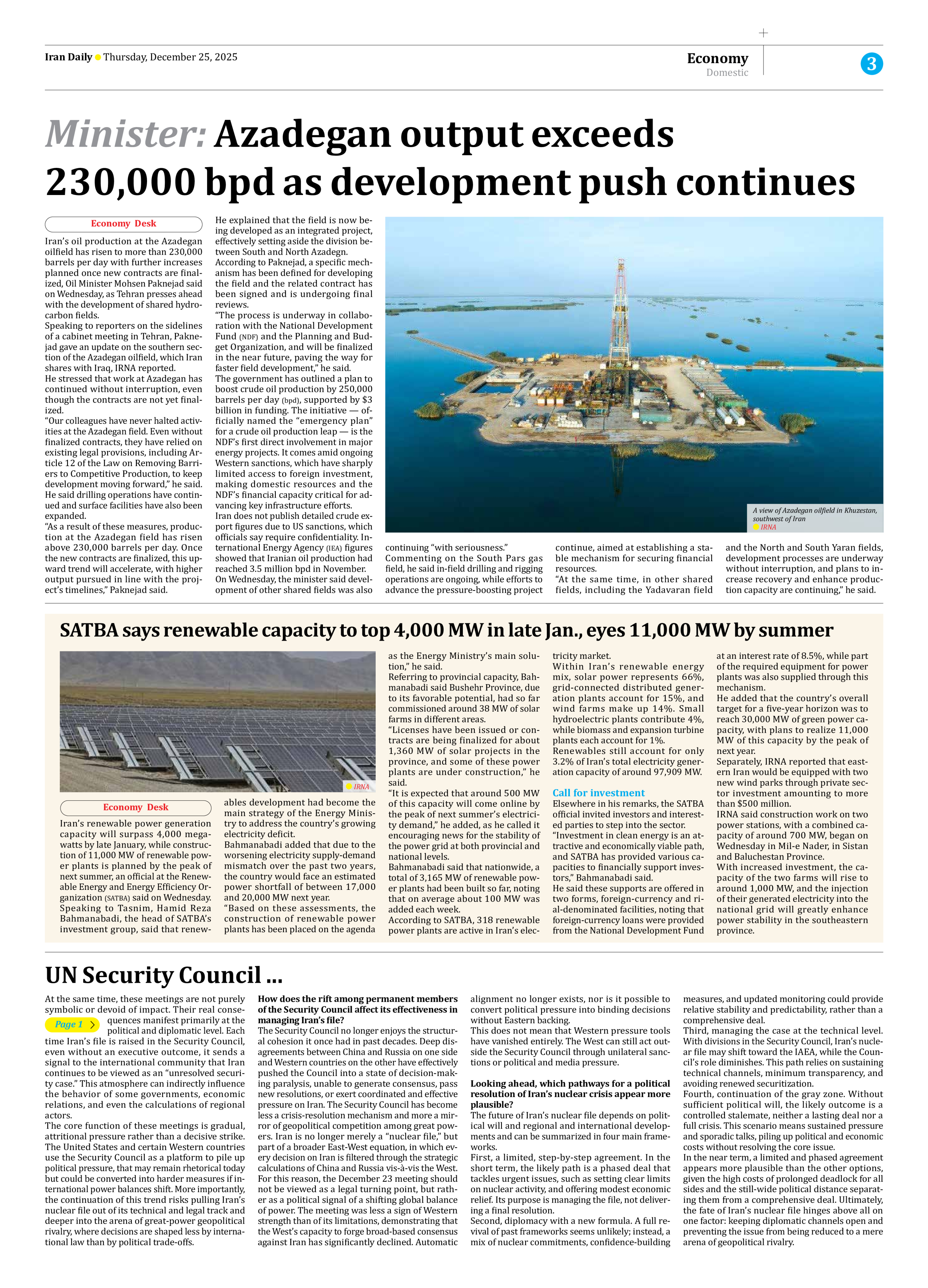
Iran’s renewable power generation capacity will surpass 4,000 megawatts by late January, while construction of 11,000 MW of renewable power plants is planned by the peak of next summer, an official at the Renewable Energy and Energy Efficiency Organization (SATBA) said on Wednesday.
Speaking to Tasnim, Hamid Reza Bahmanabadi, the head of SATBA’s investment group, said that renewables development had become the main strategy of the Energy Ministry to address the country’s growing electricity deficit.
Bahmanabadi added that due to the worsening electricity supply-demand mismatch over the past two years, the country would face an estimated power shortfall of between 17,000 and 20,000 MW next year.
“Based on these assessments, the construction of renewable power plants has been placed on the agenda as the Energy Ministry’s main solution,” he said.
Referring to provincial capacity, Bahmanabadi said Bushehr Province, due to its favorable potential, had so far commissioned around 38 MW of solar farms in different areas.
“Licenses have been issued or contracts are being finalized for about 1,360 MW of solar projects in the province, and some of these power plants are under construction,” he said.
“It is expected that around 500 MW of this capacity will come online by the peak of next summer’s electricity demand,” he added, as he called it encouraging news for the stability of the power grid at both provincial and national levels.
Bahmanabadi said that nationwide, a total of 3,165 MW of renewable power plants had been built so far, noting that on average about 100 MW was added each week.
According to SATBA, 318 renewable power plants are active in Iran’s electricity market.
Within Iran’s renewable energy mix, solar power represents 66%, grid-connected distributed generation plants account for 15%, and wind farms make up 14%. Small hydroelectric plants contribute 4%, while biomass and expansion turbine plants each account for 1%.
Renewables still account for only 3.2% of Iran’s total electricity generation capacity of around 97,909 MW.
Call for investment
Elsewhere in his remarks, the SATBA official invited investors and interested parties to step into the sector.
“Investment in clean energy is an attractive and economically viable path, and SATBA has provided various capacities to financially support investors,” Bahmanabadi said.
He said these supports are offered in two forms, foreign-currency and rial-denominated facilities, noting that foreign-currency loans were provided from the National Development Fund at an interest rate of 8.5%, while part of the required equipment for power plants was also supplied through this mechanism.
He added that the country’s overall target for a five-year horizon was to reach 30,000 MW of green power capacity, with plans to realize 11,000 MW of this capacity by the peak of next year.
Separately, IRNA reported that eastern Iran would be equipped with two new wind parks through private sector investment amounting to more than $500 million.
IRNA said construction work on two power stations, with a combined capacity of around 700 MW, began on Wednesday in Mil-e Nader, in Sistan and Baluchestan Province.
With increased investment, the capacity of the two farms will rise to around 1,000 MW, and the injection of their generated electricity into the national grid will greatly enhance power stability in the southeastern province.