







Copy in clipboard...
Iran, Kazakhstan frame shared heritage as bridge for cultural dialogue
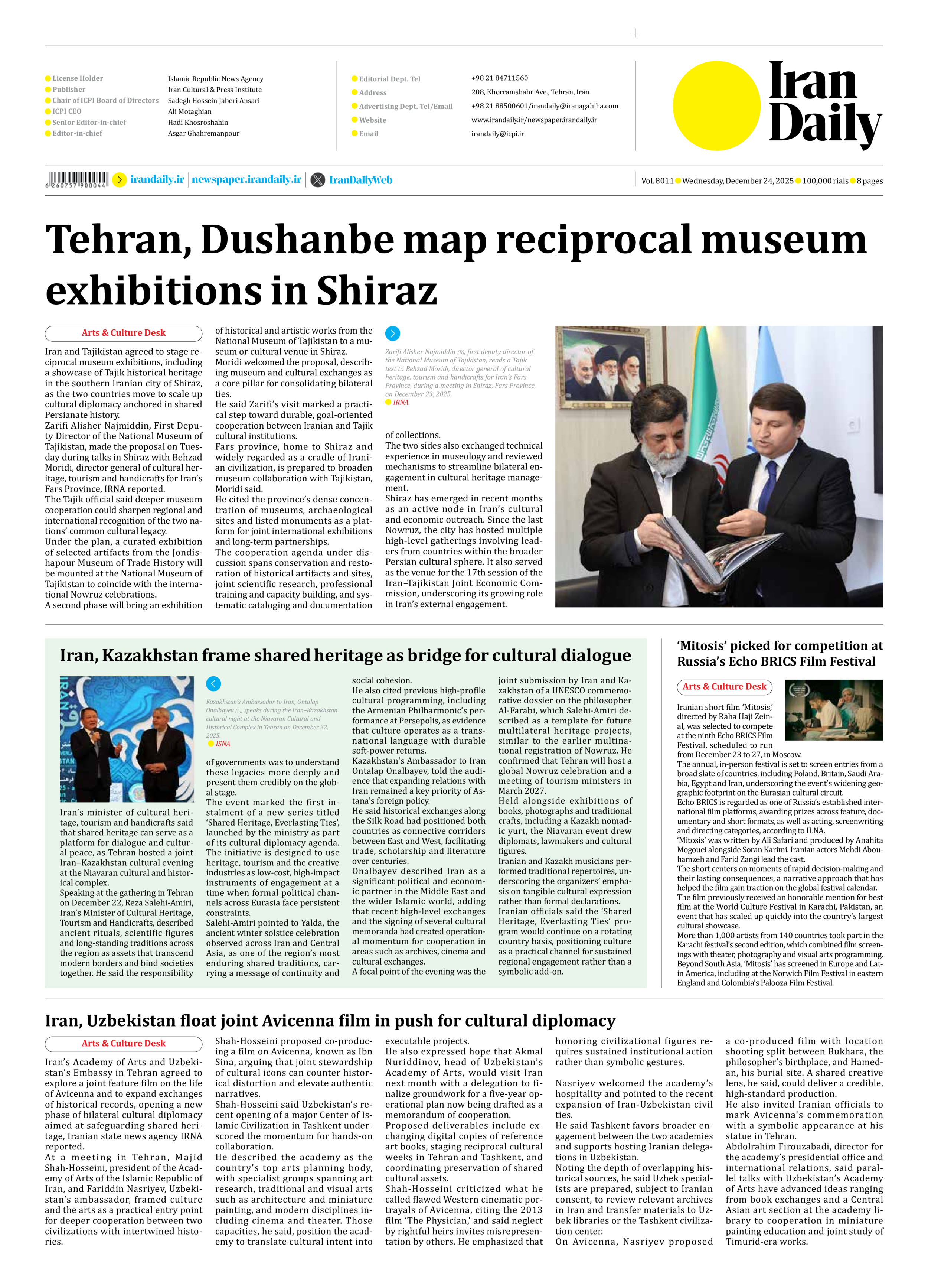
Speaking at the gathering in Tehran on December 22, Reza Salehi-Amiri, Iran’s Minister of Cultural Heritage, Tourism and Handicrafts, described ancient rituals, scientific figures and long-standing traditions across the region as assets that transcend modern borders and bind societies together. He said the responsibility of governments was to understand these legacies more deeply and present them credibly on the global stage.
The event marked the first instalment of a new series titled ‘Shared Heritage, Everlasting Ties’, launched by the ministry as part of its cultural diplomacy agenda. The initiative is designed to use heritage, tourism and the creative industries as low-cost, high-impact instruments of engagement at a time when formal political channels across Eurasia face persistent constraints.
Salehi-Amiri pointed to Yalda, the ancient winter solstice celebration observed across Iran and Central Asia, as one of the region’s most enduring shared traditions, carrying a message of continuity and social cohesion.
He also cited previous high-profile cultural programming, including the Armenian Philharmonic’s performance at Persepolis, as evidence that culture operates as a transnational language with durable soft-power returns.
Kazakhstan's Ambassador to Iran Ontalap Onalbayev, told the audience that expanding relations with Iran remained a key priority of Astana’s foreign policy.
He said historical exchanges along the Silk Road had positioned both countries as connective corridors between East and West, facilitating trade, scholarship and literature over centuries.
Onalbayev described Iran as a significant political and economic partner in the Middle East and the wider Islamic world, adding that recent high-level exchanges and the signing of several cultural memoranda had created operational momentum for cooperation in areas such as archives, cinema and cultural exchanges.
A focal point of the evening was the joint submission by Iran and Kazakhstan of a UNESCO commemorative dossier on the philosopher Al-Farabi, which Salehi-Amiri described as a template for future multilateral heritage projects, similar to the earlier multinational registration of Nowruz. He confirmed that Tehran will host a global Nowruz celebration and a meeting of tourism ministers in March 2027.
Held alongside exhibitions of books, photographs and traditional crafts, including a Kazakh nomadic yurt, the Niavaran event drew diplomats, lawmakers and cultural figures.
Iranian and Kazakh musicians performed traditional repertoires, underscoring the organizers’ emphasis on tangible cultural expression rather than formal declarations.
Iranian officials said the ‘Shared Heritage, Everlasting Ties’ program would continue on a rotating country basis, positioning culture as a practical channel for sustained regional engagement rather than a symbolic add-on.