







Budget bill presented to Parliament
President calls for unity, expert approach to overcome challenges
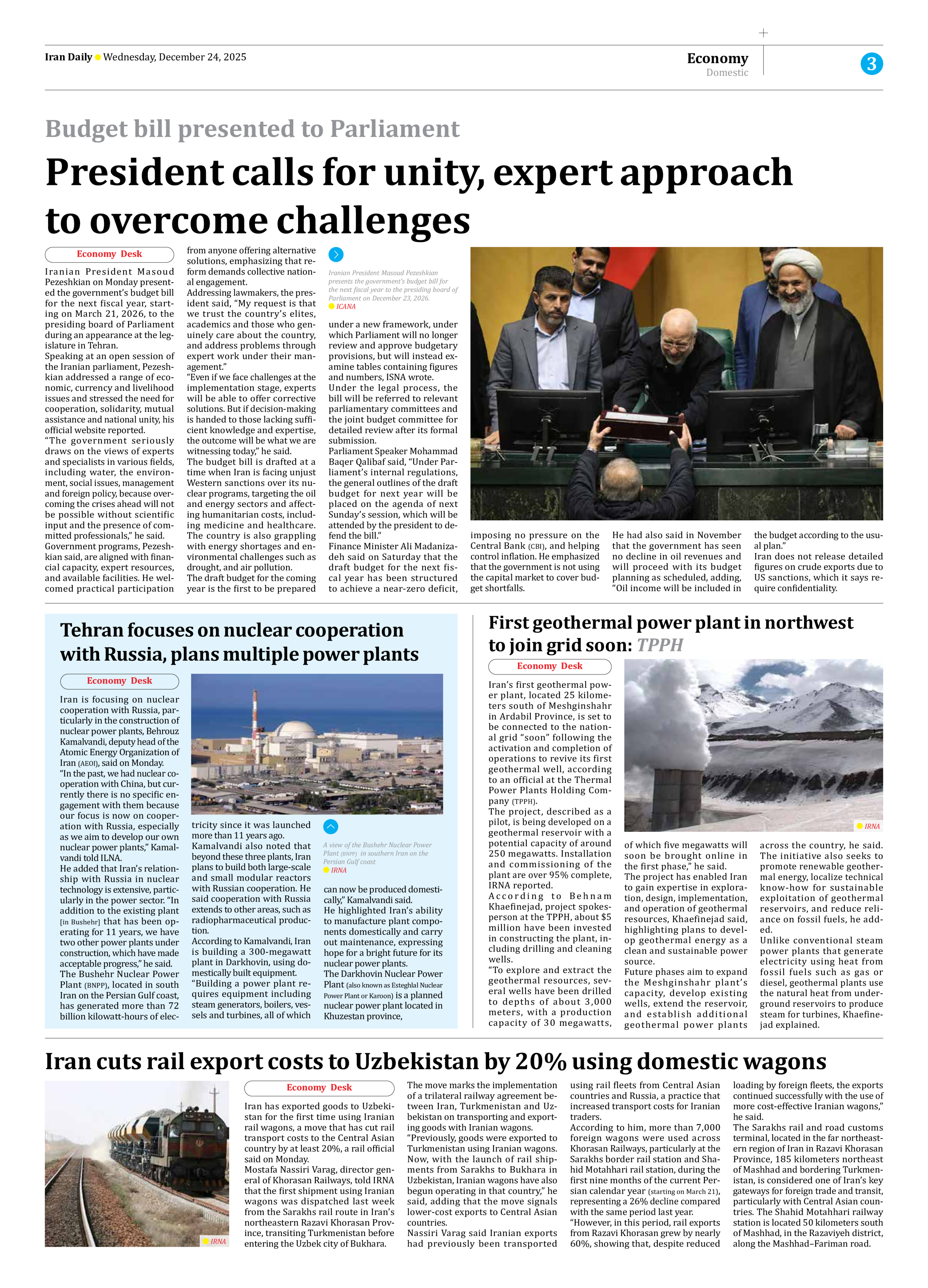
Iranian President Masoud Pezeshkian on Monday presented the government’s budget bill for the next fiscal year, starting on March 21, 2026, to the presiding board of Parliament during an appearance at the legislature in Tehran.
Speaking at an open session of the Iranian parliament, Pezeshkian addressed a range of economic, currency and livelihood issues and stressed the need for cooperation, solidarity, mutual assistance and national unity, his official website reported.
“The government seriously draws on the views of experts and specialists in various fields, including water, the environment, social issues, management and foreign policy, because overcoming the crises ahead will not be possible without scientific input and the presence of committed professionals,” he said.
Government programs, Pezeshkian said, are aligned with financial capacity, expert resources, and available facilities. He welcomed practical participation from anyone offering alternative solutions, emphasizing that reform demands collective national engagement.
Addressing lawmakers, the president said, “My request is that we trust the country’s elites, academics and those who genuinely care about the country, and address problems through expert work under their management.”
“Even if we face challenges at the implementation stage, experts will be able to offer corrective solutions. But if decision-making is handed to those lacking sufficient knowledge and expertise, the outcome will be what we are witnessing today,” he said.
The budget bill is drafted at a time when Iran is facing unjust Western sanctions over its nuclear programs, targeting the oil and energy sectors and affecting humanitarian costs, including medicine and healthcare. The country is also grappling with energy shortages and environmental challenges such as drought, and air pollution.
The draft budget for the coming year is the first to be prepared under a new framework, under which Parliament will no longer review and approve budgetary provisions, but will instead examine tables containing figures and numbers, ISNA wrote.
Under the legal process, the bill will be referred to relevant parliamentary committees and the joint budget committee for detailed review after its formal submission.
Parliament Speaker Mohammad Baqer Qalibaf said, “Under Parliament’s internal regulations, the general outlines of the draft budget for next year will be placed on the agenda of next Sunday’s session, which will be attended by the president to defend the bill.”
Finance Minister Ali Madanizadeh said on Saturday that the draft budget for the next fiscal year has been structured to achieve a near-zero deficit, imposing no pressure on the Central Bank (CBI), and helping control inflation. He emphasized that the government is not using the capital market to cover budget shortfalls.
He had also said in November that the government has seen no decline in oil revenues and will proceed with its budget planning as scheduled, adding, “Oil income will be included in the budget according to the usual plan.”
Iran does not release detailed figures on crude exports due to US sanctions, which it says require confidentiality.