





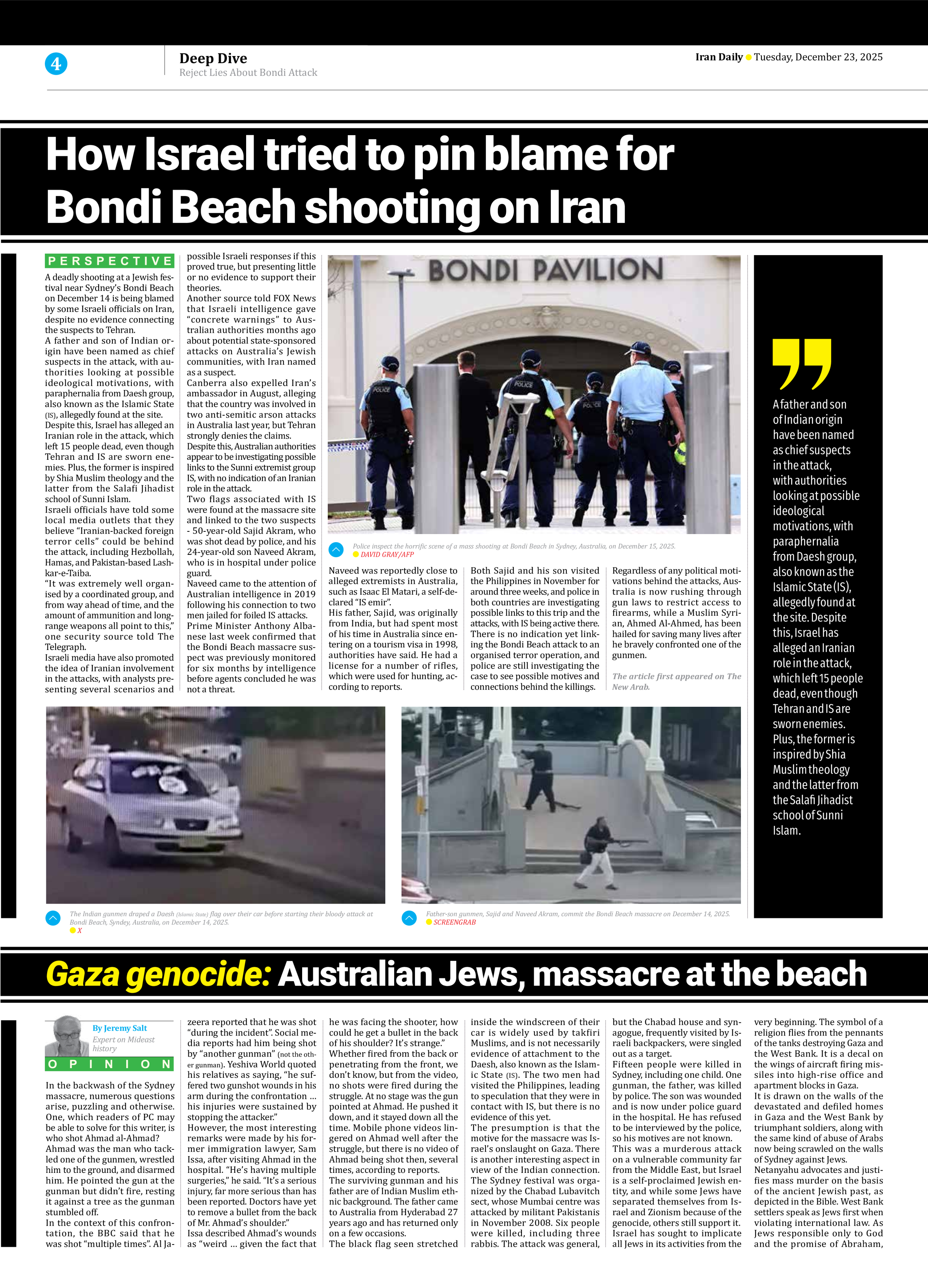


How Israel tried to pin blame for Bondi Beach shooting on Iran
A deadly shooting at a Jewish festival near Sydney’s Bondi Beach on December 14 is being blamed by some Israeli officials on Iran, despite no evidence connecting the suspects to Tehran.
A father and son of Indian origin have been named as chief suspects in the attack, with authorities looking at possible ideological motivations, with paraphernalia from Daesh group, also known as the Islamic State (IS), allegedly found at the site.
Despite this, Israel has alleged an Iranian role in the attack, which left 15 people dead, even though Tehran and IS are sworn enemies. Plus, the former is inspired by Shia Muslim theology and the latter from the Salafi Jihadist school of Sunni Islam.
Israeli officials have told some local media outlets that they believe “Iranian-backed foreign terror cells” could be behind the attack, including Hezbollah, Hamas, and Pakistan-based Lashkar-e-Taiba.
“It was extremely well organised by a coordinated group, and from way ahead of time, and the amount of ammunition and long-range weapons all point to this,” one security source told The Telegraph.
Israeli media have also promoted the idea of Iranian involvement in the attacks, with analysts presenting several scenarios and possible Israeli responses if this proved true, but presenting little or no evidence to support their theories.
Another source told FOX News that Israeli intelligence gave “concrete warnings” to Australian authorities months ago about potential state-sponsored attacks on Australia’s Jewish communities, with Iran named as a suspect.
Canberra also expelled Iran’s ambassador in August, alleging that the country was involved in two anti-semitic arson attacks in Australia last year, but Tehran strongly denies the claims.
Despite this, Australian authorities appear to be investigating possible links to the Sunni extremist group IS, with no indication of an Iranian role in the attack.
Two flags associated with IS were found at the massacre site and linked to the two suspects - 50-year-old Sajid Akram, who was shot dead by police, and his 24-year-old son Naveed Akram, who is in hospital under police guard.
Naveed came to the attention of Australian intelligence in 2019 following his connection to two men jailed for foiled IS attacks.
Prime Minister Anthony Albanese last week confirmed that the Bondi Beach massacre suspect was previously monitored for six months by intelligence before agents concluded he was not a threat.
Naveed was reportedly close to alleged extremists in Australia, such as Isaac El Matari, a self-declared “IS emir”.
His father, Sajid, was originally from India, but had spent most of his time in Australia since entering on a tourism visa in 1998, authorities have said. He had a license for a number of rifles, which were used for hunting, according to reports.
Both Sajid and his son visited the Philippines in November for around three weeks, and police in both countries are investigating possible links to this trip and the attacks, with IS being active there.
There is no indication yet linking the Bondi Beach attack to an organised terror operation, and police are still investigating the case to see possible motives and connections behind the killings.
Regardless of any political motivations behind the attacks, Australia is now rushing through gun laws to restrict access to firearms, while a Muslim Syrian, Ahmed Al-Ahmed, has been hailed for saving many lives after he bravely confronted one of the gunmen.
The article first appeared on The New Arab.