





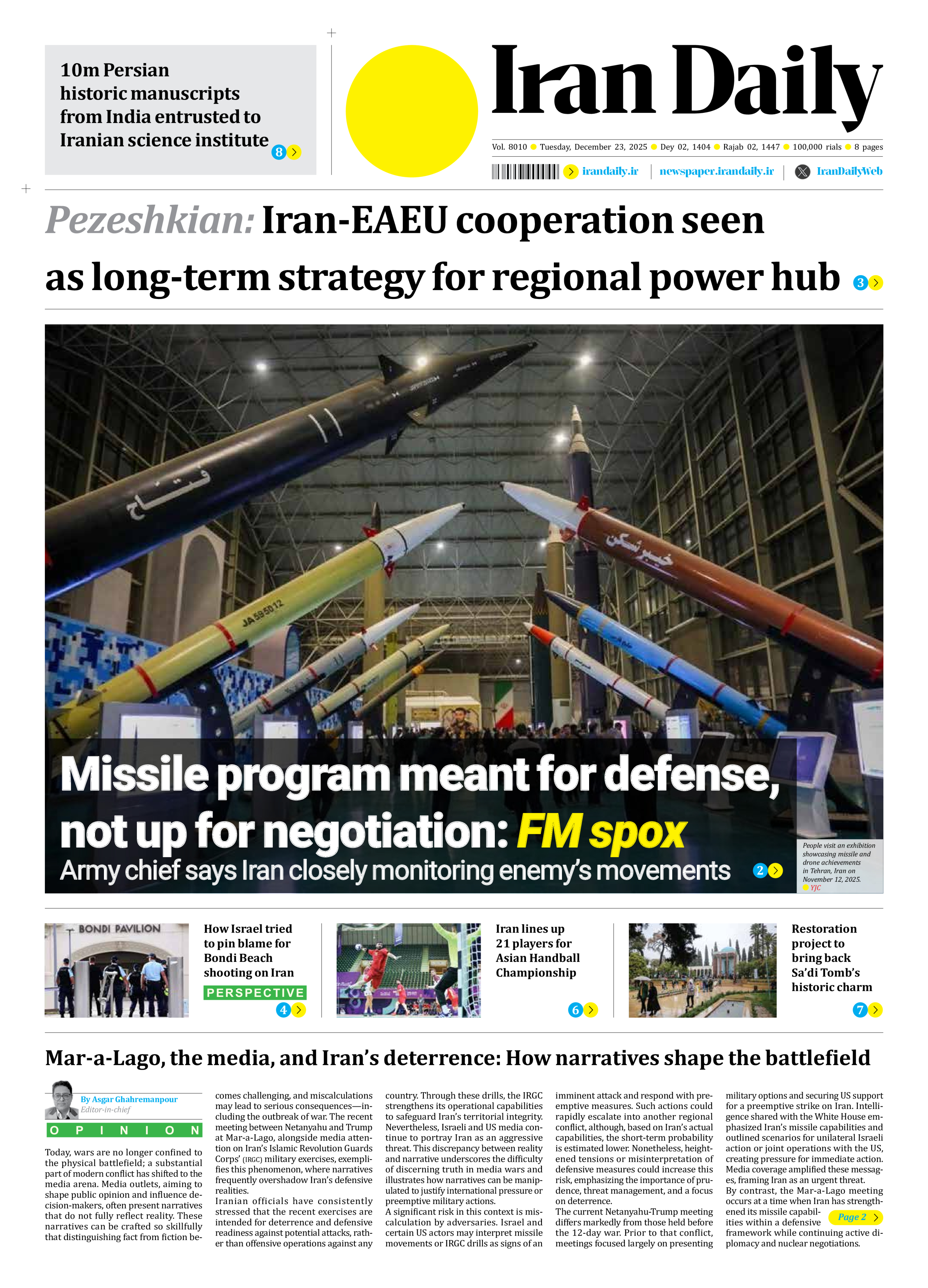


Mar-a-Lago, the media, and Iran’s deterrence: How narratives shape the battlefield
By Asgar Ghahremanpour
Editor-in-chief
Today, wars are no longer confined to the physical battlefield; a substantial part of modern conflict has shifted to the media arena. Media outlets, aiming to shape public opinion and influence decision-makers, often present narratives that do not fully reflect reality. These narratives can be crafted so skillfully that distinguishing fact from fiction becomes challenging, and miscalculations may lead to serious consequences—including the outbreak of war. The recent meeting between Netanyahu and Trump at Mar-a-Lago, alongside media attention on Iran’s Islamic Revolution Guards Corps’ (IRGC) military exercises, exemplifies this phenomenon, where narratives frequently overshadow Iran’s defensive realities.
Iranian officials have consistently stressed that the recent exercises are intended for deterrence and defensive readiness against potential attacks, rather than offensive operations against any country. Through these drills, the IRGC strengthens its operational capabilities to safeguard Iran’s territorial integrity. Nevertheless, Israeli and US media continue to portray Iran as an aggressive threat. This discrepancy between reality and narrative underscores the difficulty of discerning truth in media wars and illustrates how narratives can be manipulated to justify international pressure or preemptive military actions.
A significant risk in this context is miscalculation by adversaries. Israel and certain US actors may interpret missile movements or IRGC drills as signs of an imminent attack and respond with preemptive measures. Such actions could rapidly escalate into another regional conflict, although, based on Iran’s actual capabilities, the short-term probability is estimated lower. Nonetheless, heightened tensions or misinterpretation of defensive measures could increase this risk, emphasizing the importance of prudence, threat management, and a focus on deterrence.
The current Netanyahu-Trump meeting differs markedly from those held before the 12-day war. Prior to that conflict, meetings focused largely on presenting military options and securing US support for a preemptive strike on Iran. Intelligence shared with the White House emphasized Iran’s missile capabilities and outlined scenarios for unilateral Israeli action or joint operations with the US, creating pressure for immediate action. Media coverage amplified these messages, framing Iran as an urgent threat.
By contrast, the Mar-a-Lago meeting occurs at a time when Iran has strengthened its missile capabilities within a defensive framework while continuing active diplomacy and nuclear negotiations.
Page 2