







Where rhythm meets roots in Persian music
Hejazi: Persian music speaks in its own voice
By Hamideh Hosseini
Staff writer
Iranian traditional music is deeply embedded in the culture, lived experience, and historical memory of a people who have kept it alive generation after generation. Kourosh Hejazi, a percussionist and leader of the Nava-ye Hengam ensemble, is among the artists who, emerging from a music-loving family and trained by distinguished masters, embarked on a professional path in Iran’s classical music tradition. With extensive domestic and international performance experience, Hejazi has sought to serve as a worthy representative of Iran’s traditional and folkloric music on global stages.
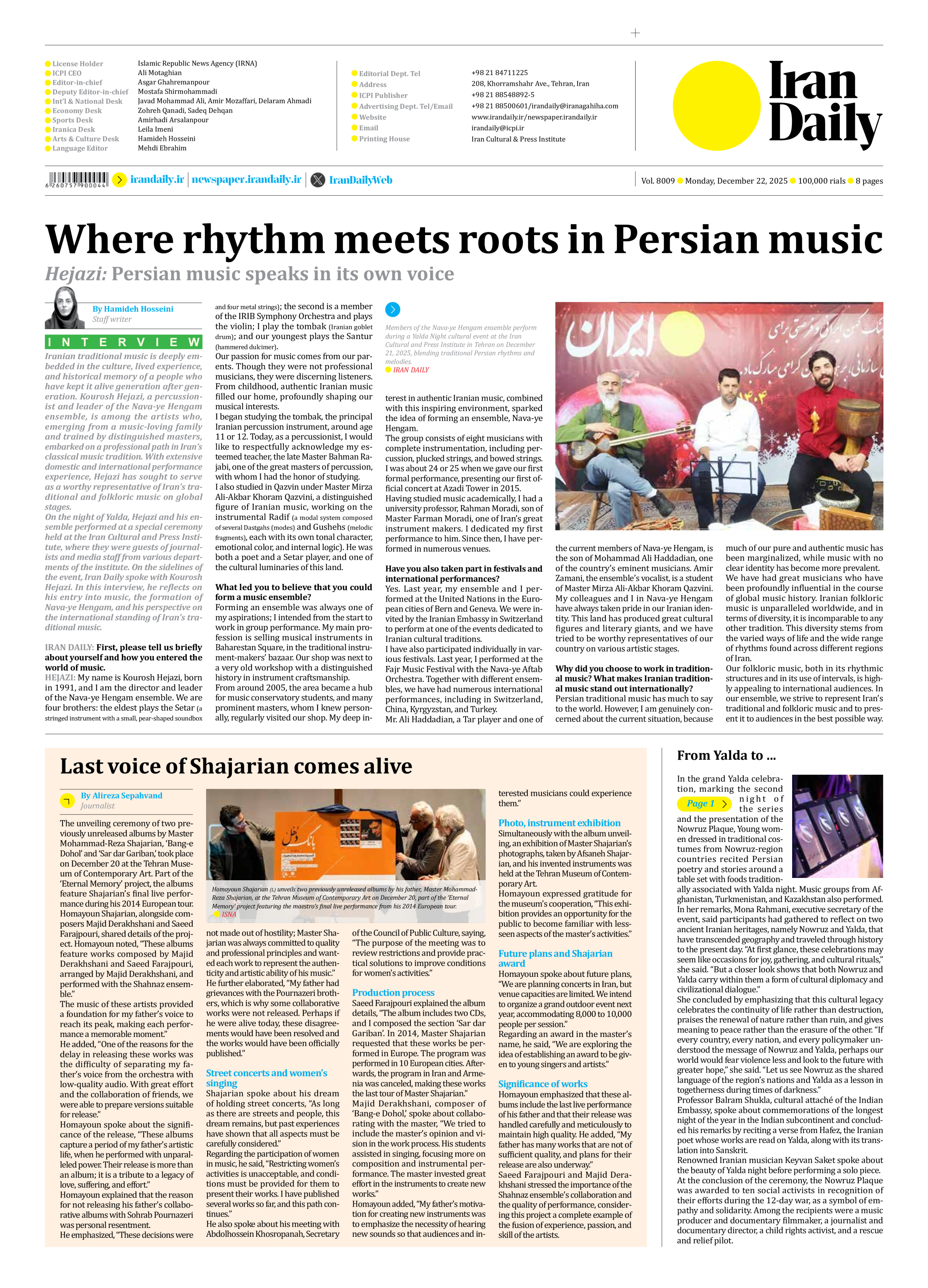
On the night of Yalda, Hejazi and his ensemble performed at a special ceremony held at the Iran Cultural and Press Institute, where they were guests of journalists and media staff from various departments of the institute. On the sidelines of the event, Iran Daily spoke with Kourosh Hejazi. In this interview, he reflects on his entry into music, the formation of Nava-ye Hengam, and his perspective on the international standing of Iran’s traditional music.
IRAN DAILY: First, please tell us briefly about yourself and how you entered the world of music.
HEJAZI: My name is Kourosh Hejazi, born in 1991, and I am the director and leader of the Nava-ye Hengam ensemble. We are four brothers: the eldest plays the Setar (a stringed instrument with a small, pear-shaped soundbox and four metal strings); the second is a member of the IRIB Symphony Orchestra and plays the violin; I play the tombak (Iranian goblet drum); and our youngest plays the Santur (hammered dulcimer).
Our passion for music comes from our parents. Though they were not professional musicians, they were discerning listeners. From childhood, authentic Iranian music filled our home, profoundly shaping our musical interests.
I began studying the tombak, the principal Iranian percussion instrument, around age 11 or 12. Today, as a percussionist, I would like to respectfully acknowledge my esteemed teacher, the late Master Bahman Rajabi, one of the great masters of percussion, with whom I had the honor of studying.
I also studied in Qazvin under Master Mirza Ali-Akbar Khoram Qazvini, a distinguished figure of Iranian music, working on the instrumental Radif (a modal system composed of several Dastgahs (modes) and Gushehs (melodic fragments), each with its own tonal character, emotional color, and internal logic). He was both a poet and a Setar player, and one of the cultural luminaries of this land.
What led you to believe that you could form a music ensemble?
Forming an ensemble was always one of my aspirations; I intended from the start to work in group performance. My main profession is selling musical instruments in Baharestan Square, in the traditional instrument-makers’ bazaar. Our shop was next to a very old workshop with a distinguished history in instrument craftsmanship.
From around 2005, the area became a hub for music conservatory students, and many prominent masters, whom I knew personally, regularly visited our shop. My deep interest in authentic Iranian music, combined with this inspiring environment, sparked the idea of forming an ensemble, Nava-ye Hengam.
The group consists of eight musicians with complete instrumentation, including percussion, plucked strings, and bowed strings. I was about 24 or 25 when we gave our first formal performance, presenting our first official concert at Azadi Tower in 2015.
Having studied music academically, I had a university professor, Rahman Moradi, son of Master Farman Moradi, one of Iran’s great instrument makers. I dedicated my first performance to him. Since then, I have performed in numerous venues.
Have you also taken part in festivals and international performances?
Yes. Last year, my ensemble and I performed at the United Nations in the European cities of Bern and Geneva. We were invited by the Iranian Embassy in Switzerland to perform at one of the events dedicated to Iranian cultural traditions.
I have also participated individually in various festivals. Last year, I performed at the Fajr Music Festival with the Nava-ye Aftab Orchestra. Together with different ensembles, we have had numerous international performances, including in Switzerland, China, Kyrgyzstan, and Turkey.
Mr. Ali Haddadian, a Tar player and one of the current members of Nava-ye Hengam, is the son of Mohammad Ali Haddadian, one of the country’s eminent musicians. Amir Zamani, the ensemble’s vocalist, is a student of Master Mirza Ali-Akbar Khoram Qazvini.
My colleagues and I in Nava-ye Hengam have always taken pride in our Iranian identity. This land has produced great cultural figures and literary giants, and we have tried to be worthy representatives of our country on various artistic stages.
Why did you choose to work in traditional music? What makes Iranian traditional music stand out internationally?
Persian traditional music has much to say to the world. However, I am genuinely concerned about the current situation, because much of our pure and authentic music has been marginalized, while music with no clear identity has become more prevalent.
We have had great musicians who have been profoundly influential in the course of global music history. Iranian folkloric music is unparalleled worldwide, and in terms of diversity, it is incomparable to any other tradition. This diversity stems from the varied ways of life and the wide range of rhythms found across different regions of Iran.
Our folkloric music, both in its rhythmic structures and in its use of intervals, is highly appealing to international audiences. In our ensemble, we strive to represent Iran’s traditional and folkloric music and to present it to audiences in the best possible way.