







VP urges national library to counter Iranophobia, boost cultural diplomacy
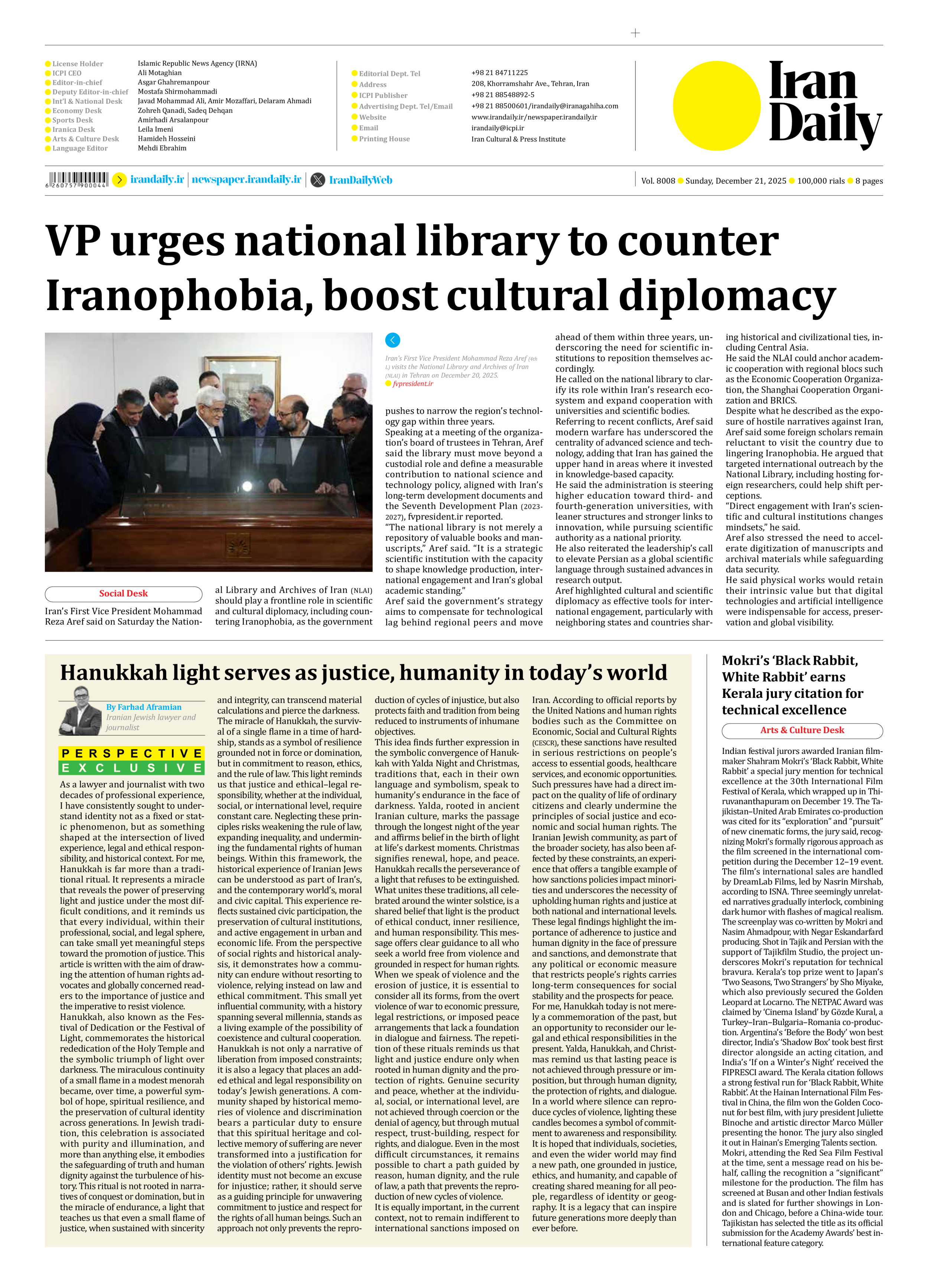
Iran’s First Vice President Mohammad Reza Aref said on Saturday the National Library and Archives of Iran (NLAI) should play a frontline role in scientific and cultural diplomacy, including countering Iranophobia, as the government pushes to narrow the region’s technology gap within three years.
Speaking at a meeting of the organization’s board of trustees in Tehran, Aref said the library must move beyond a custodial role and define a measurable contribution to national science and technology policy, aligned with Iran’s long-term development documents and the Seventh Development Plan (2023-2027), fvpresident.ir reported.
“The national library is not merely a repository of valuable books and manuscripts,” Aref said. “It is a strategic scientific institution with the capacity to shape knowledge production, international engagement and Iran’s global academic standing.”
Aref said the government’s strategy aims to compensate for technological lag behind regional peers and move ahead of them within three years, underscoring the need for scientific institutions to reposition themselves accordingly.
He called on the national library to clarify its role within Iran’s research ecosystem and expand cooperation with universities and scientific bodies.
Referring to recent conflicts, Aref said modern warfare has underscored the centrality of advanced science and technology, adding that Iran has gained the upper hand in areas where it invested in knowledge-based capacity.
He said the administration is steering higher education toward third- and fourth-generation universities, with leaner structures and stronger links to innovation, while pursuing scientific authority as a national priority.
He also reiterated the leadership’s call to elevate Persian as a global scientific language through sustained advances in research output.
Aref highlighted cultural and scientific diplomacy as effective tools for international engagement, particularly with neighboring states and countries sharing historical and civilizational ties, including Central Asia.
He said the NLAI could anchor academic cooperation with regional blocs such as the Economic Cooperation Organization, the Shanghai Cooperation Organization and BRICS.
Despite what he described as the exposure of hostile narratives against Iran, Aref said some foreign scholars remain reluctant to visit the country due to lingering Iranophobia. He argued that targeted international outreach by the National Library, including hosting foreign researchers, could help shift perceptions.
“Direct engagement with Iran’s scientific and cultural institutions changes mindsets,” he said.
Aref also stressed the need to accelerate digitization of manuscripts and archival materials while safeguarding data security.
He said physical works would retain their intrinsic value but that digital technologies and artificial intelligence were indispensable for access, preservation and global visibility.