





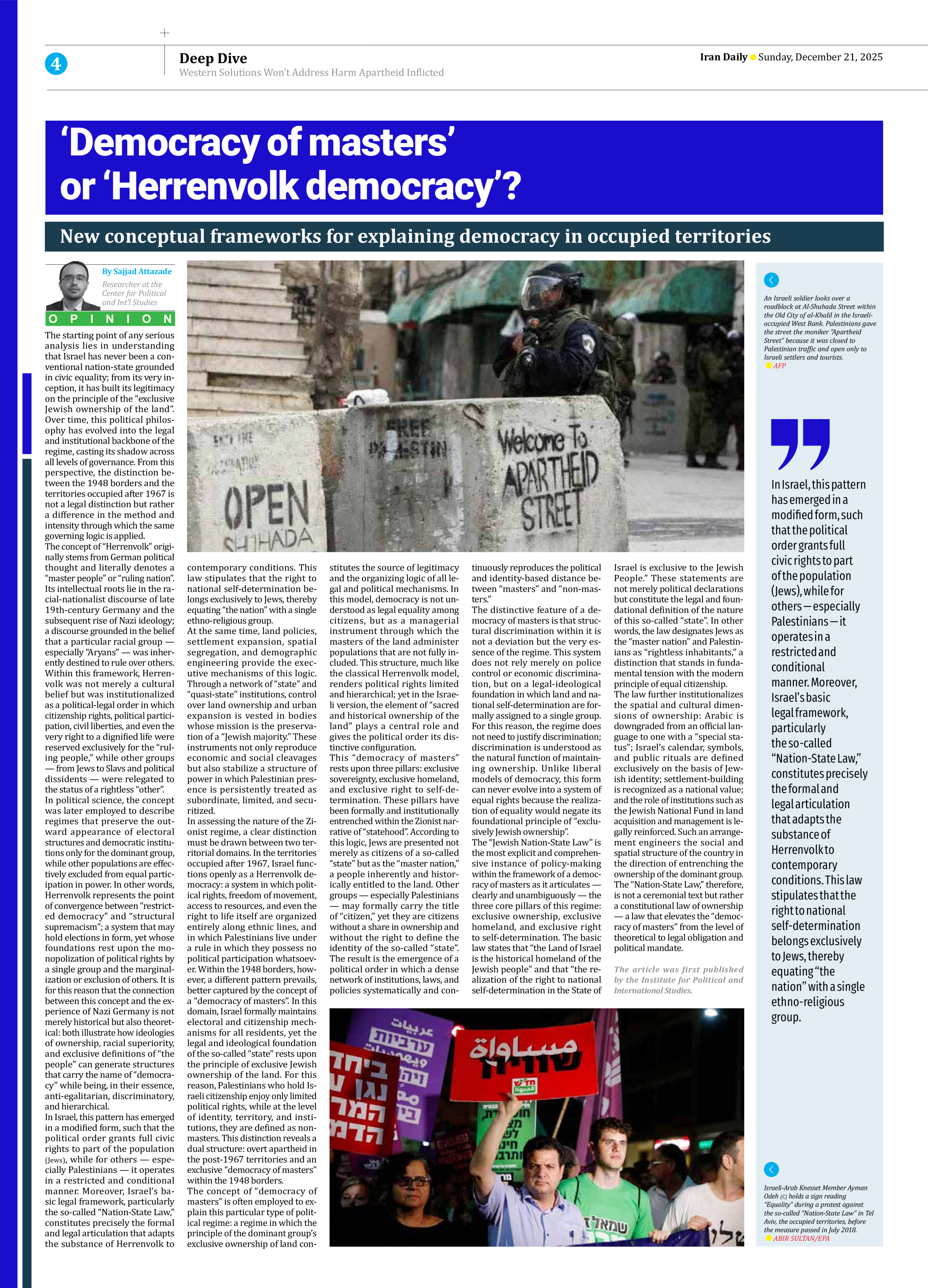


‘Democracy of masters’ or ‘Herrenvolk democracy’?
New conceptual frameworks for explaining democracy in occupied territories
By Sajjad Attazade
Researcher at the Center for Political and Int’l Studies
The starting point of any serious analysis lies in understanding that Israel has never been a conventional nation-state grounded in civic equality; from its very inception, it has built its legitimacy on the principle of the “exclusive Jewish ownership of the land”. Over time, this political philosophy has evolved into the legal and institutional backbone of the regime, casting its shadow across all levels of governance. From this perspective, the distinction between the 1948 borders and the territories occupied after 1967 is not a legal distinction but rather a difference in the method and intensity through which the same governing logic is applied.
The concept of “Herrenvolk” originally stems from German political thought and literally denotes a “master people” or “ruling nation”. Its intellectual roots lie in the racial-nationalist discourse of late 19th-century Germany and the subsequent rise of Nazi ideology; a discourse grounded in the belief that a particular racial group — especially “Aryans” — was inherently destined to rule over others. Within this framework, Herrenvolk was not merely a cultural belief but was institutionalized as a political-legal order in which citizenship rights, political participation, civil liberties, and even the very right to a dignified life were reserved exclusively for the “ruling people,” while other groups — from Jews to Slavs and political dissidents — were relegated to the status of a rightless “other”.
In political science, the concept was later employed to describe regimes that preserve the outward appearance of electoral structures and democratic institutions only for the dominant group, while other populations are effectively excluded from equal participation in power. In other words, Herrenvolk represents the point of convergence between “restricted democracy” and “structural supremacism”; a system that may hold elections in form, yet whose foundations rest upon the monopolization of political rights by a single group and the marginalization or exclusion of others. It is for this reason that the connection between this concept and the experience of Nazi Germany is not merely historical but also theoretical: both illustrate how ideologies of ownership, racial superiority, and exclusive definitions of “the people” can generate structures that carry the name of “democracy” while being, in their essence, anti-egalitarian, discriminatory, and hierarchical.
In Israel, this pattern has emerged in a modified form, such that the political order grants full civic rights to part of the population (Jews), while for others — especially Palestinians — it operates in a restricted and conditional manner. Moreover, Israel’s basic legal framework, particularly the so-called “Nation-State Law,” constitutes precisely the formal and legal articulation that adapts the substance of Herrenvolk to contemporary conditions. This law stipulates that the right to national self-determination belongs exclusively to Jews, thereby equating “the nation” with a single ethno-religious group.
At the same time, land policies, settlement expansion, spatial segregation, and demographic engineering provide the executive mechanisms of this logic. Through a network of “state” and “quasi-state” institutions, control over land ownership and urban expansion is vested in bodies whose mission is the preservation of a “Jewish majority.” These instruments not only reproduce economic and social cleavages but also stabilize a structure of power in which Palestinian presence is persistently treated as subordinate, limited, and securitized.
In assessing the nature of the Zionist regime, a clear distinction must be drawn between two territorial domains. In the territories occupied after 1967, Israel functions openly as a Herrenvolk democracy: a system in which political rights, freedom of movement, access to resources, and even the right to life itself are organized entirely along ethnic lines, and in which Palestinians live under a rule in which they possess no political participation whatsoever. Within the 1948 borders, however, a different pattern prevails, better captured by the concept of a “democracy of masters”. In this domain, Israel formally maintains electoral and citizenship mechanisms for all residents, yet the legal and ideological foundation of the so-called “state” rests upon the principle of exclusive Jewish ownership of the land. For this reason, Palestinians who hold Israeli citizenship enjoy only limited political rights, while at the level of identity, territory, and institutions, they are defined as non- masters. This distinction reveals a dual structure: overt apartheid in the post-1967 territories and an exclusive “democracy of masters” within the 1948 borders.
The concept of “democracy of masters” is often employed to explain this particular type of political regime: a regime in which the principle of the dominant group’s exclusive ownership of land constitutes the source of legitimacy and the organizing logic of all legal and political mechanisms. In this model, democracy is not understood as legal equality among citizens, but as a managerial instrument through which the masters of the land administer populations that are not fully included. This structure, much like the classical Herrenvolk model, renders political rights limited and hierarchical; yet in the Israeli version, the element of “sacred and historical ownership of the land” plays a central role and gives the political order its distinctive configuration.
This “democracy of masters” rests upon three pillars: exclusive sovereignty, exclusive homeland, and exclusive right to self-determination. These pillars have been formally and institutionally entrenched within the Zionist narrative of “statehood”. According to this logic, Jews are presented not merely as citizens of a so-called “state” but as the “master nation,” a people inherently and historically entitled to the land. Other groups — especially Palestinians — may formally carry the title of “citizen,” yet they are citizens without a share in ownership and without the right to define the identity of the so-called “state”. The result is the emergence of a political order in which a dense network of institutions, laws, and policies systematically and continuously reproduces the political and identity-based distance between “masters” and “non-masters.”
The distinctive feature of a democracy of masters is that structural discrimination within it is not a deviation but the very essence of the regime. This system does not rely merely on police control or economic discrimination, but on a legal-ideological foundation in which land and national self-determination are formally assigned to a single group. For this reason, the regime does not need to justify discrimination; discrimination is understood as the natural function of maintaining ownership. Unlike liberal models of democracy, this form can never evolve into a system of equal rights because the realization of equality would negate its foundational principle of “exclusively Jewish ownership”.
The “Jewish Nation-State Law” is the most explicit and comprehensive instance of policy-making within the framework of a democracy of masters as it articulates — clearly and unambiguously — the three core pillars of this regime: exclusive ownership, exclusive homeland, and exclusive right to self-determination. The basic law states that “the Land of Israel is the historical homeland of the Jewish people” and that “the realization of the right to national self-determination in the State of Israel is exclusive to the Jewish People.” These statements are not merely political declarations but constitute the legal and foundational definition of the nature of this so-called “state”. In other words, the law designates Jews as the “master nation” and Palestinians as “rightless inhabitants,” a distinction that stands in fundamental tension with the modern principle of equal citizenship.
The law further institutionalizes the spatial and cultural dimensions of ownership: Arabic is downgraded from an official language to one with a “special status”; Israel’s calendar, symbols, and public rituals are defined exclusively on the basis of Jewish identity; settlement-building is recognized as a national value; and the role of institutions such as the Jewish National Fund in land acquisition and management is legally reinforced. Such an arrangement engineers the social and spatial structure of the country in the direction of entrenching the ownership of the dominant group. The “Nation-State Law,” therefore, is not a ceremonial text but rather a constitutional law of ownership — a law that elevates the “democracy of masters” from the level of theoretical to legal obligation and political mandate.
The article was first published by the Institute for Political and
International Studies.