





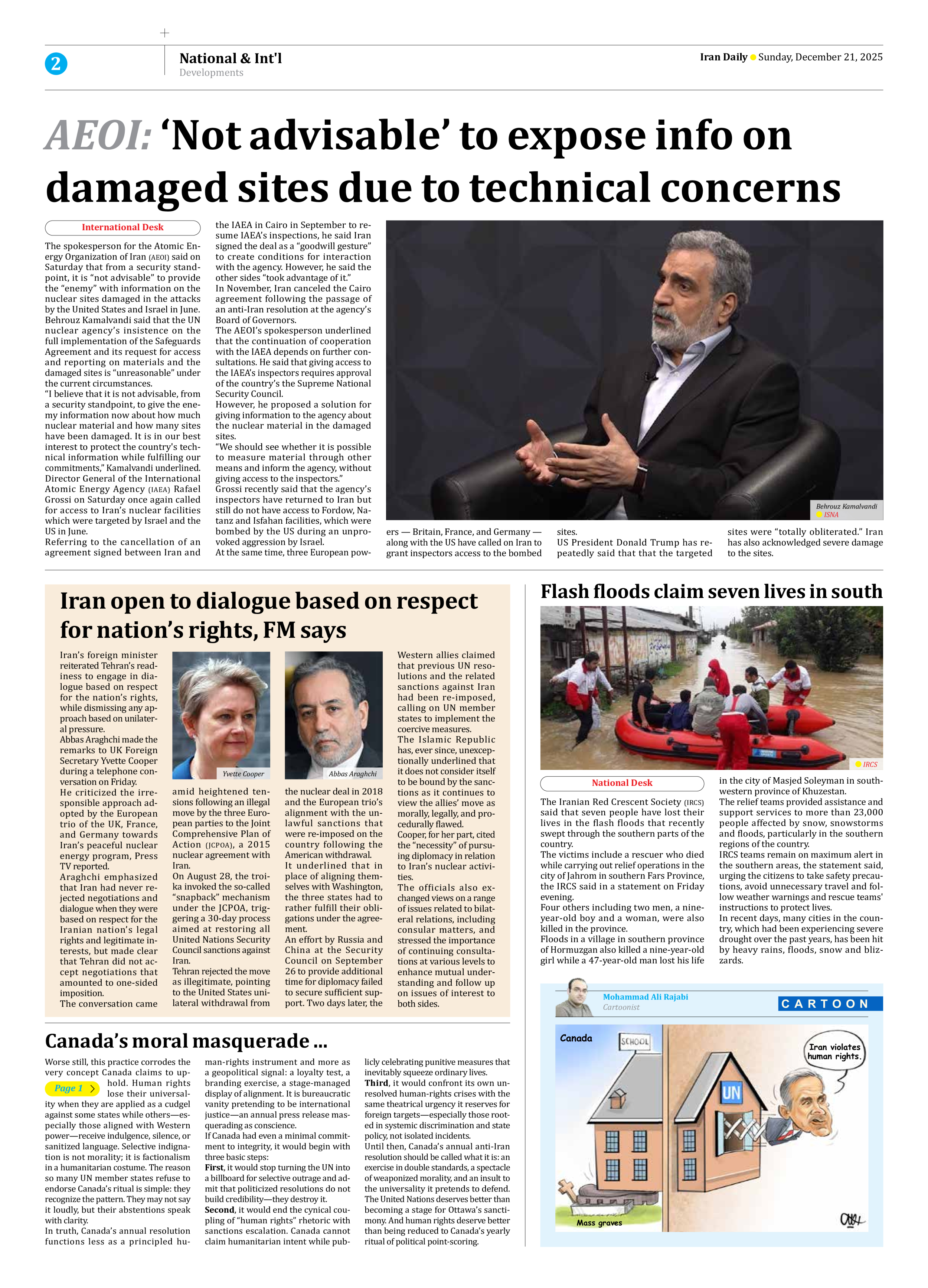


Canada’s moral masquerade ...
Page 1
Worse still, this practice corrodes the very concept Canada claims to uphold. Human rights lose their universality when they are applied as a cudgel against some states while others—especially those aligned with Western power—receive indulgence, silence, or sanitized language. Selective indignation is not morality; it is factionalism in a humanitarian costume. The reason so many UN member states refuse to endorse Canada’s ritual is simple: they recognize the pattern. They may not say it loudly, but their abstentions speak with clarity.
In truth, Canada’s annual resolution functions less as a principled human-rights instrument and more as a geopolitical signal: a loyalty test, a branding exercise, a stage-managed display of alignment. It is bureaucratic vanity pretending to be international justice—an annual press release masquerading as conscience.
If Canada had even a minimal commitment to integrity, it would begin with three basic steps:
First, it would stop turning the UN into a billboard for selective outrage and admit that politicized resolutions do not build credibility—they destroy it.
Second, it would end the cynical coupling of “human rights” rhetoric with sanctions escalation. Canada cannot claim humanitarian intent while publicly celebrating punitive measures that inevitably squeeze ordinary lives.
Third, it would confront its own unresolved human-rights crises with the same theatrical urgency it reserves for foreign targets—especially those rooted in systemic discrimination and state policy, not isolated incidents.
Until then, Canada’s annual anti-Iran resolution should be called what it is: an exercise in double standards, a spectacle of weaponized morality, and an insult to the universality it pretends to defend. The United Nations deserves better than becoming a stage for Ottawa’s sanctimony. And human rights deserve better than being reduced to Canada’s yearly ritual of political point-scoring.