





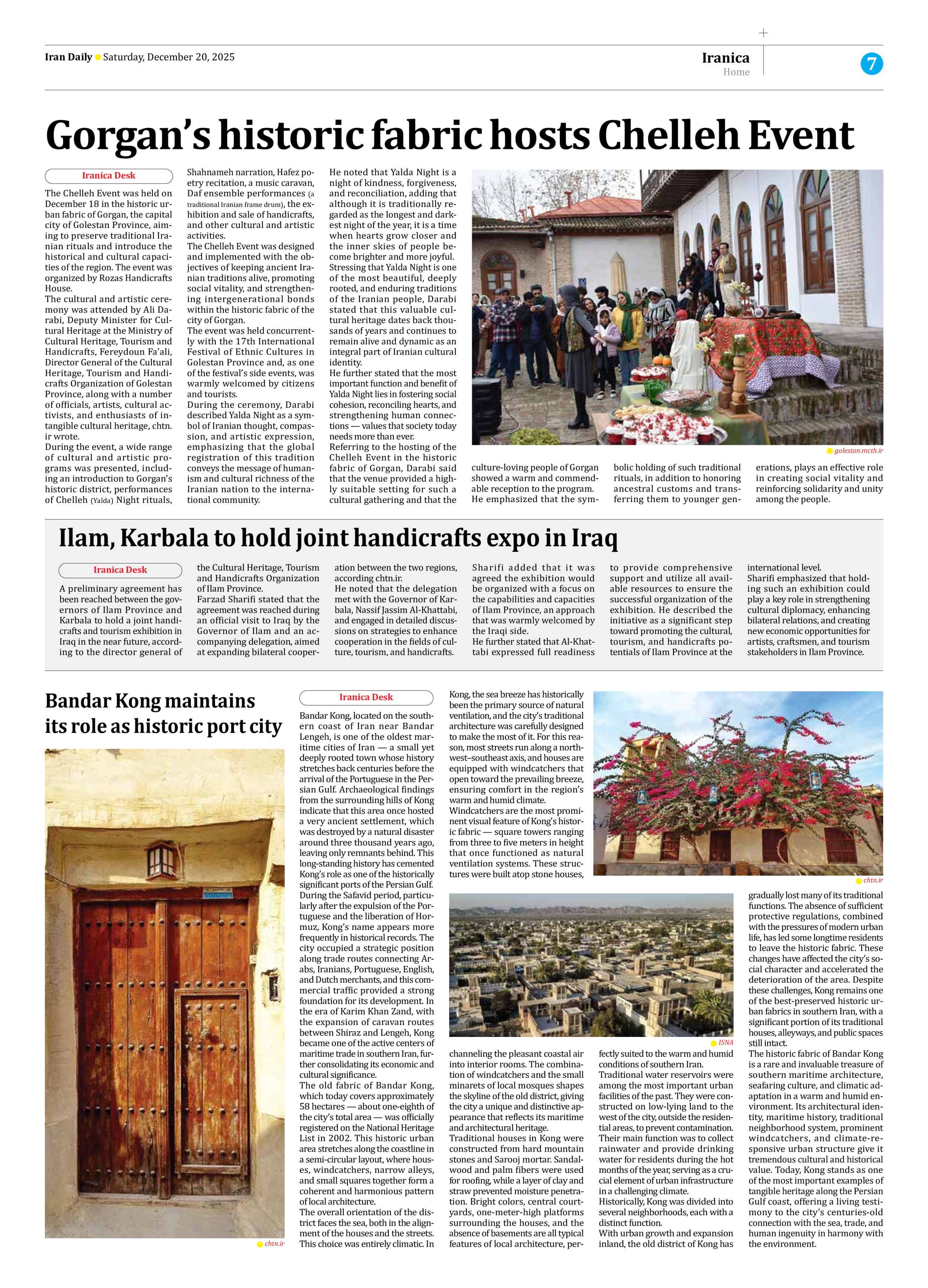


Bandar Kong maintains its role as historic port city
Bandar Kong, located on the southern coast of Iran near Bandar Lengeh, is one of the oldest maritime cities of Iran — a small yet deeply rooted town whose history stretches back centuries before the arrival of the Portuguese in the Persian Gulf. Archaeological findings from the surrounding hills of Kong indicate that this area once hosted a very ancient settlement, which was destroyed by a natural disaster around three thousand years ago, leaving only remnants behind. This long-standing history has cemented Kong’s role as one of the historically significant ports of the Persian Gulf.
During the Safavid period, particularly after the expulsion of the Portuguese and the liberation of Hormuz, Kong’s name appears more frequently in historical records. The city occupied a strategic position along trade routes connecting Arabs, Iranians, Portuguese, English, and Dutch merchants, and this commercial traffic provided a strong foundation for its development. In the era of Karim Khan Zand, with the expansion of caravan routes between Shiraz and Lengeh, Kong became one of the active centers of maritime trade in southern Iran, further consolidating its economic and cultural significance.
The old fabric of Bandar Kong, which today covers approximately 58 hectares — about one-eighth of the city’s total area — was officially registered on the National Heritage List in 2002. This historic urban area stretches along the coastline in a semi-circular layout, where houses, windcatchers, narrow alleys, and small squares together form a coherent and harmonious pattern of local architecture.
The overall orientation of the district faces the sea, both in the alignment of the houses and the streets. This choice was entirely climatic. In Kong, the sea breeze has historically been the primary source of natural ventilation, and the city’s traditional architecture was carefully designed to make the most of it. For this reason, most streets run along a northwest–southeast axis, and houses are equipped with windcatchers that open toward the prevailing breeze, ensuring comfort in the region’s warm and humid climate.
Windcatchers are the most prominent visual feature of Kong’s historic fabric — square towers ranging from three to five meters in height that once functioned as natural ventilation systems. These structures were built atop stone houses, channeling the pleasant coastal air into interior rooms. The combination of windcatchers and the small minarets of local mosques shapes the skyline of the old district, giving the city a unique and distinctive appearance that reflects its maritime and architectural heritage.
Traditional houses in Kong were constructed from hard mountain stones and Sarooj mortar. Sandalwood and palm fibers were used for roofing, while a layer of clay and straw prevented moisture penetration. Bright colors, central courtyards, one-meter-high platforms surrounding the houses, and the absence of basements are all typical features of local architecture, perfectly suited to the warm and humid conditions of southern Iran.
Traditional water reservoirs were among the most important urban facilities of the past. They were constructed on low-lying land to the west of the city, outside the residential areas, to prevent contamination. Their main function was to collect rainwater and provide drinking water for residents during the hot months of the year, serving as a crucial element of urban infrastructure in a challenging climate.
Historically, Kong was divided into several neighborhoods, each with a distinct function.
With urban growth and expansion inland, the old district of Kong has gradually lost many of its traditional functions. The absence of sufficient protective regulations, combined with the pressures of modern urban life, has led some longtime residents to leave the historic fabric. These changes have affected the city’s social character and accelerated the deterioration of the area. Despite these challenges, Kong remains one of the best-preserved historic urban fabrics in southern Iran, with a significant portion of its traditional houses, alleyways, and public spaces still intact.
The historic fabric of Bandar Kong is a rare and invaluable treasure of southern maritime architecture, seafaring culture, and climatic adaptation in a warm and humid environment. Its architectural identity, maritime history, traditional neighborhood system, prominent windcatchers, and climate-responsive urban structure give it tremendous cultural and historical value. Today, Kong stands as one of the most important examples of tangible heritage along the Persian Gulf coast, offering a living testimony to the city’s centuries-old connection with the sea, trade, and human ingenuity in harmony with the environment.