





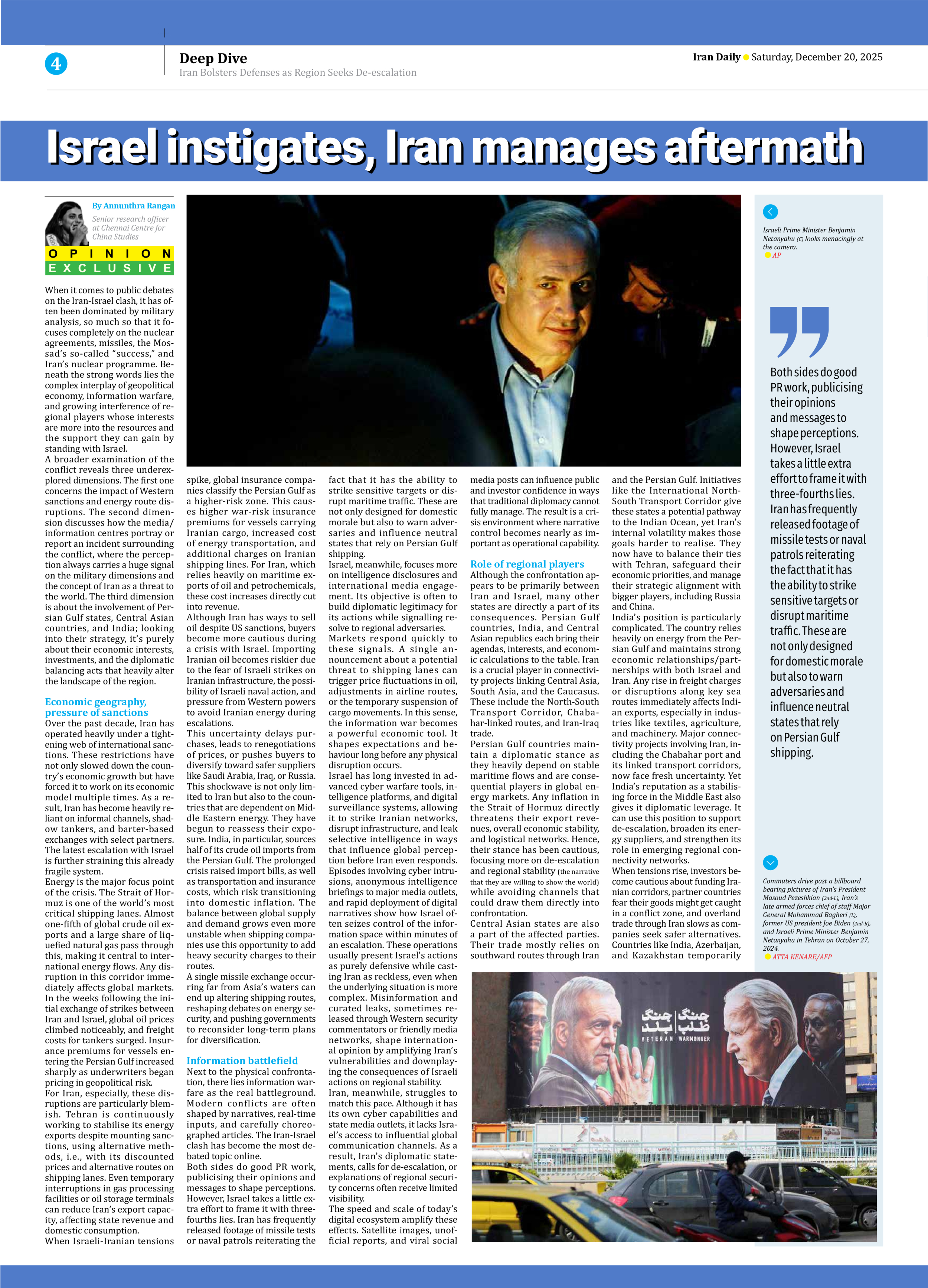


Israel instigates, Iran manages aftermath
By Annunthra Rangan
Senior research officer at Chennai Centre for China Studies
When it comes to public debates on the Iran-Israel clash, it has often been dominated by military analysis, so much so that it focuses completely on the nuclear agreements, missiles, the Mossad’s so-called “success,” and Iran’s nuclear programme. Beneath the strong words lies the complex interplay of geopolitical economy, information warfare, and growing interference of regional players whose interests are more into the resources and the support they can gain by standing with Israel.
A broader examination of the conflict reveals three underexplored dimensions. The first one concerns the impact of Western sanctions and energy route disruptions. The second dimension discusses how the media/information centres portray or report an incident surrounding the conflict, where the perception always carries a huge signal on the military dimensions and the concept of Iran as a threat to the world. The third dimension is about the involvement of Persian Gulf states, Central Asian countries, and India; looking into their strategy, it’s purely about their economic interests, investments, and the diplomatic balancing acts that heavily alter the landscape of the region.
Economic geography, pressure of sanctions
Over the past decade, Iran has operated heavily under a tightening web of international sanctions. These restrictions have not only slowed down the country’s economic growth but have forced it to work on its economic model multiple times. As a result, Iran has become heavily reliant on informal channels, shadow tankers, and barter-based exchanges with select partners. The latest escalation with Israel is further straining this already fragile system.
Energy is the major focus point of the crisis. The Strait of Hormuz is one of the world’s most critical shipping lanes. Almost one-fifth of global crude oil exports and a large share of liquefied natural gas pass through this, making it central to international energy flows. Any disruption in this corridor immediately affects global markets. In the weeks following the initial exchange of strikes between Iran and Israel, global oil prices climbed noticeably, and freight costs for tankers surged. Insurance premiums for vessels entering the Persian Gulf increased sharply as underwriters began pricing in geopolitical risk.
For Iran, especially, these disruptions are particularly blemish. Tehran is continuously working to stabilise its energy exports despite mounting sanctions, using alternative methods, i.e., with its discounted prices and alternative routes on shipping lanes. Even temporary interruptions in gas processing facilities or oil storage terminals can reduce Iran’s export capacity, affecting state revenue and domestic consumption.
When Israeli-Iranian tensions spike, global insurance companies classify the Persian Gulf as a higher-risk zone. This causes higher war-risk insurance premiums for vessels carrying Iranian cargo, increased cost of energy transportation, and additional charges on Iranian shipping lines. For Iran, which relies heavily on maritime exports of oil and petrochemicals, these cost increases directly cut into revenue.
Although Iran has ways to sell oil despite US sanctions, buyers become more cautious during a crisis with Israel. Importing Iranian oil becomes riskier due to the fear of Israeli strikes on Iranian infrastructure, the possibility of Israeli naval action, and pressure from Western powers to avoid Iranian energy during escalations.
This uncertainty delays purchases, leads to renegotiations of prices, or pushes buyers to diversify toward safer suppliers like Saudi Arabia, Iraq, or Russia.
This shockwave is not only limited to Iran but also to the countries that are dependent on Middle Eastern energy. They have begun to reassess their exposure. India, in particular, sources half of its crude oil imports from the Persian Gulf. The prolonged crisis raised import bills, as well as transportation and insurance costs, which risk transitioning into domestic inflation. The balance between global supply and demand grows even more unstable when shipping companies use this opportunity to add heavy security charges to their routes.
A single missile exchange occurring far from Asia’s waters can end up altering shipping routes, reshaping debates on energy security, and pushing governments to reconsider long-term plans for diversification.
Information battlefield
Next to the physical confrontation, there lies information warfare as the real battleground. Modern conflicts are often shaped by narratives, real-time inputs, and carefully choreographed articles. The Iran-Israel clash has become the most debated topic online.
Both sides do good PR work, publicising their opinions and messages to shape perceptions. However, Israel takes a little extra effort to frame it with three-fourths lies. Iran has frequently released footage of missile tests or naval patrols reiterating the fact that it has the ability to strike sensitive targets or disrupt maritime traffic. These are not only designed for domestic morale but also to warn adversaries and influence neutral states that rely on Persian Gulf shipping.
Israel, meanwhile, focuses more on intelligence disclosures and international media engagement. Its objective is often to build diplomatic legitimacy for its actions while signalling resolve to regional adversaries.
Markets respond quickly to these signals. A single announcement about a potential threat to shipping lanes can trigger price fluctuations in oil, adjustments in airline routes, or the temporary suspension of cargo movements. In this sense, the information war becomes a powerful economic tool. It shapes expectations and behaviour long before any physical disruption occurs.
Israel has long invested in advanced cyber warfare tools, intelligence platforms, and digital surveillance systems, allowing it to strike Iranian networks, disrupt infrastructure, and leak selective intelligence in ways that influence global perception before Iran even responds. Episodes involving cyber intrusions, anonymous intelligence briefings to major media outlets, and rapid deployment of digital narratives show how Israel often seizes control of the information space within minutes of an escalation. These operations usually present Israel’s actions as purely defensive while casting Iran as reckless, even when the underlying situation is more complex. Misinformation and curated leaks, sometimes released through Western security commentators or friendly media networks, shape international opinion by amplifying Iran’s vulnerabilities and downplaying the consequences of Israeli actions on regional stability.
Iran, meanwhile, struggles to match this pace. Although it has its own cyber capabilities and state media outlets, it lacks Israel’s access to influential global communication channels. As a result, Iran’s diplomatic statements, calls for de-escalation, or explanations of regional security concerns often receive limited visibility.
The speed and scale of today’s digital ecosystem amplify these effects. Satellite images, unofficial reports, and viral social media posts can influence public and investor confidence in ways that traditional diplomacy cannot fully manage. The result is a crisis environment where narrative control becomes nearly as important as operational capability.
Role of regional players
Although the confrontation appears to be primarily between Iran and Israel, many other states are directly a part of its consequences. Persian Gulf countries, India, and Central Asian republics each bring their agendas, interests, and economic calculations to the table. Iran is a crucial player in connectivity projects linking Central Asia, South Asia, and the Caucasus. These include the North-South Transport Corridor, Chabahar-linked routes, and Iran-Iraq trade.
Persian Gulf countries maintain a diplomatic stance as they heavily depend on stable maritime flows and are consequential players in global energy markets. Any inflation in the Strait of Hormuz directly threatens their export revenues, overall economic stability, and logistical networks. Hence, their stance has been cautious, focusing more on de-escalation and regional stability (the narrative that they are willing to show the world) while avoiding channels that could draw them directly into confrontation.
Central Asian states are also a part of the affected parties. Their trade mostly relies on southward routes through Iran and the Persian Gulf. Initiatives like the International North-South Transport Corridor give these states a potential pathway to the Indian Ocean, yet Iran’s internal volatility makes those goals harder to realise. They now have to balance their ties with Tehran, safeguard their economic priorities, and manage their strategic alignment with bigger players, including Russia and China.
India’s position is particularly complicated. The country relies heavily on energy from the Persian Gulf and maintains strong economic relationships/partnerships with both Israel and Iran. Any rise in freight charges or disruptions along key sea routes immediately affects Indian exports, especially in industries like textiles, agriculture, and machinery. Major connectivity projects involving Iran, including the Chabahar port and its linked transport corridors, now face fresh uncertainty. Yet India’s reputation as a stabilising force in the Middle East also gives it diplomatic leverage. It can use this position to support de-escalation, broaden its energy suppliers, and strengthen its role in emerging regional connectivity networks.
When tensions rise, investors become cautious about funding Iranian corridors, partner countries fear their goods might get caught in a conflict zone, and overland trade through Iran slows as companies seek safer alternatives. Countries like India, Azerbaijan, and Kazakhstan temporarily pause or reevaluate their plans that depend on Iranian territory.
Investors already wary because of sanctions become even more hesitant when Iran enters a cycle of confrontation with Israel. Foreign investors respond to tensions between Israel and Iran with considerable caution, often delaying infrastructure and energy projects, pausing technology or mining partnerships, and cancelling long-term exploration or trade plans altogether as the psychological weight of uncertainty makes Tehran a far less attractive destination for capital.
Countries that maintain ties with both sides also adopt subtle protective measures, such as slowing bilateral trade, adding extra checks on Iranian shipments, and restricting banking channels to avoid secondary risks. Inside Iran, markets react almost immediately; the rial typically weakens on fears of escalation, import prices for essentials like food, machinery, and medicine increase, stock markets become volatile, and households and businesses begin stockpiling goods, which further fuels inflation.
Continental consequences
Disruptions in the Persian Gulf immediately alter pricing models for crude benchmarks used in Europe and Asia, forcing energy-importing economies such as India, South Korea, and Japan to adjust procurement schedules and hedge more aggressively. Escalation also affects the calculations of major transport corridors: freight moving through the Suez Canal faces rerouting pressures, European buyers reconsider the reliability of East-West supply chains, and Central Asian states reassess the long-term viability of corridors that depend on Iranian territory. Cyber exchanges between Israel and Iran trigger precautionary reviews across global financial networks as banks and payment systems in Asia and Europe increase monitoring for spillover attacks. At the diplomatic level, the confrontation complicates the strategic balancing acts of countries that engage with both sides, particularly India, Turkey, Qatar, and the UAE, pushing them to recalibrate voting patterns in multilateral forums and reassess defence procurements tied to either bloc.
Iran-Israel is a classic example of how a conflict can extend far beyond its major participants. Any conflict between countries alters the course of economic routes and global trade, accelerates conversations about energy diversification, and pushes the others to take sides.
The crisis is not only about weapons, retaliations, and power show off. It majorly decides and dictates the instability in the region and how it will cause rippling effects across the world.