





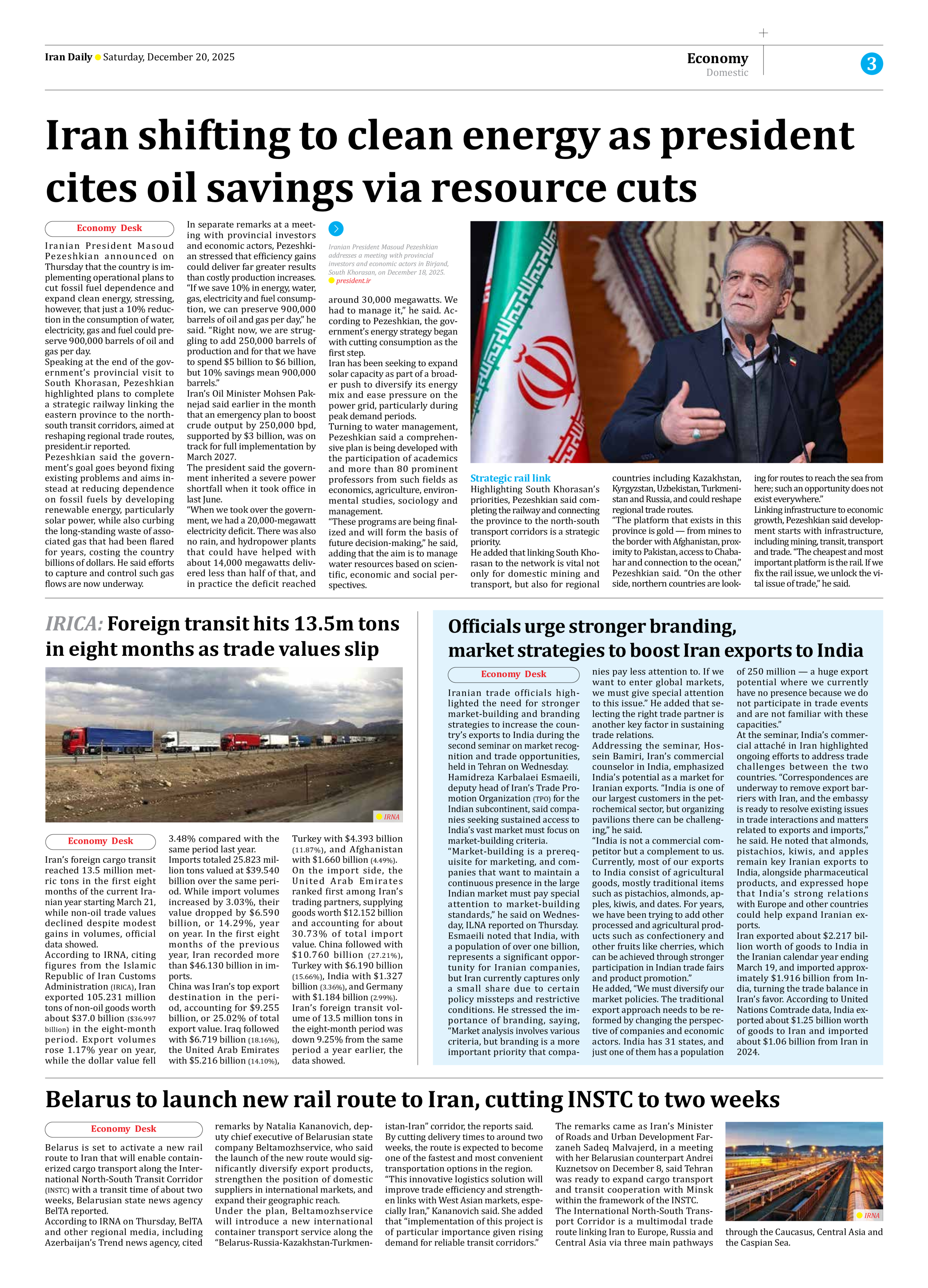


Iran shifting to clean energy as president cites oil savings via resource cuts
Iranian President Masoud Pezeshkian announced on Thursday that the country is implementing operational plans to cut fossil fuel dependence and expand clean energy, stressing, however, that just a 10% reduction in the consumption of water, electricity, gas and fuel could preserve 900,000 barrels of oil and gas per day.
Speaking at the end of the government’s provincial visit to South Khorasan, Pezeshkian highlighted plans to complete a strategic railway linking the eastern province to the north-south transit corridors, aimed at reshaping regional trade routes, president.ir reported.
Pezeshkian said the government’s goal goes beyond fixing existing problems and aims instead at reducing dependence on fossil fuels by developing renewable energy, particularly solar power, while also curbing the long-standing waste of associated gas that had been flared for years, costing the country billions of dollars. He said efforts to capture and control such gas flows are now underway.
In separate remarks at a meeting with provincial investors and economic actors, Pezeshkian stressed that efficiency gains could deliver far greater results than costly production increases. “If we save 10% in energy, water, gas, electricity and fuel consumption, we can preserve 900,000 barrels of oil and gas per day,” he said. “Right now, we are struggling to add 250,000 barrels of production and for that we have to spend $5 billion to $6 billion, but 10% savings mean 900,000 barrels.”
Iran’s Oil Minister Mohsen Paknejad said earlier in the month that an emergency plan to boost crude output by 250,000 bpd, supported by $3 billion, was on track for full implementation by March 2027.
The president said the government inherited a severe power shortfall when it took office in last June.
“When we took over the government, we had a 20,000-megawatt electricity deficit. There was also no rain, and hydropower plants that could have helped with about 14,000 megawatts delivered less than half of that, and in practice the deficit reached around 30,000 megawatts. We had to manage it,” he said. According to Pezeshkian, the government’s energy strategy began with cutting consumption as the first step.
Iran has been seeking to expand solar capacity as part of a broader push to diversify its energy mix and ease pressure on the power grid, particularly during peak demand periods.
Turning to water management, Pezeshkian said a comprehensive plan is being developed with the participation of academics and more than 80 prominent professors from such fields as economics, agriculture, environmental studies, sociology and management.
“These programs are being finalized and will form the basis of future decision-making,” he said, adding that the aim is to manage water resources based on scientific, economic and social perspectives.
Strategic rail link
Highlighting South Khorasan’s priorities, Pezeshkian said completing the railway and connecting the province to the north-south transport corridors is a strategic priority.
He added that linking South Khorasan to the network is vital not only for domestic mining and transport, but also for regional countries including Kazakhstan, Kyrgyzstan, Uzbekistan, Turkmenistan and Russia, and could reshape regional trade routes.
“The platform that exists in this province is gold — from mines to the border with Afghanistan, proximity to Pakistan, access to Chabahar and connection to the ocean,” Pezeshkian said. “On the other side, northern countries are looking for routes to reach the sea from here; such an opportunity does not exist everywhere.”
Linking infrastructure to economic growth, Pezeshkian said development starts with infrastructure, including mining, transit, transport and trade. “The cheapest and most important platform is the rail. If we fix the rail issue, we unlock the vital issue of trade,” he said.