







Curtains down on Haqiqat Cinema
Iran’s rich history, diversity contribute to documentary cinema: Minister
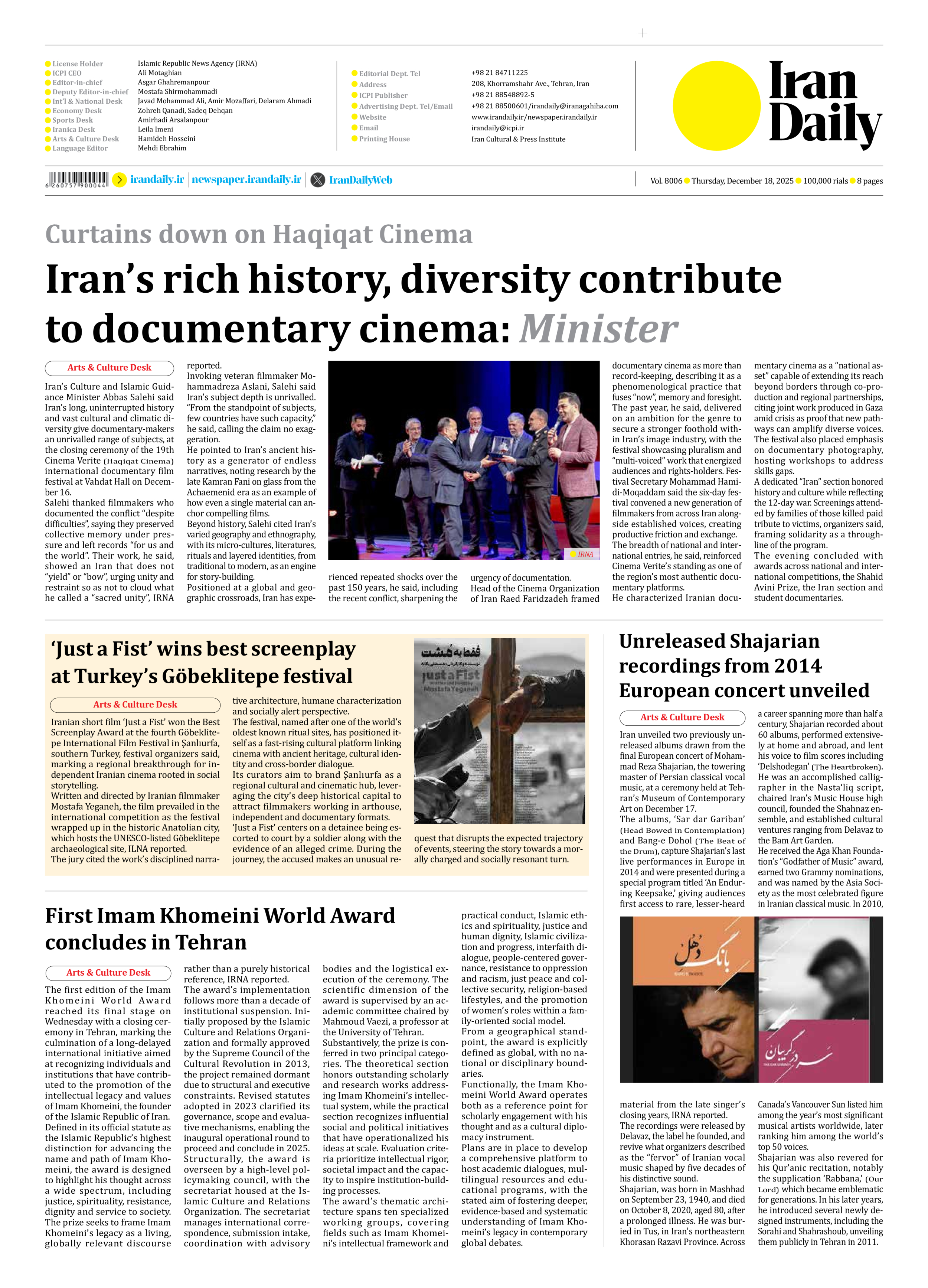
Iran’s Culture and Islamic Guidance Minister Abbas Salehi said Iran’s long, uninterrupted history and vast cultural and climatic diversity give documentary-makers an unrivalled range of subjects, at the closing ceremony of the 19th Cinema Verite (Haqiqat Cinema) international documentary film festival at Vahdat Hall on December 16.
Salehi thanked filmmakers who documented the conflict “despite difficulties”, saying they preserved collective memory under pressure and left records “for us and the world”. Their work, he said, showed an Iran that does not “yield” or “bow”, urging unity and restraint so as not to cloud what he called a “sacred unity”, IRNA reported.
Invoking veteran filmmaker Mohammadreza Aslani, Salehi said Iran’s subject depth is unrivalled. “From the standpoint of subjects, few countries have such capacity,” he said, calling the claim no exaggeration.
He pointed to Iran’s ancient history as a generator of endless narratives, noting research by the late Kamran Fani on glass from the Achaemenid era as an example of how even a single material can anchor compelling films.
Beyond history, Salehi cited Iran’s varied geography and ethnography, with its micro-cultures, literatures, rituals and layered identities, from traditional to modern, as an engine for story-building.
Positioned at a global and geographic crossroads, Iran has experienced repeated shocks over the past 150 years, he said, including the recent conflict, sharpening the urgency of documentation.
Head of the Cinema Organization of Iran Raed Faridzadeh framed documentary cinema as more than record-keeping, describing it as a phenomenological practice that fuses “now”, memory and foresight.
The past year, he said, delivered on an ambition for the genre to secure a stronger foothold within Iran’s image industry, with the festival showcasing pluralism and “multi-voiced” work that energized audiences and rights-holders. Festival Secretary Mohammad Hamidi-Moqaddam said the six-day festival convened a new generation of filmmakers from across Iran alongside established voices, creating productive friction and exchange.
The breadth of national and international entries, he said, reinforced Cinema Verite’s standing as one of the region’s most authentic documentary platforms.
He characterized Iranian documentary cinema as a “national asset” capable of extending its reach beyond borders through co-production and regional partnerships, citing joint work produced in Gaza amid crisis as proof that new pathways can amplify diverse voices. The festival also placed emphasis on documentary photography, hosting workshops to address skills gaps.
A dedicated “Iran” section honored history and culture while reflecting the 12-day war. Screenings attended by families of those killed paid tribute to victims, organizers said, framing solidarity as a through-line of the program.
The evening concluded with awards across national and international competitions, the Shahid Avini Prize, the Iran section and student documentaries.