





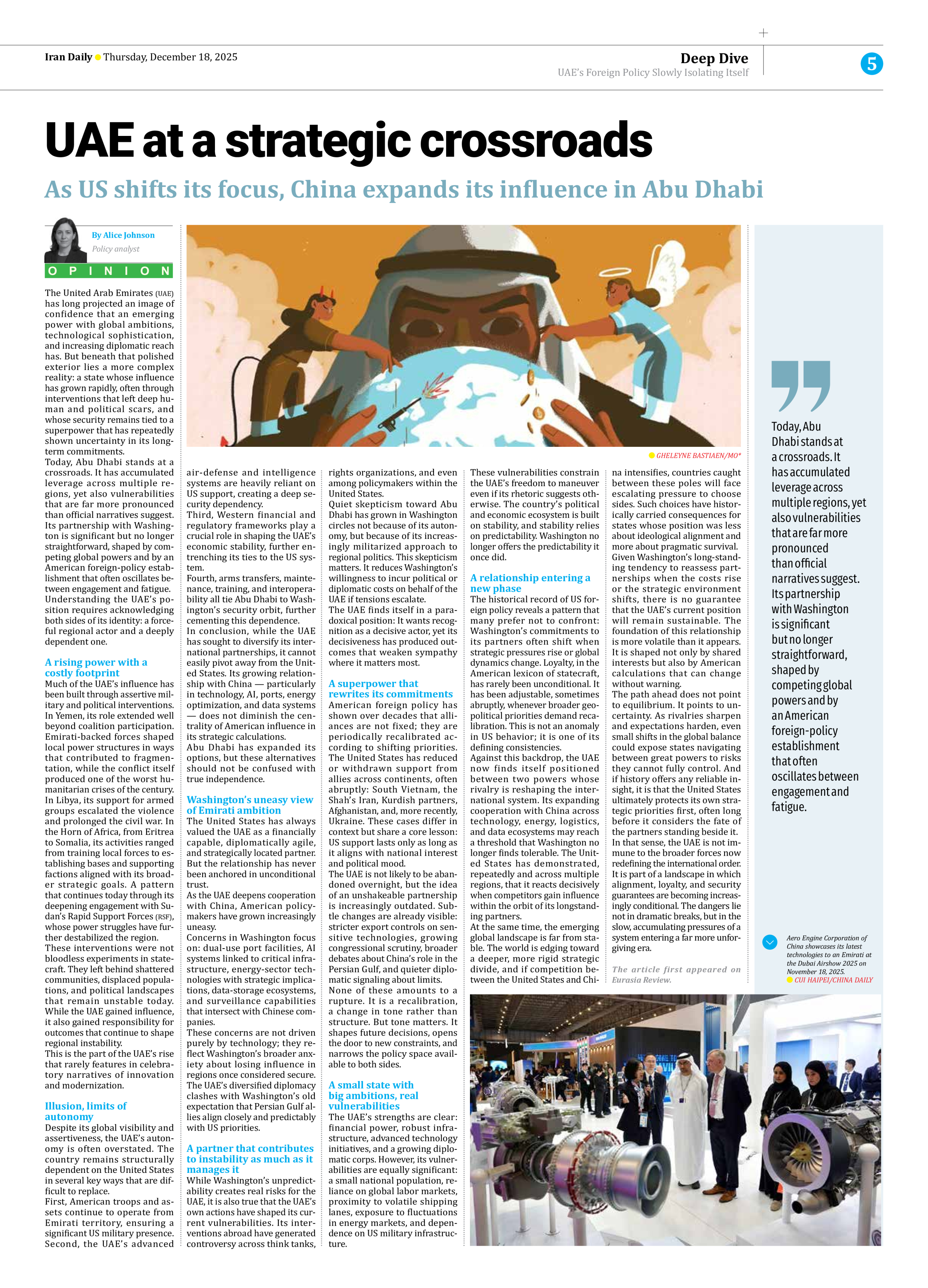


UAE at a strategic crossroads
As US shifts its focus, China expands its influence in Abu Dhabi
By Alice Johnson
Policy analyst
The United Arab Emirates (UAE) has long projected an image of confidence that an emerging power with global ambitions, technological sophistication, and increasing diplomatic reach has. But beneath that polished exterior lies a more complex reality: a state whose influence has grown rapidly, often through interventions that left deep human and political scars, and whose security remains tied to a superpower that has repeatedly shown uncertainty in its long-term commitments.
Today, Abu Dhabi stands at a crossroads. It has accumulated leverage across multiple regions, yet also vulnerabilities that are far more pronounced than official narratives suggest. Its partnership with Washington is significant but no longer straightforward, shaped by competing global powers and by an American foreign-policy establishment that often oscillates between engagement and fatigue.
Understanding the UAE’s position requires acknowledging both sides of its identity: a forceful regional actor and a deeply dependent one.
A rising power with a costly footprint
Much of the UAE’s influence has been built through assertive military and political interventions. In Yemen, its role extended well beyond coalition participation. Emirati-backed forces shaped local power structures in ways that contributed to fragmentation, while the conflict itself produced one of the worst humanitarian crises of the century. In Libya, its support for armed groups escalated the violence and prolonged the civil war. In the Horn of Africa, from Eritrea to Somalia, its activities ranged from training local forces to establishing bases and supporting factions aligned with its broader strategic goals. A pattern that continues today through its deepening engagement with Sudan’s Rapid Support Forces (RSF), whose power struggles have further destabilized the region.
These interventions were not bloodless experiments in statecraft. They left behind shattered communities, displaced populations, and political landscapes that remain unstable today. While the UAE gained influence, it also gained responsibility for outcomes that continue to shape regional instability.
This is the part of the UAE’s rise that rarely features in celebratory narratives of innovation and modernization.
Illusion, limits of autonomy
Despite its global visibility and assertiveness, the UAE’s autonomy is often overstated. The country remains structurally dependent on the United States in several key ways that are difficult to replace.
First, American troops and assets continue to operate from Emirati territory, ensuring a significant US military presence.
Second, the UAE’s advanced air-defense and intelligence systems are heavily reliant on US support, creating a deep security dependency.
Third, Western financial and regulatory frameworks play a crucial role in shaping the UAE’s economic stability, further entrenching its ties to the US system.
Fourth, arms transfers, maintenance, training, and interoperability all tie Abu Dhabi to Washington’s security orbit, further cementing this dependence.
In conclusion, while the UAE has sought to diversify its international partnerships, it cannot easily pivot away from the United States. Its growing relationship with China — particularly in technology, AI, ports, energy optimization, and data systems — does not diminish the centrality of American influence in its strategic calculations.
Abu Dhabi has expanded its options, but these alternatives should not be confused with true independence.
Washington’s uneasy view of Emirati ambition
The United States has always valued the UAE as a financially capable, diplomatically agile, and strategically located partner. But the relationship has never been anchored in unconditional trust.
As the UAE deepens cooperation with China, American policymakers have grown increasingly uneasy.
Concerns in Washington focus on: dual-use port facilities, AI systems linked to critical infrastructure, energy-sector technologies with strategic implications, data-storage ecosystems, and surveillance capabilities that intersect with Chinese companies.
These concerns are not driven purely by technology; they reflect Washington’s broader anxiety about losing influence in regions once considered secure.
The UAE’s diversified diplomacy clashes with Washington’s old expectation that Persian Gulf allies align closely and predictably with US priorities.
A partner that contributes to instability as much as it manages it
While Washington’s unpredictability creates real risks for the UAE, it is also true that the UAE’s own actions have shaped its current vulnerabilities. Its interventions abroad have generated controversy across think tanks, rights organizations, and even among policymakers within the United States.
Quiet skepticism toward Abu Dhabi has grown in Washington circles not because of its autonomy, but because of its increasingly militarized approach to regional politics. This skepticism matters. It reduces Washington’s willingness to incur political or diplomatic costs on behalf of the UAE if tensions escalate.
The UAE finds itself in a paradoxical position: It wants recognition as a decisive actor, yet its decisiveness has produced outcomes that weaken sympathy where it matters most.
A superpower that rewrites its commitments
American foreign policy has shown over decades that alliances are not fixed; they are periodically recalibrated according to shifting priorities. The United States has reduced or withdrawn support from allies across continents, often abruptly: South Vietnam, the Shah’s Iran, Kurdish partners, Afghanistan, and, more recently, Ukraine. These cases differ in context but share a core lesson: US support lasts only as long as it aligns with national interest and political mood.
The UAE is not likely to be abandoned overnight, but the idea of an unshakeable partnership is increasingly outdated. Subtle changes are already visible: stricter export controls on sensitive technologies, growing congressional scrutiny, broader debates about China’s role in the Persian Gulf, and quieter diplomatic signaling about limits.
None of these amounts to a rupture. It is a recalibration, a change in tone rather than structure. But tone matters. It shapes future decisions, opens the door to new constraints, and narrows the policy space available to both sides.
A small state with big ambitions, real vulnerabilities
The UAE’s strengths are clear: financial power, robust infrastructure, advanced technology initiatives, and a growing diplomatic corps. However, its vulnerabilities are equally significant: a small national population, reliance on global labor markets, proximity to volatile shipping lanes, exposure to fluctuations in energy markets, and dependence on US military infrastructure.
These vulnerabilities constrain the UAE’s freedom to maneuver even if its rhetoric suggests otherwise. The country’s political and economic ecosystem is built on stability, and stability relies on predictability. Washington no longer offers the predictability it once did.
A relationship entering a new phase
The historical record of US foreign policy reveals a pattern that many prefer not to confront: Washington’s commitments to its partners often shift when strategic pressures rise or global dynamics change. Loyalty, in the American lexicon of statecraft, has rarely been unconditional. It has been adjustable, sometimes abruptly, whenever broader geopolitical priorities demand recalibration. This is not an anomaly in US behavior; it is one of its defining consistencies.
Against this backdrop, the UAE now finds itself positioned between two powers whose rivalry is reshaping the international system. Its expanding cooperation with China across technology, energy, logistics, and data ecosystems may reach a threshold that Washington no longer finds tolerable. The United States has demonstrated, repeatedly and across multiple regions, that it reacts decisively when competitors gain influence within the orbit of its longstanding partners.
At the same time, the emerging global landscape is far from stable. The world is edging toward a deeper, more rigid strategic divide, and if competition between the United States and China intensifies, countries caught between these poles will face escalating pressure to choose sides. Such choices have historically carried consequences for states whose position was less about ideological alignment and more about pragmatic survival.
Given Washington’s long-standing tendency to reassess partnerships when the costs rise or the strategic environment shifts, there is no guarantee that the UAE’s current position will remain sustainable. The foundation of this relationship is more volatile than it appears. It is shaped not only by shared interests but also by American calculations that can change without warning.
The path ahead does not point to equilibrium. It points to uncertainty. As rivalries sharpen and expectations harden, even small shifts in the global balance could expose states navigating between great powers to risks they cannot fully control. And if history offers any reliable insight, it is that the United States ultimately protects its own strategic priorities first, often long before it considers the fate of the partners standing beside it.
In that sense, the UAE is not immune to the broader forces now redefining the international order. It is part of a landscape in which alignment, loyalty, and security guarantees are becoming increasingly conditional. The dangers lie not in dramatic breaks, but in the slow, accumulating pressures of a system entering a far more unforgiving era.
The article first appeared on
Eurasia Review.