





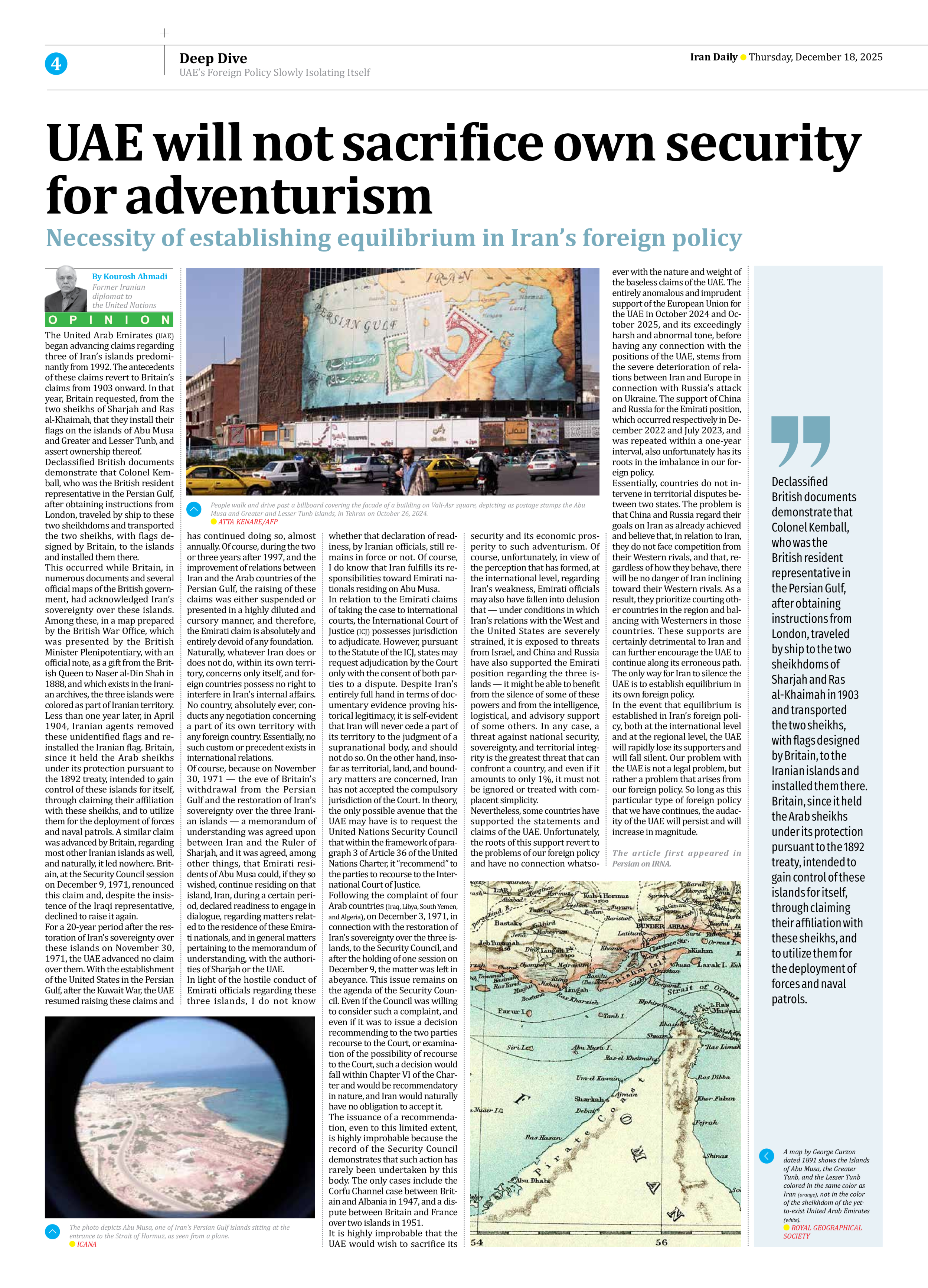


UAE will not sacrifice own security for adventurism
Necessity of establishing equilibrium in Iran’s foreign policy
By Kourosh Ahmadi
Former Iranian diplomat to
the United Nations
The United Arab Emirates (UAE) began advancing claims regarding three of Iran’s islands predominantly from 1992. The antecedents of these claims revert to Britain’s claims from 1903 onward. In that year, Britain requested, from the two sheikhs of Sharjah and Ras al-Khaimah, that they install their flags on the islands of Abu Musa and Greater and Lesser Tunb, and assert ownership thereof.
Declassified British documents demonstrate that Colonel Kemball, who was the British resident representative in the Persian Gulf, after obtaining instructions from London, traveled by ship to these two sheikhdoms and transported the two sheikhs, with flags designed by Britain, to the islands and installed them there.
This occurred while Britain, in numerous documents and several official maps of the British government, had acknowledged Iran’s sovereignty over these islands. Among these, in a map prepared by the British War Office, which was presented by the British Minister Plenipotentiary, with an official note, as a gift from the British Queen to Naser al-Din Shah in 1888, and which exists in the Iranian archives, the three islands were colored as part of Iranian territory.
Less than one year later, in April 1904, Iranian agents removed these unidentified flags and reinstalled the Iranian flag. Britain, since it held the Arab sheikhs under its protection pursuant to the 1892 treaty, intended to gain control of these islands for itself, through claiming their affiliation with these sheikhs, and to utilize them for the deployment of forces and naval patrols. A similar claim was advanced by Britain, regarding most other Iranian islands as well, and naturally, it led nowhere. Britain, at the Security Council session on December 9, 1971, renounced this claim and, despite the insistence of the Iraqi representative, declined to raise it again.
For a 20-year period after the restoration of Iran’s sovereignty over these islands on November 30, 1971, the UAE advanced no claim over them. With the establishment of the United States in the Persian Gulf, after the Kuwait War, the UAE resumed raising these claims and has continued doing so, almost annually. Of course, during the two or three years after 1997, and the improvement of relations between Iran and the Arab countries of the Persian Gulf, the raising of these claims was either suspended or presented in a highly diluted and cursory manner, and therefore, the Emirati claim is absolutely and entirely devoid of any foundation.
Naturally, whatever Iran does or does not do, within its own territory, concerns only itself, and foreign countries possess no right to interfere in Iran’s internal affairs. No country, absolutely ever, conducts any negotiation concerning a part of its own territory with any foreign country. Essentially, no such custom or precedent exists in international relations.
Of course, because on November 30, 1971 — the eve of Britain’s withdrawal from the Persian Gulf and the restoration of Iran’s sovereignty over the three Iranian islands — a memorandum of understanding was agreed upon between Iran and the Ruler of Sharjah, and it was agreed, among other things, that Emirati residents of Abu Musa could, if they so wished, continue residing on that island, Iran, during a certain period, declared readiness to engage in dialogue, regarding matters related to the residence of these Emirati nationals, and in general matters pertaining to the memorandum of understanding, with the authorities of Sharjah or the UAE.
In light of the hostile conduct of Emirati officials regarding these three islands, I do not know whether that declaration of readiness, by Iranian officials, still remains in force or not. Of course, I do know that Iran fulfills its responsibilities toward Emirati nationals residing on Abu Musa.
In relation to the Emirati claims of taking the case to international courts, the International Court of Justice (ICJ) possesses jurisdiction to adjudicate. However, pursuant to the Statute of the ICJ, states may request adjudication by the Court only with the consent of both parties to a dispute. Despite Iran’s entirely full hand in terms of documentary evidence proving historical legitimacy, it is self-evident that Iran will never cede a part of its territory to the judgment of a supranational body, and should not do so. On the other hand, insofar as territorial, land, and boundary matters are concerned, Iran has not accepted the compulsory jurisdiction of the Court. In theory, the only possible avenue that the UAE may have is to request the United Nations Security Council that within the framework of paragraph 3 of Article 36 of the United Nations Charter, it “recommend” to the parties to recourse to the International Court of Justice.
Following the complaint of four Arab countries (Iraq, Libya, South Yemen, and Algeria), on December 3, 1971, in connection with the restoration of Iran’s sovereignty over the three islands, to the Security Council, and after the holding of one session on December 9, the matter was left in abeyance. This issue remains on the agenda of the Security Council. Even if the Council was willing to consider such a complaint, and even if it was to issue a decision recommending to the two parties recourse to the Court, or examination of the possibility of recourse to the Court, such a decision would fall within Chapter VI of the Charter and would be recommendatory in nature, and Iran would naturally have no obligation to accept it.
The issuance of a recommendation, even to this limited extent, is highly improbable because the record of the Security Council demonstrates that such action has rarely been undertaken by this body. The only cases include the Corfu Channel case between Britain and Albania in 1947, and a dispute between Britain and France over two islands in 1951.
It is highly improbable that the UAE would wish to sacrifice its security and its economic prosperity to such adventurism. Of course, unfortunately, in view of the perception that has formed, at the international level, regarding Iran’s weakness, Emirati officials may also have fallen into delusion that — under conditions in which Iran’s relations with the West and the United States are severely strained, it is exposed to threats from Israel, and China and Russia have also supported the Emirati position regarding the three islands — it might be able to benefit from the silence of some of these powers and from the intelligence, logistical, and advisory support of some others. In any case, a threat against national security, sovereignty, and territorial integrity is the greatest threat that can confront a country, and even if it amounts to only 1%, it must not be ignored or treated with complacent simplicity.
Nevertheless, some countries have supported the statements and claims of the UAE. Unfortunately, the roots of this support revert to the problems of our foreign policy and have no connection whatsoever with the nature and weight of the baseless claims of the UAE. The entirely anomalous and imprudent support of the European Union for the UAE in October 2024 and October 2025, and its exceedingly harsh and abnormal tone, before having any connection with the positions of the UAE, stems from the severe deterioration of relations between Iran and Europe in connection with Russia’s attack on Ukraine. The support of China and Russia for the Emirati position, which occurred respectively in December 2022 and July 2023, and was repeated within a one-year interval, also unfortunately has its roots in the imbalance in our foreign policy.
Essentially, countries do not intervene in territorial disputes between two states. The problem is that China and Russia regard their goals on Iran as already achieved and believe that, in relation to Iran, they do not face competition from their Western rivals, and that, regardless of how they behave, there will be no danger of Iran inclining toward their Western rivals. As a result, they prioritize courting other countries in the region and balancing with Westerners in those countries. These supports are certainly detrimental to Iran and can further encourage the UAE to continue along its erroneous path. The only way for Iran to silence the UAE is to establish equilibrium in its own foreign policy.
In the event that equilibrium is established in Iran’s foreign policy, both at the international level and at the regional level, the UAE will rapidly lose its supporters and will fall silent. Our problem with the UAE is not a legal problem, but rather a problem that arises from our foreign policy. So long as this particular type of foreign policy that we have continues, the audacity of the UAE will persist and will increase in magnitude.
The article first appeared in
Persian on IRNA.