





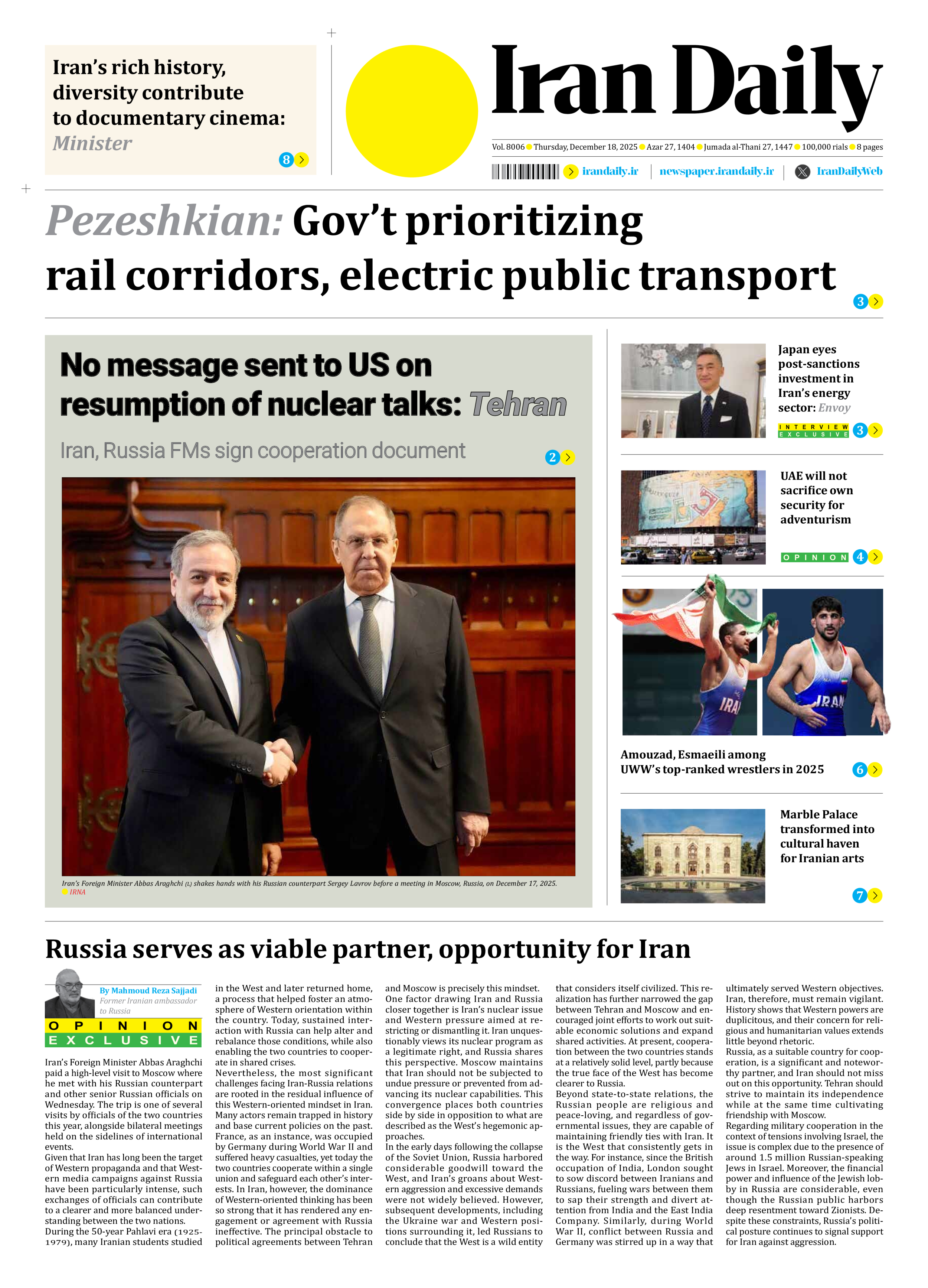


Russia serves as viable partner, opportunity for Iran
By Mahmoud Reza Sajjadi
Former Iranian ambassador to Russia
Iran’s Foreign Minister Abbas Araghchi paid a high-level visit to Moscow where he met with his Russian counterpart and other senior Russian officials on Wednesday. The trip is one of several visits by officials of the two countries this year, alongside bilateral meetings held on the sidelines of international events.
Given that Iran has long been the target of Western propaganda and that Western media campaigns against Russia have been particularly intense, such exchanges of officials can contribute to a clearer and more balanced understanding between the two nations.
During the 50-year Pahlavi era (1925-1979), many Iranian students studied in the West and later returned home, a process that helped foster an atmosphere of Western orientation within the country. Today, sustained interaction with Russia can help alter and rebalance those conditions, while also enabling the two countries to cooperate in shared crises.
Nevertheless, the most significant challenges facing Iran-Russia relations are rooted in the residual influence of this Western-oriented mindset in Iran. Many actors remain trapped in history and base current policies on the past. France, as an instance, was occupied by Germany during World War II and suffered heavy casualties, yet today the two countries cooperate within a single union and safeguard each other’s interests. In Iran, however, the dominance of Western-oriented thinking has been so strong that it has rendered any engagement or agreement with Russia ineffective. The principal obstacle to political agreements between Tehran and Moscow is precisely this mindset.
One factor drawing Iran and Russia closer together is Iran’s nuclear issue and Western pressure aimed at restricting or dismantling it. Iran unquestionably views its nuclear program as a legitimate right, and Russia shares this perspective. Moscow maintains that Iran should not be subjected to undue pressure or prevented from advancing its nuclear capabilities. This convergence places both countries side by side in opposition to what are described as the West’s hegemonic approaches.
In the early days following the collapse of the Soviet Union, Russia harbored considerable goodwill toward the West, and Iran’s groans about Western aggression and excessive demands were not widely believed. However, subsequent developments, including the Ukraine war and Western positions surrounding it, led Russians to conclude that the West is a wild entity that considers itself civilized. This realization has further narrowed the gap between Tehran and Moscow and encouraged joint efforts to work out suitable economic solutions and expand shared activities. At present, cooperation between the two countries stands at a relatively solid level, partly because the true face of the West has become clearer to Russia.
Beyond state-to-state relations, the Russian people are religious and peace-loving, and regardless of governmental issues, they are capable of maintaining friendly ties with Iran. It is the West that consistently gets in the way. For instance, since the British occupation of India, London sought to sow discord between Iranians and Russians, fueling wars between them to sap their strength and divert attention from India and the East India Company. Similarly, during World War II, conflict between Russia and Germany was stirred up in a way that ultimately served Western objectives. Iran, therefore, must remain vigilant. History shows that Western powers are duplicitous, and their concern for religious and humanitarian values extends little beyond rhetoric.
Russia, as a suitable country for cooperation, is a significant and noteworthy partner, and Iran should not miss out on this opportunity. Tehran should strive to maintain its independence while at the same time cultivating friendship with Moscow.
Regarding military cooperation in the context of tensions involving Israel, the issue is complex due to the presence of around 1.5 million Russian-speaking Jews in Israel. Moreover, the financial power and influence of the Jewish lobby in Russia are considerable, even though the Russian public harbors deep resentment toward Zionists. Despite these constraints, Russia’s political posture continues to signal support for Iran against aggression.