





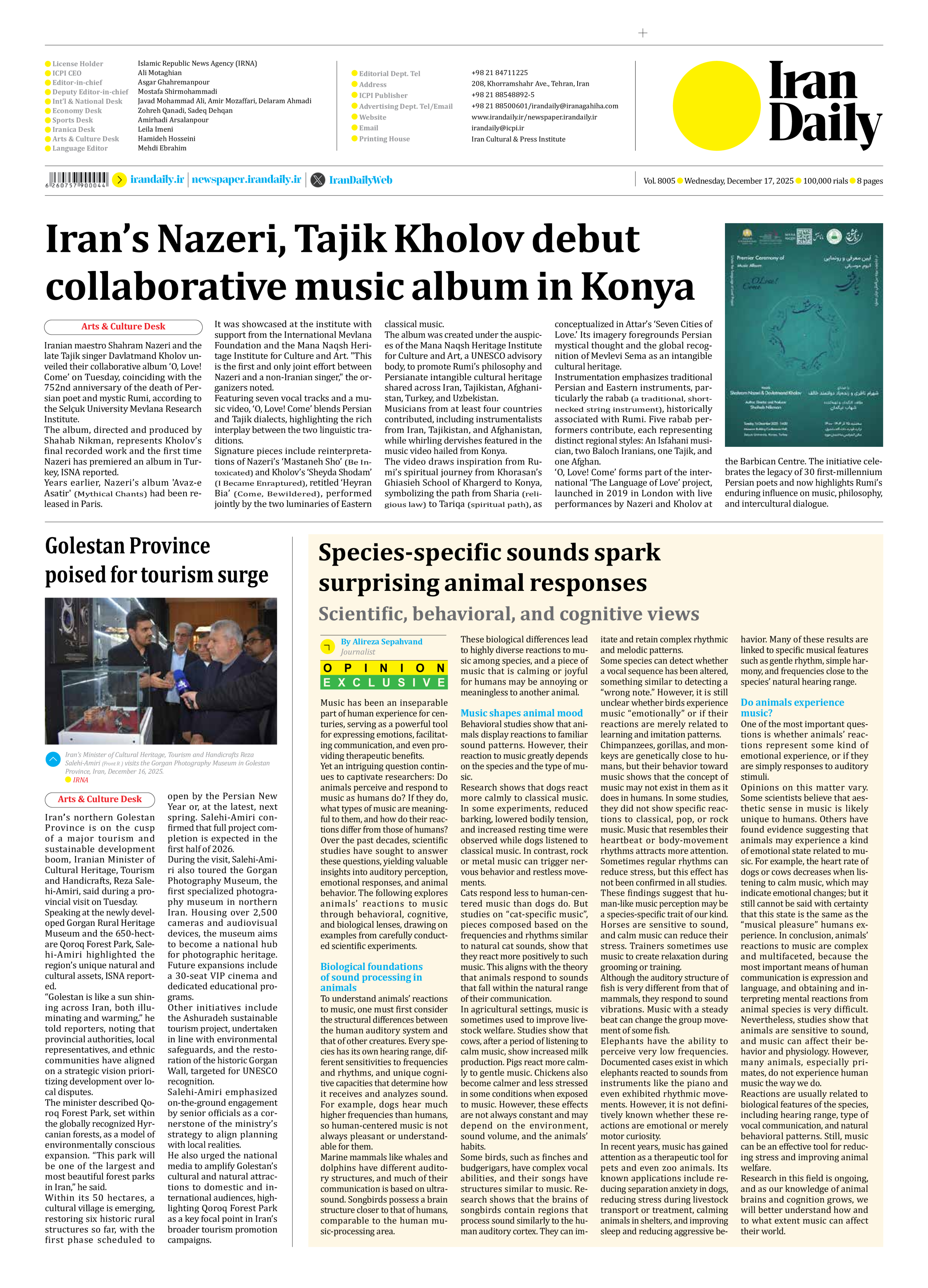


Iran’s Nazeri, Tajik Kholov debut collaborative music album in Konya
Iranian maestro Shahram Nazeri and the late Tajik singer Davlatmand Kholov unveiled their collaborative album ‘O, Love! Come’ on Tuesday, coinciding with the 752nd anniversary of the death of Persian poet and mystic Rumi, according to the Selçuk University Mevlana Research Institute.
The album, directed and produced by Shahab Nikman, represents Kholov’s final recorded work and the first time Nazeri has premiered an album in Turkey, ISNA reported.
Years earlier, Nazeri’s album 'Avaz-e Asatir' (Mythical Chants) had been released in Paris.
It was showcased at the institute with support from the International Mevlana Foundation and the Mana Naqsh Heritage Institute for Culture and Art. "This is the first and only joint effort between Nazeri and a non-Iranian singer," the organizers noted.
Featuring seven vocal tracks and a music video, ‘O, Love! Come’ blends Persian and Tajik dialects, highlighting the rich interplay between the two linguistic traditions.
Signature pieces include reinterpretations of Nazeri’s ‘Mastaneh Sho’ (Be Intoxicated) and Kholov’s ‘Sheyda Shodam’ (I Became Enraptured), retitled ‘Heyran Bia’ (Come, Bewildered), performed jointly by the two luminaries of Eastern classical music.
The album was created under the auspices of the Mana Naqsh Heritage Institute for Culture and Art, a UNESCO advisory body, to promote Rumi’s philosophy and Persianate intangible cultural heritage shared across Iran, Tajikistan, Afghanistan, Turkey, and Uzbekistan.
Musicians from at least four countries contributed, including instrumentalists from Iran, Tajikistan, and Afghanistan, while whirling dervishes featured in the music video hailed from Konya.
The video draws inspiration from Rumi’s spiritual journey from Khorasan’s Ghiasieh School of Khargerd to Konya, symbolizing the path from Sharia (religious law) to Tariqa (spiritual path), as conceptualized in Attar’s ‘Seven Cities of Love.’ Its imagery foregrounds Persian mystical thought and the global recognition of Mevlevi Sema as an intangible cultural heritage.
Instrumentation emphasizes traditional Persian and Eastern instruments, particularly the rabab (a traditional, short-necked string instrument), historically associated with Rumi. Five rabab performers contribute, each representing distinct regional styles: An Isfahani musician, two Baloch Iranians, one Tajik, and one Afghan.
‘O, Love! Come’ forms part of the international ‘The Language of Love’ project, launched in 2019 in London with live performances by Nazeri and Kholov at the Barbican Centre. The initiative celebrates the legacy of 30 first-millennium Persian poets and now highlights Rumi’s enduring influence on music, philosophy, and intercultural dialogue.