





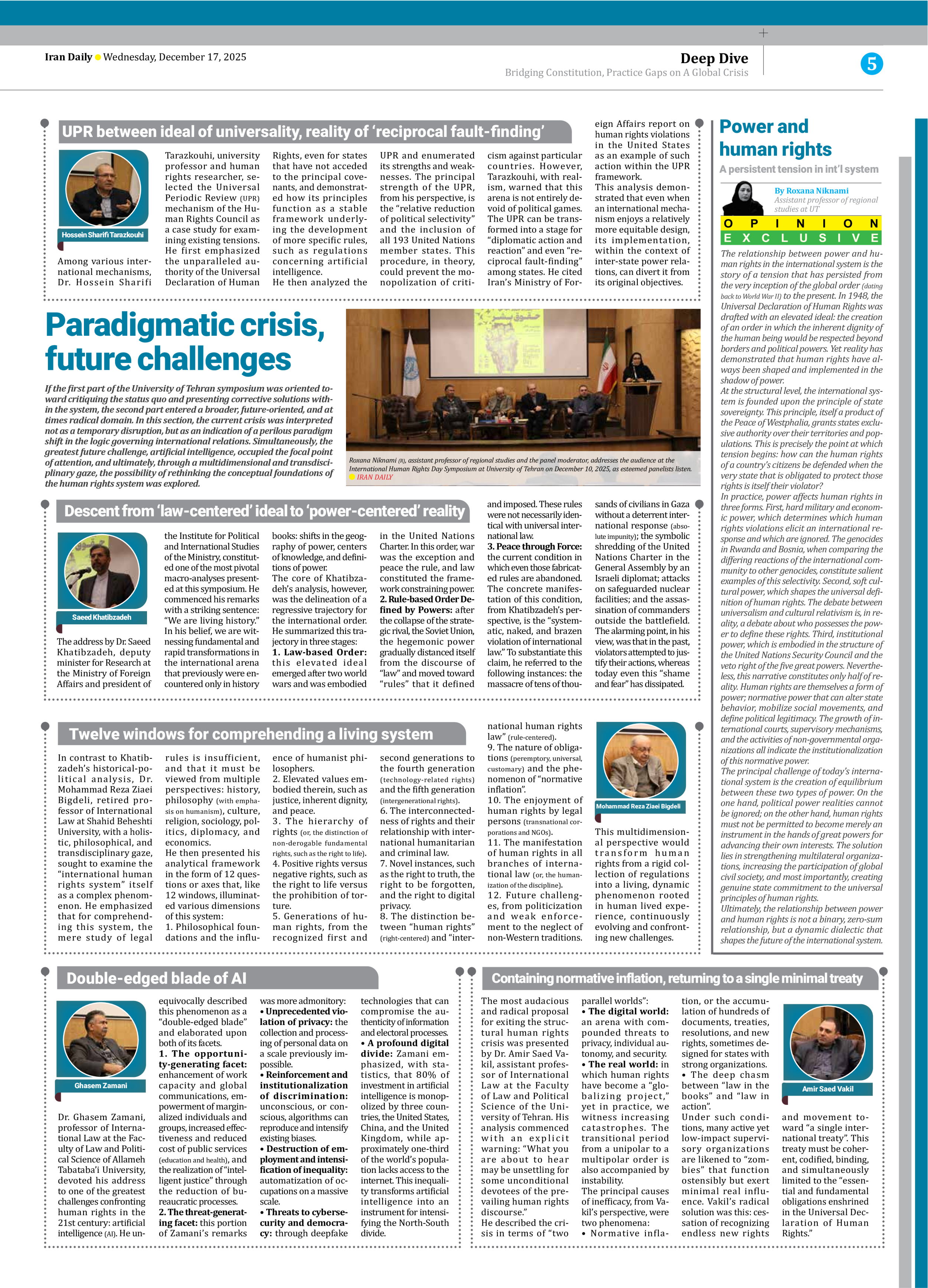


Paradigmatic crisis, future challenges
If the first part of the University of Tehran symposium was oriented toward critiquing the status quo and presenting corrective solutions within the system, the second part entered a broader, future-oriented, and at times radical domain. In this section, the current crisis was interpreted not as a temporary disruption, but as an indication of a perilous paradigm shift in the logic governing international relations. Simultaneously, the greatest future challenge, artificial intelligence, occupied the focal point of attention, and ultimately, through a multidimensional and transdisciplinary gaze, the possibility of rethinking the conceptual foundations of the human rights system was explored.
Descent from ‘law-centered’ ideal to ‘power-centered’ reality
Saeed Khatibzadeh
The address by Dr. Saeed Khatibzadeh, deputy minister for Research at the Ministry of Foreign Affairs and president of the Institute for Political and International Studies of the Ministry, constituted one of the most pivotal macro-analyses presented at this symposium. He commenced his remarks with a striking sentence: “We are living history.” In his belief, we are witnessing fundamental and rapid transformations in the international arena that previously were encountered only in history books: shifts in the geography of power, centers of knowledge, and definitions of power.
The core of Khatibzadeh’s analysis, however, was the delineation of a regressive trajectory for the international order. He summarized this trajectory in three stages:
1. Law-based Order: this elevated ideal emerged after two world wars and was embodied in the United Nations Charter. In this order, war was the exception and peace the rule, and law constituted the framework constraining power.
2. Rule-based Order Defined by Powers: after the collapse of the strategic rival, the Soviet Union, the hegemonic power gradually distanced itself from the discourse of “law” and moved toward “rules” that it defined and imposed. These rules were not necessarily identical with universal international law.
3. Peace through Force: the current condition in which even those fabricated rules are abandoned. The concrete manifestation of this condition, from Khatibzadeh’s perspective, is the “systematic, naked, and brazen violation of international law.” To substantiate this claim, he referred to the following instances: the massacre of tens of thousands of civilians in Gaza without a deterrent international response (absolute impunity); the symbolic shredding of the United Nations Charter in the General Assembly by an Israeli diplomat; attacks on safeguarded nuclear facilities; and the assassination of commanders outside the battlefield. The alarming point, in his view, was that in the past, violators attempted to justify their actions, whereas today even this “shame and fear” has dissipated.
Twelve windows for comprehending a living system
Mohammad Reza Ziaei Bigdeli
In contrast to Khatibzadeh’s historical-political analysis, Dr. Mohammad Reza Ziaei Bigdeli, retired professor of International Law at Shahid Beheshti University, with a holistic, philosophical, and transdisciplinary gaze, sought to examine the “international human rights system” itself as a complex phenomenon. He emphasized that for comprehending this system, the mere study of legal rules is insufficient, and that it must be viewed from multiple perspectives: history, philosophy (with emphasis on humanism), culture, religion, sociology, politics, diplomacy, and economics.
He then presented his analytical framework in the form of 12 questions or axes that, like 12 windows, illuminated various dimensions of this system:
1. Philosophical foundations and the influence of humanist philosophers.
2. Elevated values embodied therein, such as justice, inherent dignity, and peace.
3. The hierarchy of rights (or, the distinction of non-derogable fundamental rights, such as the right to life).
4. Positive rights versus negative rights, such as the right to life versus the prohibition of torture.
5. Generations of human rights, from the recognized first and second generations to the fourth generation (technology-related rights) and the fifth generation (intergenerational rights).
6. The interconnectedness of rights and their relationship with international humanitarian and criminal law.
7. Novel instances, such as the right to truth, the right to be forgotten, and the right to digital privacy.
8. The distinction between “human rights” (right-centered) and “international human rights law” (rule-centered).
9. The nature of obligations (peremptory, universal, customary) and the phenomenon of “normative inflation”.
10. The enjoyment of human rights by legal persons (transnational corporations and NGOs).
11. The manifestation of human rights in all branches of international law (or, the humanization of the discipline).
12. Future challenges, from politicization and weak enforcement to the neglect of non-Western traditions.
This multidimensional perspective would transform human rights from a rigid collection of regulations into a living, dynamic phenomenon rooted in human lived experience, continuously evolving and confronting new challenges.
Double-edged blade of AI
Ghasem Zamani
Dr. Ghasem Zamani, professor of International Law at the Faculty of Law and Political Science of Allameh Tabataba’i University, devoted his address to one of the greatest challenges confronting human rights in the 21st century: artificial intelligence (AI). He unequivocally described this phenomenon as a “double-edged blade” and elaborated upon both of its facets.
1. The opportunity-generating facet: enhancement of work capacity and global communications, empowerment of marginalized individuals and groups, increased effectiveness and reduced cost of public services (education and health), and the realization of “intelligent justice” through the reduction of bureaucratic processes.
2. The threat-generating facet: this portion of Zamani’s remarks was more admonitory:
• Unprecedented violation of privacy: the collection and processing of personal data on a scale previously impossible.
• Reinforcement and institutionalization of discrimination: unconscious, or conscious, algorithms can reproduce and intensify existing biases.
• Destruction of employment and intensification of inequality: automatization of occupations on a massive scale.
• Threats to cybersecurity and democracy: through deepfake technologies that can compromise the authenticity of information and electoral processes.
• A profound digital divide: Zamani emphasized, with statistics, that 80% of investment in artificial intelligence is monopolized by three countries, the United States, China, and the United Kingdom, while approximately one-third of the world’s population lacks access to the internet. This inequality transforms artificial intelligence into an instrument for intensifying the North-South divide.
Containing normative inflation, returning to a single minimal treaty
Amir Saed Vakil
The most audacious and radical proposal for exiting the structural human rights crisis was presented by Dr. Amir Saed Vakil, assistant professor of International Law at the Faculty of Law and Political Science of the University of Tehran. His analysis commenced with an explicit warning: “What you are about to hear may be unsettling for some unconditional devotees of the prevailing human rights discourse.”
He described the crisis in terms of “two parallel worlds”:
• The digital world: an arena with compounded threats to privacy, individual autonomy, and security.
• The real world: in which human rights have become a “globalizing project,” yet in practice, we witness increasing catastrophes. The transitional period from a unipolar to a multipolar order is also accompanied by instability.
The principal causes of inefficacy, from Vakil’s perspective, were two phenomena:
• Normative inflation, or the accumulation of hundreds of documents, treaties, resolutions, and new rights, sometimes designed for states with strong organizations.
• The deep chasm between “law in the books” and “law in action”.
Under such conditions, many active yet low-impact supervisory organizations are likened to “zombies” that function ostensibly but exert minimal real influence. Vakil’s radical solution was this: cessation of recognizing endless new rights and movement toward “a single international treaty”. This treaty must be coherent, codified, binding, and simultaneously limited to the “essential and fundamental obligations enshrined in the Universal Declaration of Human Rights.”