







International Human Rights Day Symposium at University of Tehran
Redrawing Iran’s relationship with int’l organizations on human rights
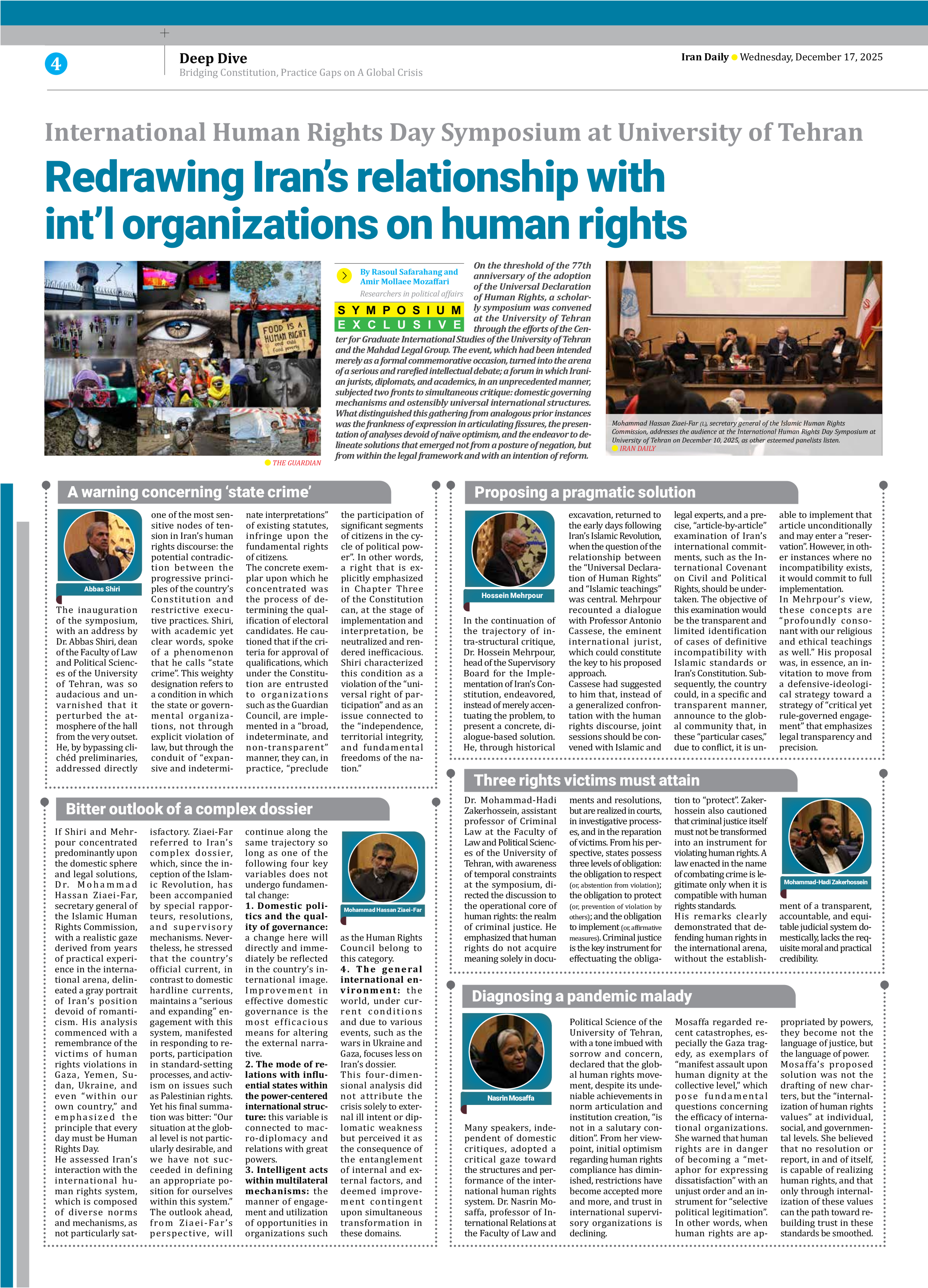
On the threshold of the 77th anniversary of the adoption of the Universal Declaration of Human Rights, a scholarly symposium was convened at the University of Tehran through the efforts of the Center for Graduate International Studies of the University of Tehran and the Mahdad Legal Group. The event, which had been intended merely as a formal commemorative occasion, turned into the arena of a serious and rarefied intellectual debate; a forum in which Iranian jurists, diplomats, and academics, in an unprecedented manner, subjected two fronts to simultaneous critique: domestic governing mechanisms and ostensibly universal international structures. What distinguished this gathering from analogous prior instances was the frankness of expression in articulating fissures, the presentation of analyses devoid of naïve optimism, and the endeavor to delineate solutions that emerged not from a posture of negation, but from within the legal framework and with an intention of reform.
By Rasoul Safarahang and Amir Mollaee Mozaffari
Researchers in political affairs
A warning concerning ‘state crime’
Abbas Shiri
The inauguration of the symposium, with an address by Dr. Abbas Shiri, dean of the Faculty of Law and Political Sciences of the University of Tehran, was so audacious and unvarnished that it perturbed the atmosphere of the hall from the very outset. He, by bypassing clichéd preliminaries, addressed directly one of the most sensitive nodes of tension in Iran’s human rights discourse: the potential contradiction between the progressive principles of the country’s Constitution and restrictive executive practices. Shiri, with academic yet clear words, spoke of a phenomenon that he calls “state crime”. This weighty designation refers to a condition in which the state or governmental organizations, not through explicit violation of law, but through the conduit of “expansive and indeterminate interpretations” of existing statutes, infringe upon the fundamental rights of citizens.
The concrete exemplar upon which he concentrated was the process of determining the qualification of electoral candidates. He cautioned that if the criteria for approval of qualifications, which under the Constitution are entrusted to organizations such as the Guardian Council, are implemented in a “broad, indeterminate, and non-transparent” manner, they can, in practice, “preclude the participation of significant segments of citizens in the cycle of political power”. In other words, a right that is explicitly emphasized in Chapter Three of the Constitution can, at the stage of implementation and interpretation, be neutralized and rendered inefficacious. Shiri characterized this condition as a violation of the “universal right of participation” and as an issue connected to the “independence, territorial integrity, and fundamental freedoms of the nation.”
Proposing a pragmatic solution
Hossein Mehrpour
In the continuation of the trajectory of intra-structural critique, Dr. Hossein Mehrpour, head of the Supervisory Board for the Implementation of Iran’s Constitution, endeavored, instead of merely accentuating the problem, to present a concrete, dialogue-based solution. He, through historical excavation, returned to the early days following Iran’s Islamic Revolution, when the question of the relationship between the “Universal Declaration of Human Rights” and “Islamic teachings” was central. Mehrpour recounted a dialogue with Professor Antonio Cassese, the eminent international jurist, which could constitute the key to his proposed approach.
Cassese had suggested to him that, instead of a generalized confrontation with the human rights discourse, joint sessions should be convened with Islamic and legal experts, and a precise, “article-by-article” examination of Iran’s international commitments, such as the International Covenant on Civil and Political Rights, should be undertaken. The objective of this examination would be the transparent and limited identification of cases of definitive incompatibility with Islamic standards or Iran’s Constitution. Subsequently, the country could, in a specific and transparent manner, announce to the global community that, in these “particular cases,” due to conflict, it is unable to implement that article unconditionally and may enter a “reservation”. However, in other instances where no incompatibility exists, it would commit to full implementation.
In Mehrpour’s view, these concepts are “profoundly consonant with our religious and ethical teachings as well.” His proposal was, in essence, an invitation to move from a defensive-ideological strategy toward a strategy of “critical yet rule-governed engagement” that emphasizes legal transparency and precision.
Bitter outlook of a complex dossier
Mohammad Hassan Ziaei-Far
If Shiri and Mehrpour concentrated predominantly upon the domestic sphere and legal solutions, Dr. Mohammad Hassan Ziaei-Far, secretary general of the Islamic Human Rights Commission, with a realistic gaze derived from years of practical experience in the international arena, delineated a gray portrait of Iran’s position devoid of romanticism. His analysis commenced with a remembrance of the victims of human rights violations in Gaza, Yemen, Sudan, Ukraine, and even “within our own country,” and emphasized the principle that every day must be Human Rights Day.
He assessed Iran’s interaction with the international human rights system, which is composed of diverse norms and mechanisms, as not particularly satisfactory. Ziaei-Far referred to Iran’s complex dossier, which, since the inception of the Islamic Revolution, has been accompanied by special rapporteurs, resolutions, and supervisory mechanisms. Nevertheless, he stressed that the country’s official current, in contrast to domestic hardline currents, maintains a “serious and expanding” engagement with this system, manifested in responding to reports, participation in standard-setting processes, and activism on issues such as Palestinian rights.
Yet his final summation was bitter: “Our situation at the global level is not particularly desirable, and we have not succeeded in defining an appropriate position for ourselves within this system.” The outlook ahead, from Ziaei-Far’s perspective, will continue along the same trajectory so long as one of the following four key variables does not undergo fundamental change:
1. Domestic politics and the quality of governance: a change here will directly and immediately be reflected in the country’s international image. Improvement in effective domestic governance is the most efficacious means for altering the external narrative.
2. The mode of relations with influential states within the power-centered international structure: this variable is connected to macro-diplomacy and relations with great powers.
3. Intelligent acts within multilateral mechanisms: the manner of engagement and utilization of opportunities in organizations such as the Human Rights Council belong to this category.
4. The general international environment: the world, under current conditions and due to various events, such as the wars in Ukraine and Gaza, focuses less on Iran’s dossier.
This four-dimensional analysis did not attribute the crisis solely to external ill intent or diplomatic weakness but perceived it as the consequence of the entanglement of internal and external factors, and deemed improvement contingent upon simultaneous transformation in these domains.
Three rights victims must attain
Mohammad-Hadi Zakerhossein
Dr. Mohammad-Hadi Zakerhossein, assistant professor of Criminal Law at the Faculty of Law and Political Sciences of the University of Tehran, with awareness of temporal constraints at the symposium, directed the discussion to the operational core of human rights: the realm of criminal justice. He emphasized that human rights do not acquire meaning solely in documents and resolutions, but are realized in courts, in investigative processes, and in the reparation of victims. From his perspective, states possess three levels of obligation: the obligation to respect (or, abstention from violation); the obligation to protect (or, prevention of violation by others); and the obligation to implement (or, affirmative measures). Criminal justice is the key instrument for effectuating the obligation to “protect”. Zakerhossein also cautioned that criminal justice itself must not be transformed into an instrument for violating human rights. A law enacted in the name of combating crime is legitimate only when it is compatible with human rights standards.
His remarks clearly demonstrated that defending human rights in the international arena, without the establishment of a transparent, accountable, and equitable judicial system domestically, lacks the requisite moral and practical credibility.
Diagnosing a pandemic malady
Nasrin Mosaffa
Many speakers, independent of domestic critiques, adopted a critical gaze toward the structures and performance of the international human rights system. Dr. Nasrin Mosaffa, professor of International Relations at the Faculty of Law and Political Science of the University of Tehran, with a tone imbued with sorrow and concern, declared that the global human rights movement, despite its undeniable achievements in norm articulation and institution creation, “is not in a salutary condition”. From her viewpoint, initial optimism regarding human rights compliance has diminished, restrictions have become accepted more and more, and trust in international supervisory organizations is declining.
Mosaffa regarded recent catastrophes, especially the Gaza tragedy, as exemplars of “manifest assault upon human dignity at the collective level,” which pose fundamental questions concerning the efficacy of international organizations. She warned that human rights are in danger of becoming a “metaphor for expressing dissatisfaction” with an unjust order and an instrument for “selective political legitimation”. In other words, when human rights are appropriated by powers, they become not the language of justice, but the language of power.
Mosaffa’s proposed solution was not the drafting of new charters, but the “internalization of human rights values” at individual, social, and governmental levels. She believed that no resolution or report, in and of itself, is capable of realizing human rights, and that only through internalization of these values can the path toward rebuilding trust in these standards be smoothed.
UPR between ideal of universality, reality of ‘reciprocal fault-finding’
Hossein Sharifi Tarazkouhi
Among various international mechanisms, Dr. Hossein Sharifi Tarazkouhi, university professor and human rights researcher, selected the Universal Periodic Review (UPR) mechanism of the Human Rights Council as a case study for examining existing tensions. He first emphasized the unparalleled authority of the Universal Declaration of Human Rights, even for states that have not acceded to the principal covenants, and demonstrated how its principles function as a stable framework underlying the development of more specific rules, such as regulations concerning artificial intelligence.
He then analyzed the UPR and enumerated its strengths and weaknesses. The principal strength of the UPR, from his perspective, is the “relative reduction of political selectivity” and the inclusion of all 193 United Nations member states. This procedure, in theory, could prevent the monopolization of criticism against particular countries. However, Tarazkouhi, with realism, warned that this arena is not entirely devoid of political games. The UPR can be transformed into a stage for “diplomatic action and reaction” and even “reciprocal fault-finding” among states. He cited Iran’s Ministry of Foreign Affairs report on human rights violations in the United States as an example of such action within the UPR framework.
This analysis demonstrated that even when an international mechanism enjoys a relatively more equitable design, its implementation, within the context of inter-state power relations, can divert it from its original objectives.