







Japan pledges €210,000 in medical aid to shore up healthcare in southern Iran
By Sadeq Dehqan
Staff writer
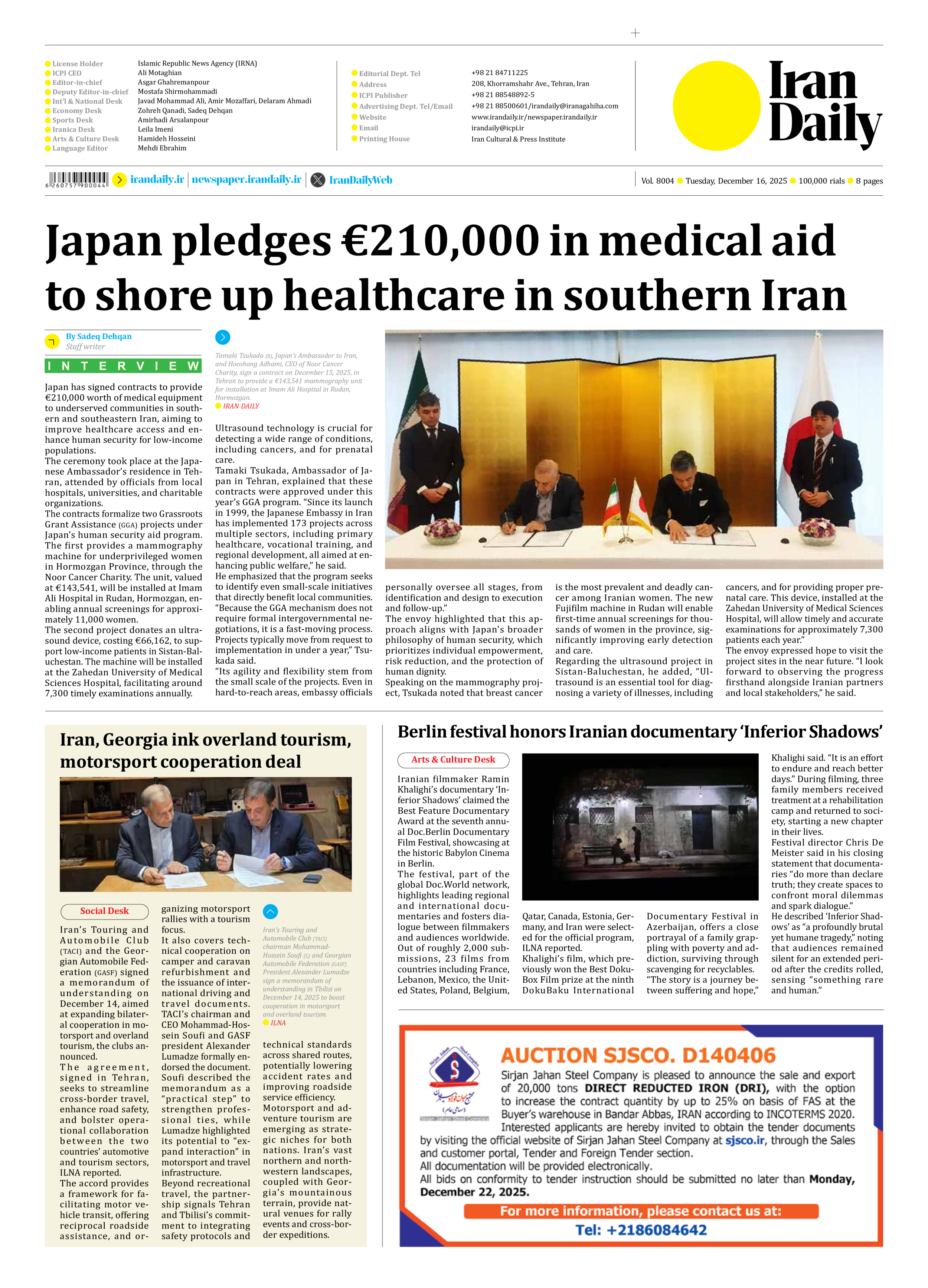
Japan has signed contracts to provide €210,000 worth of medical equipment to underserved communities in southern and southeastern Iran, aiming to improve healthcare access and enhance human security for low-income populations.
The ceremony took place at the Japanese Ambassador’s residence in Tehran, attended by officials from local hospitals, universities, and charitable organizations.
The contracts formalize two Grassroots Grant Assistance (GGA) projects under Japan’s human security aid program. The first provides a mammography machine for underprivileged women in Hormozgan Province, through the Noor Cancer Charity. The unit, valued at €143,541, will be installed at Imam Ali Hospital in Rudan, Hormozgan, enabling annual screenings for approximately 11,000 women.
The second project donates an ultrasound device, costing €66,162, to support low-income patients in Sistan-Baluchestan. The machine will be installed at the Zahedan University of Medical Sciences Hospital, facilitating around 7,300 timely examinations annually.
Ultrasound technology is crucial for detecting a wide range of conditions, including cancers, and for prenatal care.
Tamaki Tsukada, Ambassador of Japan in Tehran, explained that these contracts were approved under this year’s GGA program. “Since its launch in 1999, the Japanese Embassy in Iran has implemented 173 projects across multiple sectors, including primary healthcare, vocational training, and regional development, all aimed at enhancing public welfare,” he said.
He emphasized that the program seeks to identify even small-scale initiatives that directly benefit local communities.
“Because the GGA mechanism does not require formal intergovernmental negotiations, it is a fast-moving process. Projects typically move from request to implementation in under a year,” Tsukada said.
“Its agility and flexibility stem from the small scale of the projects. Even in hard-to-reach areas, embassy officials personally oversee all stages, from identification and design to execution and follow-up.”
The envoy highlighted that this approach aligns with Japan’s broader philosophy of human security, which prioritizes individual empowerment, risk reduction, and the protection of human dignity.
Speaking on the mammography project, Tsukada noted that breast cancer is the most prevalent and deadly cancer among Iranian women. The new Fujifilm machine in Rudan will enable first-time annual screenings for thousands of women in the province, significantly improving early detection and care.
Regarding the ultrasound project in Sistan-Baluchestan, he added, “Ultrasound is an essential tool for diagnosing a variety of illnesses, including cancers, and for providing proper prenatal care. This device, installed at the Zahedan University of Medical Sciences Hospital, will allow timely and accurate examinations for approximately 7,300 patients each year.”
The envoy expressed hope to visit the project sites in the near future. “I look forward to observing the progress firsthand alongside Iranian partners and local stakeholders,” he said.