





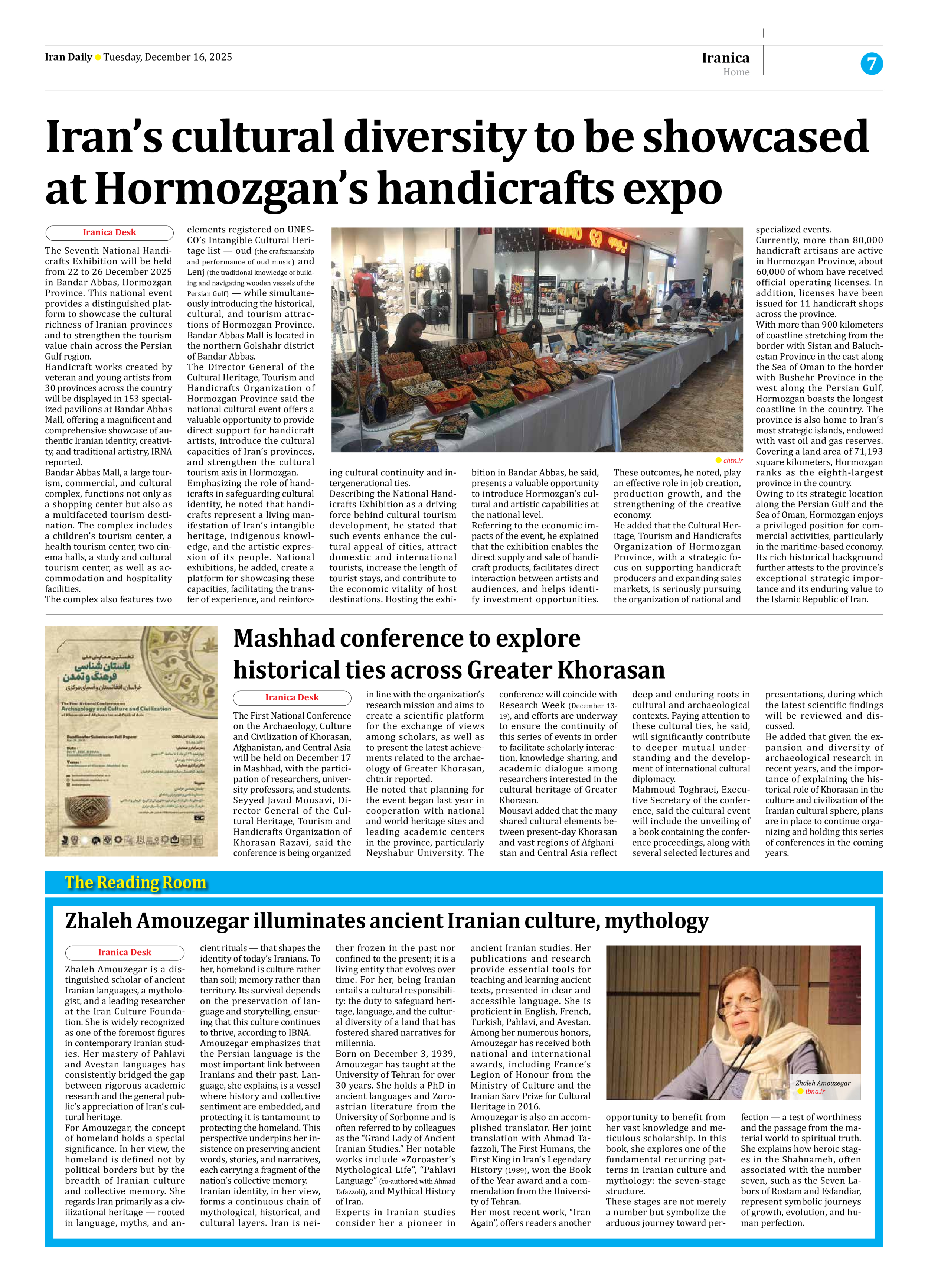


Zhaleh Amouzegar illuminates ancient Iranian culture, mythology
Zhaleh Amouzegar is a distinguished scholar of ancient Iranian languages, a mythologist, and a leading researcher at the Iran Culture Foundation. She is widely recognized as one of the foremost figures in contemporary Iranian studies. Her mastery of Pahlavi and Avestan languages has consistently bridged the gap between rigorous academic research and the general public’s appreciation of Iran’s cultural heritage.
For Amouzegar, the concept of homeland holds a special significance. In her view, the homeland is defined not by political borders but by the breadth of Iranian culture and collective memory. She regards Iran primarily as a civilizational heritage — rooted in language, myths, and ancient rituals — that shapes the identity of today’s Iranians. To her, homeland is culture rather than soil; memory rather than territory. Its survival depends on the preservation of language and storytelling, ensuring that this culture continues to thrive, according to IBNA.
Amouzegar emphasizes that the Persian language is the most important link between Iranians and their past. Language, she explains, is a vessel where history and collective sentiment are embedded, and protecting it is tantamount to protecting the homeland. This perspective underpins her insistence on preserving ancient words, stories, and narratives, each carrying a fragment of the nation’s collective memory.
Iranian identity, in her view, forms a continuous chain of mythological, historical, and cultural layers. Iran is neither frozen in the past nor confined to the present; it is a living entity that evolves over time. For her, being Iranian entails a cultural responsibility: the duty to safeguard heritage, language, and the cultural diversity of a land that has fostered shared narratives for millennia.
Born on December 3, 1939, Amouzegar has taught at the University of Tehran for over 30 years. She holds a PhD in ancient languages and Zoroastrian literature from the University of Sorbonne and is often referred to by colleagues as the “Grand Lady of Ancient Iranian Studies.” Her notable works include «Zoroaster’s Mythological Life”, “Pahlavi Language” (co-authored with Ahmad Tafazzoli), and Mythical History of Iran.
Experts in Iranian studies consider her a pioneer in ancient Iranian studies. Her publications and research provide essential tools for teaching and learning ancient texts, presented in clear and accessible language. She is proficient in English, French, Turkish, Pahlavi, and Avestan.
Among her numerous honors, Amouzegar has received both national and international awards, including France’s Legion of Honour from the Ministry of Culture and the Iranian Sarv Prize for Cultural Heritage in 2016.
Amouzegar is also an accomplished translator. Her joint translation with Ahmad Tafazzoli, The First Humans, the First King in Iran’s Legendary History (1989), won the Book of the Year award and a commendation from the University of Tehran.
Her most recent work, “Iran Again”, offers readers another opportunity to benefit from her vast knowledge and meticulous scholarship. In this book, she explores one of the fundamental recurring patterns in Iranian culture and mythology: the seven-stage structure.
These stages are not merely a number but symbolize the arduous journey toward perfection — a test of worthiness and the passage from the material world to spiritual truth. She explains how heroic stages in the Shahnameh, often associated with the number seven, such as the Seven Labors of Rostam and Esfandiar, represent symbolic journeys of growth, evolution, and human perfection.